Muscovite "Russians" taught Hitler how to exterminate all Jews . Why Juchi empire hate the Jews so much? my answer is ´cos Muscovites (their empire ) are Backward, Asiatic , uneducated
losers were, and and always will be. do you agree?
some facts ,
base of extermination :
The Protocols of the Elders of Zion (
Russian: ) or
The Protocols of the Meetings of the Learned Elders of Zion is a
fabricated antisemitic text purporting to describe a
Jewish plan for global domination.
The hoax, which was shown to be plagiarized from several earlier sources, some not antisemitic in nature,[1] was first published in Russia in 1903, translated into multiple languages, and disseminated internationally in the early part of the 20th century. According to the claims made by some of its publishers, the
Protocols are the minutes of a late 19th-century meeting where
Jewish leaders discussed their goal of global Jewish hegemony by subverting the morals of Gentiles, and by controlling the press and the world's economies.
institutes :
Muscovite
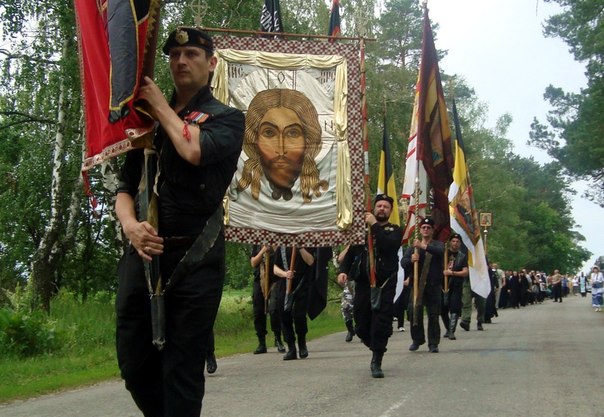
Einsatzkommando The Black Hundred :
The Black Hundred ( in Russian; Chornaya sotnya), also known as the black-hundredists ( chernosotentsy), was an ultra-nationalist movement in Russia in the early 20th century. It was a staunch supporter of the House of Romanov and opposed any retreat from the autocracy of the reigning monarch.[2] The Black Hundreds were also noted for extremism and incitement to pogroms, nationalistic Russocentric doctrines, different xenophobic beliefs, including anti-Ukrainian sentiment[3] and anti-semitism.[4]
Members of the Black Hundreds organizations came from different social strata—such as landowners, clergymen, the high and petty bourgeoisie, merchants, artisans, workers and the so-called "declassed elements". The Sovet ob’yedinyonnogo dvoryanstva (United Gentry Council) guided the activities of the black-hundredists; the tsarist regime provided moral and financial support to the movement.[citation needed] The Black Hundreds were founded on a devotion to Tsar, church and motherland, expressed previously by the motto of Tsar Nicholas I: "Orthodoxy, Autocracy, and Nationality" (Pravoslavie, Samoderzhavie i Narodnost). Despite certain program differences, all of the black-hundredist organizations had one goal in common, namely their struggle against the revolutionary movement.[citation needed] The black-hundredists conducted oral propaganda: in churches by holding special services, and during meetings, lectures and demonstrations. Such propaganda provoked antisemitic sentiments and monarchic "exaltation" and caused[citation needed] numerous pogroms and terrorist acts against revolutionaries and certain public figures, performed by the Black Hundreds' paramilitary groups, sometimes known as "Yellow Shirts".[5]
and today
ACTIONS:
Anti-Jewish pogroms in the Russian Empire - Wikipedia
Anti-Jewish pogroms in the Russian Empire - Wikipedia
The term "pogrom" became commonly used in English after a large-scale wave of anti-Jewish riots swept through south-western Imperial Russia (present-day Ukraine and Poland) from 1881 to 1884; during this time, more than 200 anti-Jewish events occurred in the Russian Empire, notably pogroms in Kiev, Warsaw and Odessa.
Hitler got his ideas about ridding Germany of Jews by reading American Democratic policies regarding blacks.
it is a commie myth , population of blacks in usa have always grown . this is what
Muscovite ulus did to GDL/Polish Jews
Anti-Jewish pogroms in the Russian Empire (
Russian: ;
Hebrew:
ha-sufot ba-negev; lit. "the storms in the South") were large-scale, targeted, and repeated
anti-Jewish rioting that first began in the 19th century.
Pogroms began occurring after the
Russian Empire, which previously had very few
Jews, acquired territories with large Jewish populations from the
Polish–Lithuanian Commonwealth during 1791–1835. These territories were designated "the
Pale of Settlement" by the Imperial Russian government, within which Jews were reluctantly permitted to live, and it was within them that the pogroms largely took place. Most Jews were forbidden from moving to other parts of the Empire, unless they converted to the
Russian Orthodox state religion.
The term "pogrom" became commonly used in English after a large-scale wave of anti-Jewish riots swept through south-western
Imperial Russia (present-day
Ukraine and
Poland) from 1881 to 1884; during this time, more than 200 anti-Jewish events occurred in the
Russian Empire, notably pogroms in
Kiev,
Warsaw and
Odessa.
[3]
The trigger for these pogroms was the
assassination of Tsar Alexander II, for which some blamed "foreign influence agents", implying the Jews.
[4][5] One of the conspirators was of Jewish origins, and the importance of her role in the assassination was greatly exaggerated during the pogroms that followed; another conspirator was baselessly rumored to be Jewish.
[6] The extent to which the Russian press was responsible for encouraging perceptions of the assassination as a Jewish act has been disputed.
[7]
Local economic conditions (such as
ancestral debts owed to
moneylenders) are thought to have contributed significantly to the rioting, especially with regard to the participation of the business competitors of local Jews and the participation of
railroad workers. At this time Russia was becoming more industrialized, causing Russians to be moving into and out of major cities.
[8] People trying to escape the big cities carried their Anti-Semitic values with them, spreading these ideas throughout Russia causing more pogroms in different regions of Russia.
[9] It has been argued that this was actually more important than rumours of Jewish responsibility for the death of the Tsar.
[10] These rumours, however, were clearly of some importance, if only as a trigger, and they drew upon a small kernel of truth: one of the close associates of the assassins,
Gesya Gelfman, was born into a Jewish home. The fact that the other assassins were all atheists and that the wider Jewish community had nothing to do with the assassination had little impact on the spread of such antisemitic rumours. Nonetheless, the assassination inspired "retaliatory" attacks on Jewish communities. During these pogroms thousands of Jewish homes were destroyed, many families were reduced to poverty, and large numbers of men, women, and children were injured in 166 towns in the southwest provinces of the Empire such as
Ukraine.
There also was a large pogrom on the night of 15–16 April 1881 (the day of
Eastern Orthodox Easter) in the city of
Yelizavetgrad (now
Kropyvnytskyi). On 17 April, the Army units were dispatched and were forced to use firearms to extinguish the riot. However, that only incited the whole situation in the region and a week later series of pogroms rolled through parts of the
Kherson Governorate.
On 26 April 1881, an even bigger disorder engulfed the city of
Kiev. The
Kiev pogrom of 1881 is considered the worst one that took place in 1881.
[11] The pogroms of 1881 did not stop then. They continued on through the summer, spreading across a big territory of modern-day Ukraine: (
Podolie Governorate,
Volyn Governorate,
Chernigov Governorate,
Yekaterinoslav Governorate, and others). During these pogroms the first local Jewish self-defense organizations started to form, the most prominent one in Odessa. It was organized by the Jewish students of the
Novorossiysk University.
For decades after the 1880 pogroms, most government officials had anti-semitic beliefs that Jews in villages were more dangerous than Jews who lived in towns. The Minister of the Interior
Nikolay Pavlovich Ignatyev rejected the theory that pogroms were caused by revolutionary socialists and instead, he adopted the idea that they were a protest by the rural population against Jewish exploitation. With this idea in mind, he wrongly believed and spread the idea that pogroms had spread from villages to towns. Historians today recognize that although rural peasantry did largely participate in the pogrom violence, pogroms began in the towns and spread to the villages.
[12]
The new
Tsar Alexander III initially blamed revolutionaries and the Jews themselves for the riots and in May 1882 issued the
May Laws, a series of harsh restrictions on Jews.
The pogroms continued for more than three years and were thought to have benefited from at least the tacit support of the authorities, although there were also attempts by the Russian government to end the rioting.
[10]
The pogroms and the official reaction to them led many Russian Jews to reassess their perceptions of their status within the Russian Empire, and so to significant Jewish
emigration, mostly to the
United States.
These pogroms were referred to among Jews as the "Storms in the South." Changed perceptions among Russian Jews also indirectly gave a significant boost to the early
Zionist movement.
[13]
Casualties
At least 40 Jews were killed during pogroms during April to December 1881.
[14] Of these, 17 were reportedly killed while being raped. An additional 225 incidents of Jewish women being raped were reported.
British reaction
The leaders of the Jewish community in London were slow to speak out. It was only after
Louisa Goldsmid's support following leadership from an anonymous writer named "Juriscontalus" and the editor of the
Jewish Chronicle that action was taken in 1881. Public meetings were held across the country and Jewish and Christian leaders in Britain spoke out against the atrocities.
[15]
The anti-Jewish riots in
Kishinev,
Bessarabia [modern
Moldova], are worse than the censor will permit to publish. There was a well laid-out plan for the general massacre of Jews on the day following the Orthodox Easter. The mob was led by priests, and the general cry, "Kill the Jews", was taken up all over the city. The Jews were taken wholly unaware and were slaughtered like sheep. The dead number 120 [Note: the actual number of dead was 47–48
[17]] and the injured about 500. The scenes of horror attending this massacre are beyond description. Babies were literally torn to pieces by the frenzied and bloodthirsty mob. The local police made no attempt to check the reign of terror. At sunset the streets were piled with corpses and wounded. Those who could make their escape fled in terror, and the city is now practically deserted of Jews.
[18]
This series of pogroms affected 64 towns (including
Odessa,
Yekaterinoslav,
Kiev,
Kishinev,
Simferopol,
Romny,
Kremenchug,
Nikolayev,
Chernigov,
Kamenets-Podolski,
Yelizavetgrad), and 626 small towns (Russian: ) and villages, mostly in
Ukraine and
Bessarabia.
Historians such as
Edward Radzinsky suggest that many pogroms were incited by authorities and supported by the
Tsarist Russian
secret police (the
Okhrana), even if some happened spontaneously.
[19] The perpetrators who were prosecuted usually received clemency by Tsar's decree.
[20]
Even outside these main outbreaks, pogroms remained common; there was an anti-Jewish riot in Odessa in 1905 in which thousands were killed in total.
[21]
The 1903
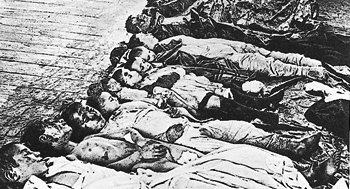
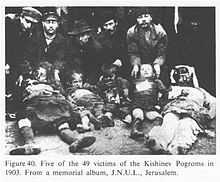
Kishinev pogrom, also known as the Kishinev Massacre, in present-day Moldova killed 47–49 persons. It provoked an international outcry after it was publicized by
The Times and
The New York Times. There was a second, smaller Kishinev pogrom in 1905.
A pogrom on July 20, 1905, in
Yekaterinoslav (present-day
Dnipro, Ukraine), was stopped by the Jewish self-defense group (one man in the group killed).
On July 31, 1905, there was the first pogrom outside the
Pale of Settlement, in the town of Makariev (near
Nizhni Novgorod), where a patriotic procession led by the mayor turned violent.
At a pogrom in
Kerch in
Crimea on 31 July 1905,
[22] the mayor ordered the police to fire at the self-defence group, and two fighters were killed (one of them, P. Kirilenko, was a Ukrainian who joined the Jewish defence group). The pogrom was conducted by the port workers apparently brought in for the purpose.
After the publication of the
Tsar's Manifesto of October 17, 1905, pogroms erupted in 660 towns mainly in the present-day Ukraine, in the Southern and Southeastern areas of the Pale of Settlement. In contrast, there were no pogroms in present-day Lithuania. There were also very few incidents in Belarus or Russia proper. There were 24 pogroms outside of the
Pale of Settlement, but those were directed at the revolutionaries rather than Jews.
The greatest number of pogroms were registered in the
Chernigov gubernia in northern Ukraine. The pogroms there in October 1905 took 800 Jewish lives, the material damages estimated at 70,000,000 rubles. 400 were killed in
Odessa, over 150 in
Rostov-on-Don, 67 in
Yekaterinoslav, 54 in
Minsk, 30 in
Simferopol—over 40, in
Orsha—over 30.
In 1906, the pogroms continued: January — in
Gomel, June — in
Bialystok (ca. 80 dead), and August — in
Siedlce (ca. 30 dead). The Russian secret police and the military personnel organized the massacres.
In many of these incidents the most prominent participants were railway workers, industrial workers, and small shopkeepers and craftsmen, and (if the town was a river port (e.g.
Dnipro) or a seaport (e.g.
Kerch)),
waterfront workmen; peasants mainly joined in to loot.
[23]
Organization of the pogroms
The pogroms are generally thought to have been either organized or at least condoned by the authorities.
[24][25][26][27] This view was challenged by Hans Rogger, I. Michael Aronson and
John Klier, who couldn't find such sanctions documented in the state archives.
[28][29] However, the
antisemitic policy that was carried out from 1881 to 1917 made them possible. Official persecution and harassment of Jews influenced numerous antisemites to presume that their violence was legitimate, and this sentiment was reinforced by the active participation of a few high and many minor officials in fomenting attacks, as well as by the reluctance of the government to stop pogroms and to punish those responsible for them.
Influence of the pogroms
The pogroms of the 1880s caused a worldwide outcry and, along with harsh laws, propelled mass
Jewish emigration. Among the passed antisemitic laws were the 1882
May Laws. They prohibited Jews from moving into villages in an attempt to address the cause of the pogroms, when in fact, the pogroms were caused by a different reason. The majority of High Commission for the Review of Jewish Legislation (1883-1888) actually noted the fact that almost all of the pogroms had begun in the towns and attempted to abolish the Laws. Yet, the minority of the High Commission ignored the facts and backed the anti-semitic May Laws.
[30] Two million Jews fled the
Russian Empire between 1880 and 1920, with many going to the
United Kingdom and
United States.
[31]
In reaction to the pogroms and other oppressions of the Tsarist period, Jews increasingly became politically active. Jewish participation in The
General Jewish Labor Bund, colloquially known as The Bund, and in the
Bolshevik movements, was directly influenced by the pogroms. Similarly, the organization of Jewish self-defense leagues (which stopped the pogromists in certain areas during the second Kishinev pogrom), such as
Hovevei Zion, led to a strong embrace of
Zionism, especially by
Russian Jews.
Cultural references
In 1903, Hebrew poet
Hayyim Nahman Bialik wrote the poem
In the City of Slaughter[32] in response to the
Kishinev pogrom.
Elie Wiesel's
The Trial of God depicts Jews fleeing a pogrom and setting up a fictitious "trial of God" for His negligence in not assisting them against the bloodthirsty mobs. In the end, it turns out that the mysterious stranger who has argued as God's advocate is none other than
Lucifer. The experience of a Russian Jew is also depicted in
Elie Wiesel's
The Testament.
A pogrom is one of the central events in the play
Fiddler on the Roof, which is adapted from Russian author
Sholem Aleichem's Tevye the Dairyman stories. Aleichem writes about the pogroms in a story called "Lekh-Lekho".
[33] The famous Broadway musical and film
Fiddler on the Roof showed the cruelty of the Russian pogroms on the Jews in the fictional
Anatevka in the early 20th century.
In the adult animated musical drama film
American Pop, set during Imperial Russia during the late 1890s, a rabbi's wife and her young son Zalmie escape to America while the rabbi is killed by the Cossacks.
In the animated film
An American Tail, set during and after the 1880s pogroms, Fievel and his family's village is destroyed by a pogrom. (Fievel and his family are mice, and their Cossack attackers are cats.)
The novel
The Sacrifice by
Adele Wiseman also deals with a family that is displaced after a pogrom in their home country and who emigrate to Canada after losing two sons to the riot and barely surviving themselves. The loss and murder of the sons haunts the entire story.
Mark Twain gives graphic descriptions of the Russian pogroms in Reflections on Religion, Part 3, published in 1906.
[34]
Joseph Joffo describes the early history of his mother, a Jew in the Russia of
Tsar Nicholas II, in the biographical 'Anna and her Orchestra'. He describes the raids by Cossacks on Jewish quarters and the eventual retribution inflicted by Anna's father and brothers on the Cossacks who murdered and burnt homes at the behest of the tsar.
In
Bernard Malamud's novel
The Fixer, set in Czarist Russia around 1911, a Russian-Jewish handyman, Yakov Bog, is wrongly imprisoned for a most unlikely crime. It was later made into a
film directed by
John Frankenheimer with a screenplay by
Dalton Trumbo.
Anti-Jewish pogroms in the Russian Empire - Wikipedia