Compre His Very Best: Jimmy Carter, a Life (English Edition) de Alter, Jonathan na Amazon.com.br. Confira também os eBooks mais vendidos, lançamentos e livros digitais exclusivos.
www.amazon.com.br
excerpt:
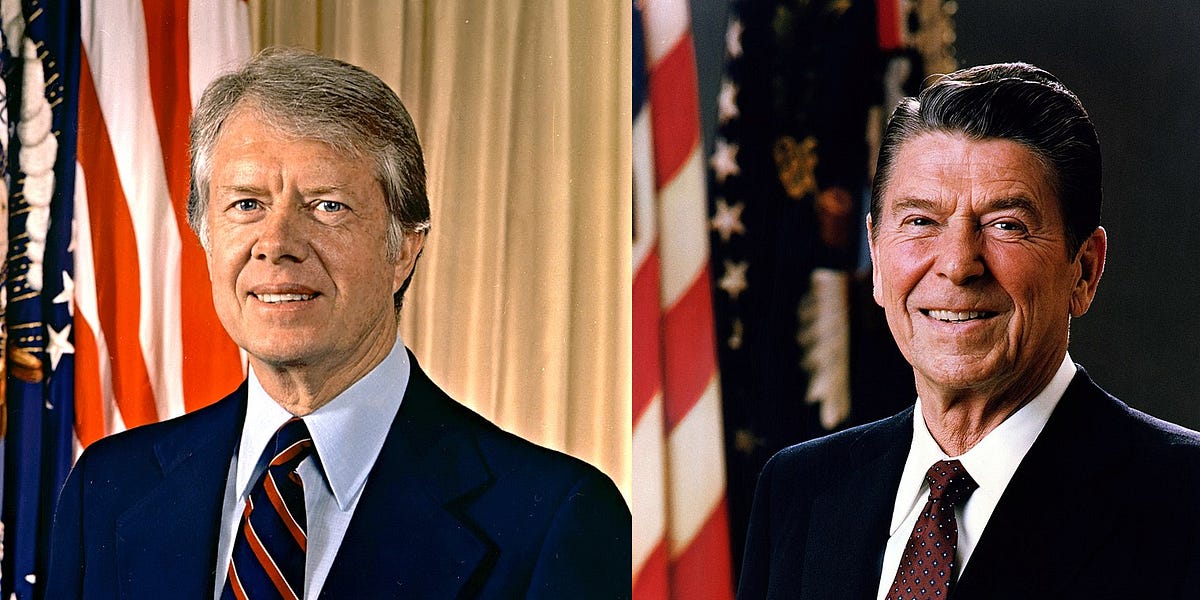
Carter was a Democratic president, but he accomplished many things commonly associated with Ronald Reagan. It was Carter, not Reagan, who ended rampant inflation by appointing Paul Volcker as chairman of the Federal Reserve Board; Carter, not Reagan, who cut the deficit and the growth rate of the federal workforce; Carter, not Reagan, who first broke with the Richard Nixon–Henry Kissinger policy of detente with Moscow by inviting Soviet dissidents to the White House and building the MX missile. Contrary to his reputation, Carter—after some hesitation—showed toughness by placing intermediate-range nuclear missiles in Europe. His Pentagon developed the B-2 stealth bomber and other high-tech weapons that the Soviet Union could not match. He sharply increased the defense budget and approved covert aid to anti-Communist Afghan rebels, who helped turn Afghanistan into the Soviet Union’s Vietnam.
And yet Carter also took risks for peace—and paid a political price for avoiding escalation, most conspicuously in the case of the Panama Canal Treaties. Ratified despite fierce opposition, the treaties prevented the deployment of more than a hundred thousand troops to the Canal Zone and dramatically improved the image of the United States across Latin America.
Carter was the first president with a policy devoted explicitly to promoting individual human rights in other countries. While applied unevenly, the new approach helped hasten the demise of more than a dozen dictatorships, gave hope to dissidents worldwide, and set a new and timeless global standard for how governments should treat their own people. Conservatives who had once thought it naive later admitted that the policy helped win the Cold War. And in the wake of the Vietnam War and CIA abuses that left the United States deeply unpopular in many parts of the world, the humble and respectful approach of the Carter administration offered a model for repairing America’s global reputation in the 2020s.
Carter forged the nation’s first comprehensive energy policy and historic accomplishments on the environment that included strong new pollution controls, the first toxic waste cleanup, and doubling the size of the national park system. He set the bar on consumer protection; signed two major pieces of ethics legislation; carried out the first civil service reform in a century; established two new Cabinet-level departments (Energy and Education); deregulated airlines, trucking, and utilities in ways that served the public interest; and took federal judgeships out of the era of tokenism by selecting more women and blacks for the federal bench than all of his predecessors combined, times five. Ruth Bader Ginsburg, whom he appointed to the appellate court, said Carter “literally changed the complexion of the federal judiciary,” though he never had a Supreme Court vacancy to fill. Carter did the same for the executive branch, while empowering for the first time the vice president and the first lady, both of whom were given far more responsibilities than any of their predecessors.
So much legislation passed on his watch that major bill-signing ceremonies—a rarity in later administrations—were greeted by the jaded press with yawns. While Carter served only one term, he was, unlike Bill Clinton and Barack Obama, backed by a Democratic Congress for all four years, with a Senate where filibusters were rare. This meant that for all of his problems, he enacted more of his agenda than any postwar American president except Lyndon Johnson, whose legislative program was so big it made the next Democratic president’s look underwhelming by comparison. Even little-publicized Carter bills changed parts of American life, from requiring banks to invest in low-income communities to legalizing craft breweries. While Carter suffered several painful defeats—on tax reform, welfare reform, consumer protection, and health care—he won much more than he lost. This scorecard went largely unnoticed, in part because the aggressive post-Watergate press tended to assume the worst about him.
Carter himself made a good argument that his most lasting foreign policy achievement was walking through the door that Richard Nixon had opened to China in 1972. He ended Nixon’s and Gerald Ford’s unworkable “two-China policy” (which tilted toward Taiwan) and established full diplomatic relations with Peking, a move that launched the world’s most important bilateral relationship.