Nope, he was right.
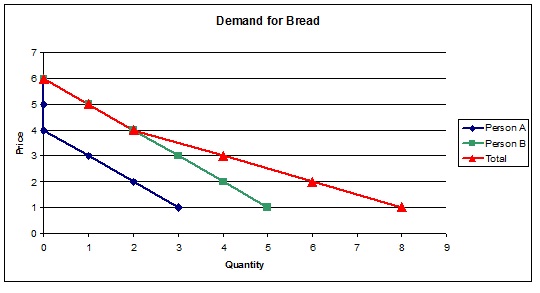
Once again, if one person demands something, and you add a second person demanding the same thing... the aggregate demand has just increased.
(picture an upward sloping supply curve, and you will arrive at the correct answer -> increase in price).
Too difficult of a concept to understand for some. Even after extensive explaining regarding the subject. Only an indoctrination can explain this degree of not being to able to understand simple concepts.
It's not like he didn't make it ABUNDANTLY clear, what plays a role in the increase in demand (cheap credit).
Diamonds may not be expensive only because they are rare. But if they were rarer, they would be even more expensive. Rarity is not the only factor in the price, but it is one. Perhaps this is why you are confoosed...
Nope. Once again you demonstrate that you're operating on simplistic interpretations and false equivocations, leading to bastardized conclusions.
One person can want 10 loaves of bread. Next week two people could each want five loaves of bread. Or they might each want 1 loaf of bread. You're just digging yourself into an even bigger hole. You're adding more and more factors, all with their own sets of unspoken assumptions you expect people to agree upon, in your attempt to abstract a conclusion that does not actually exist.
And it is all because you are stubbornly refusing to widen your understanding. You
want demand to be equivalent to volume. Probably because you're too much of an idiot to understand anything more complex. You want easy answers so that someone else can reduce it all to a chart for you and allow you to feel like you're magically smart.
Sorry bud, but it's not going to fly. Because chap stick, lighters, q-tips, toilet paper, and an entire reality full of high volume, low priced items prove you wrong. You've read something on a page. But you don't understand how to apply it to every day life. Demand is not volume. And just because volume
might effect demand
at times does not in any way justify your insistence on reducing demand to volume. Demand is, ultimately, the
willingness to pay. That's why the world of marketing exists. That's why an increase in price might reduce demand while a reduction in price rarely increases demand in practice. Actual willingness to buy primarily stems from other factors.
The fact that you are arguing this is its own evidence that you're an uneducated, ignorant fool. This isn't a question to debate, this is the established definition of the ******* word.
Demand is an economic principle that describes a consumer's desire and willingness to pay a price for a specific good or service.
Demand Definition | Investopedia
The amount of a particular economic good or service that a consumer or group of consumers will want to purchase at a given price.
What is Demand? definition and meaning
(1) Desire for certain good or service supported by the capacity to purchase it. (2) The aggregate quantity of a product or service estimated to be bought at a particular price. (3) The total amount of funds which individuals or organizations want to commit for spending on goods or services over a specific period. See also law of supply and demand.
What is demand? definition and meaning
Economists refer to the demand side and the supply side of a market where the market price for a good is determined simultaneously by both. The prior describes the quantity of a good consumers are willing to buy at a given price
http://www.impact.wsu.edu/bradyfiles/demandwhitepaper_v5.pdf
Demand is the quantity of a good or service that consumers are willing and able to buy at a given price in a given time period....Demand is different to desire! Effective demand is when a desire to buy a product is backed up by an ability to pay for it
Theory of Demand | Economics | tutor2u