Let's do a thought experiment.
You go to your local voting station, walk into the booth, pull the curtain, and see a well-dressed man standing inside with a little note pad. He asks whom you're voting for, appears to record what you say in his note pad, tells you he'll add your vote to his running total, thanks you, and asks you to send the next voter into the booth.
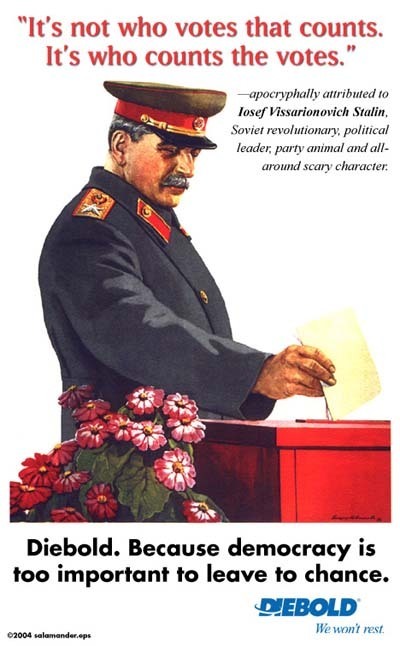
Whatever objections you have to this voting scenario should be reserved for the more familiar one involving Diebold and other voting machines. It's long been known that electronic machines run proprietary software and don't keep paper records of the votes cast. Similarly, the man in the voting booth also runs proprietary "mental software" whose commitment to honesty we have no way of ascertaining and simply supplies us with the vote total at the end of the day. He's probably honest and careful and, since he seems to be taking notes, his total is likely to be accurate, but would you trust such a voting system?
What if the guy in the booth was this guy?
Walden W. O'Dell, the chairman and chief executive of Diebold Inc., said in 2004 that it had been a ''huge mistake'' for him, as the head of a voting machine company, to express support for President Bush's re-election in a fund-raising letter last year. Mr. O'Dell also said the company was working to address computer security problems and build voter confidence in its wares.
IN mid-August, Walden W. O'Dell, the chief executive of Diebold Inc., sat down at his computer to compose a letter inviting 100 wealthy and politically inclined friends to a Republican Party fund-raiser, to be held at his home in a suburb of Columbus, Ohio. ''I am committed to helping Ohio deliver its electoral votes to the president next year,'' wrote Mr. O'Dell, whose company is based in Canton, Ohio.
That is hardly unusual for Mr. O'Dell. A longtime Republican, he is a member of President Bush's ''Rangers and Pioneers,'' an elite group of loyalists who have raised at least $100,000 each for the 2004 race.
But it is not the only way that Mr. O'Dell is involved in the election process. Through Diebold Election Systems, a subsidiary in McKinney, Tex., his company is among the country's biggest suppliers of paperless, touch-screen voting machines.
Judging from Federal Election Commission data, at least eight million people will cast their ballots using Diebold machines next November. That is 8 percent of the number of people who voted in 2000, and includes all voters in the states of Georgia and Maryland and those in various counties of California, Virginia, Texas, Indiana, Arizona and Kansas.
Some people find Mr. O'Dell's pairing of interests -- as voting-machine magnate and devoted Republican fund-raiser -- troubling. To skeptics, including more than a few Democrats, it raises at least the appearance of an ethical problem. Some of the chatter on the Internet goes so far as to suggest that he could use his own machines to sway the election.