“So successful were the Jewish pioneers that by 1900, there wasn’t a single settlement west of the Mississippi of any significance which had not had a Jewish mayor,” says historian Kenneth Libo. “This includes Deadwood, Dodge City, and Tombstone.”
Between 1840 and 1880, the European Jewish population in America increased from 15,000 to around 250,000. Most migrated for familiar reasons—to escape religious persecution, political upheaval, and poverty. “What is clear, even at this early stage, is the complex nature of the collective Jewish experience in America,” writes Libo in his 1985 book
We Lived There Too, coauthored with the late Irving Howe. “For already there are those who stay east and those who go west, those who come with special privileges and those who suffer discrimination, those who care about the faith of their fathers and those who do not, those who remain uprooted and those who transplant themselves.” Jewish settlers encountered little prejudice in the West, according to Libo. “They were looked upon as fellow settlers.”
During this same time, the United States increased its size by a third with the annexation of Texas in 1845, the ratification of the Oregon Treaty, the seizure of tribal lands, and the acquisition of California, Nevada, Utah, and parts of Arizona, Colorado, and New Mexico, as spoils from the Mexican-American War.
With expansion came opportunities. Boomtowns appeared as word spread of copper in Montana and Arizona, silver in New Mexico, and gold in California. Just like their Gentile counterparts, Jewish men and women were lured into hostile landscapes, traveling west by buckboard, stagecoach, horseback, and prairie schooner through Indian country to new settlements in the Black Hills of South Dakota, the deserts of the Southwest, and the gold fields of California with the hope of striking it rich, or at the very least, the possibility of a new life for themselves and their families.
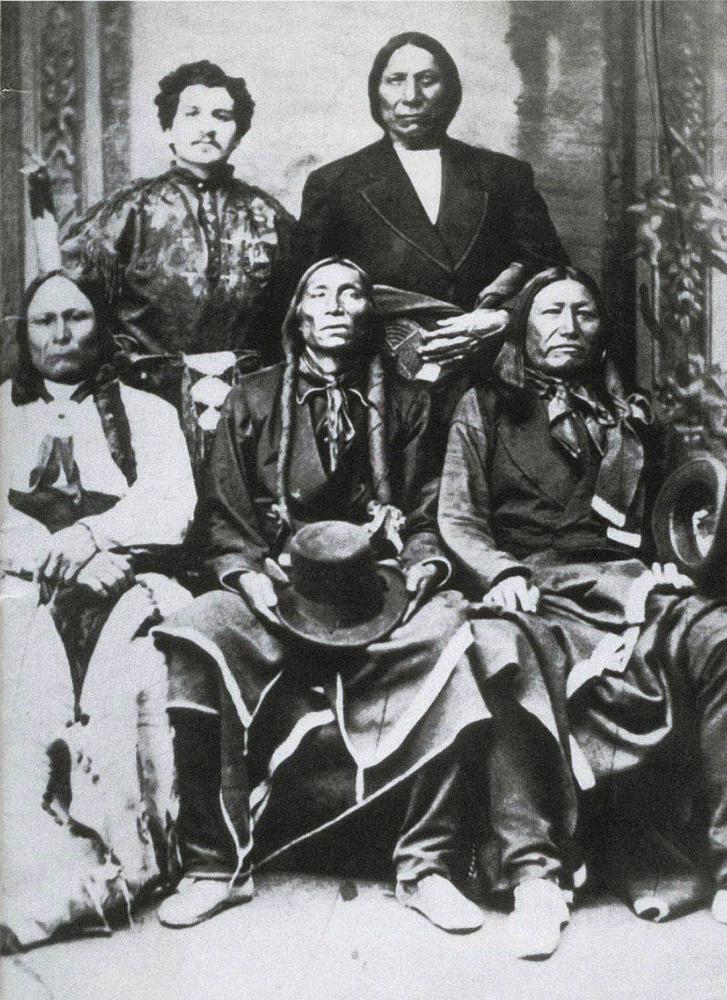
Photo caption
Trader Julius Mayer with Chiefs Red Cloud, Sitting Bull, Swift Bear, and Spotted Tail. The Pawnee tribe also gave him the name Box-ka-re-sha-has-ta-ka or Curly-headed white chief with one tongue.
Nebraska State Historical Society
But it was the Jewish merchant, not the fly-by-night prospector, who played a major role in the development of the West, turning dusty little cow towns into urban centers. “Jews literally brought civilization to countless cities and towns in America west of the Mississippi by establishing ‘the department store’ in every town of any consequence,” says Libo. “Their numbers may have been small, but their influence was substantial.”
(full article online)

www.neh.gov