I took the liberty of rewording the title of this article . Questioning your government is the most American thing a person can do, unless you no longer respect the Constitution, namely the First Amendment.
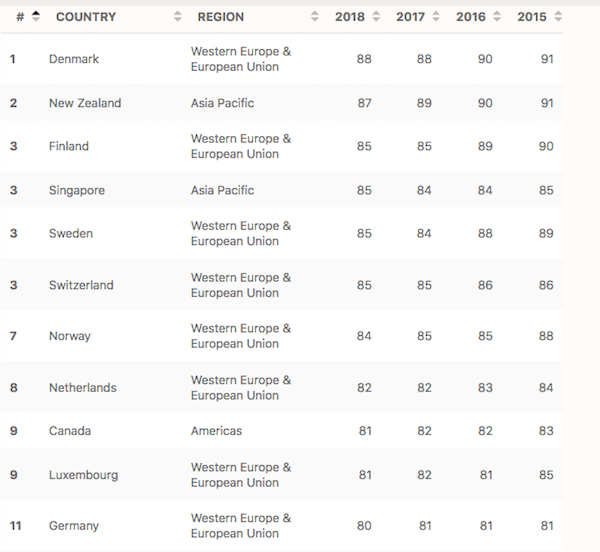
The United States fell six places to a ranking of only 22 in Transparency International’s list of countries by corruption. Under Donald Trump, America is not in the top 20 for fair dealing.
But as I have argued before, the United States is the most corrupt country in the world and should be ranked 194, not 22. What follows is a much-revised version of my popular list.
Obviously, the U.S. Departments of Justice and the Treasury would not give corporations impunity for obtaining contracts by bribery, and it is this sort of scrupulousness that the Transparency International list is rewarding. And Americans don’t have to bribe government officials, as is true in many countries (though, to be fair to the government officials, they typically demand bribes because their governments don’t pay them a living wage).
But in all sorts of ways, U.S. corruption is off the charts, and because the U.S. is still the No. 1 economy in the world by nominal gross domestic product, massive corruption here has a global impact.
Here are the top signs that the U.S. is the most corrupt country in the world:
The United States Is the Most Corrupt Country in the World
The Democratic Party is far the most corrupt / criminal PARTY; however, the US is far from the most corrupt / criminal COUNTRY in the world.
Try leaving the country, travel, & experience it / life for yourself to decide.
Did it. And lived and worked, not visited thanks. Now, about this predatory economic system.
1) Most americans are not doing that well.
a. 40% cannot cover a $400 emergency.
b. 78% of full time workers live paycheck to paycheck.
c. Only 28% of the american population is considered “financially healthy”.
2) We are not a land of opportunity.
a. An american born to a household in the bottom 20% of earnings has a 7.8% chance of joining the top 20% when they grow up.
b. Institutionally we nurture these conditions, when you’re poor, everything costs more, one need look no further than our financial and criminal just us systems which fee to death the non-wealthy.
3) The wedding industrial complex
a. Couples who spend more the $20K on a wedding are 46% more likely to divorce than those who pay $1K or less on a wedding.
b. Recidivism is as good for the wedding business as it is for the private for profit prison industry.
4) The ethnic rich do not play by the same rules the rest of us are admonished to.
a. Over the past half century they have tilted everything in their favor via the political and economic system.
b. Think tank drafted legislation, lobbyists, the tax structure’s societal wealth redistribution scam.
c. The Powell Memorandum comes to mind.
5) Americans pay way more for healthcare (2x in many cases) than any other advanced nation on the planet.
a. For much shittier care and outcomes overall, with shorter life spans and higher birth mortality rates
b. Our administrative costs? 8%
c. Other advanced nations? 1-3%
d. The only winners are the insurance and the pharmaceutical industry/corporations.
6) Americans pay way more for college (2x in many cases) than any other advanced nation on the planet.
a. There is no reason college must cost so much.
b. We’re turning generations into debt peons.
c. Public college expenses have risen 213% since the late 1980s.
d. Not to fund faculty wages/benefits/healthcare, but to fund non-productive administrative bureaucrats, outside consultants, travel expenses, top officials and “undisclosed expenses”.
7) The stock market is not the real economy and it very often means nothing as to how the average american worker is doing. If you are of the investor class of course this will not pertain to you. And no, a 401K in lieu of a pension does not mean you are one of them.
a. Real wages have nothing to do with the stock market other than rising wages terrifies investors and have been stagnant for half a century now.
b. A system predicated upon endless expansion and profit margin growth to infinity is at odds with what is best for society at large and average working americans.
c. What is often good for investors is often terrible for the average american working family.
d. Working hard in america is not a way to "get ahead" at all.