Okay. You win. Marxism is a bad idea.
How about we just go back to what we had in the 1950's, where you had a strong, unionized middle class bringing home good wages and strong protections for our markets?
Most of what you desire resulted from a.) a racially unified culture where assimilation was heavily enforced and b.) a period which was 30 years into an immigration moratorium.
Cultural unity coupled with labor shortages will do wonders for building up community cohesion and in lowering income inequality.
I'm game, let's go back to the dynamics of that era. So tell me, how are you going to unscramble the egg, how are you going to ethnically cleanse the US to return the demographics back to what they were in the 1950s?
The problem is we implemented liberal policies, which amounted to us jumping off the edge of a cliff on the basis of liberal promises that we wouldn't plummet into the canyon and those liberal policies all turned out to be lies and now you don't like the world that
liberal policies have created.
Senate immigration subcommittee chairman Edward Kennedy
(D-MA.) reassured his colleagues and the nation with the following:
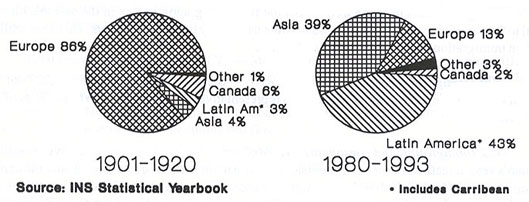
"First, our cities will not be flooded with a million immigrants annually. Under the proposed bill, the present level of immigration remains substantially the same ... Secondly, the ethnic mix of this country will not be upset ... Contrary to the charges in some quarters, [the bill] will not inundate America with immigrants from any one country or area, or the most populated and deprived nations of Africa and Asia ... In the final analysis, the ethnic pattern of immigration under the proposed measure is not expected to change as sharply as the critics seem to think." . . .
"The bill will not flood our cities with immigrants. It will not upset the ethnic mix of our society. It will not relax the standards of admission. It will not cause American workers to lose their jobs." (U.S. Senate, Subcommittee on Immigration and Naturalization of the Committee on the Judiciary, Washington, D.C., Feb. 10, 1965. pp. 1-3.)
Rep. Emanuel Celler
(D-NY), a sponsor of the bill, told his colleagues:
"With the end of discrimination due to place of birth, there will be shifts in countries other than those of northern and western Europe. Immigrants from Asia and Africa will have to compete and qualify in order to get in, quantitatively and qualitatively, which, itself will hold the numbers down. There will not be, comparatively, many Asians or Africans entering this country. .. .Since the people of Africa and Asia have very few relatives here, comparatively few could immigrate from those countries because they have no family ties in the U.S." (Congressional Record, Aug. 25, 1965, p. 21812.)
Another rosy prediction from a supporter of the bill, Sen. Claiborne Pell
(D-RI):
"Contrary to the opinions of some of the misinformed, this legislation does not open the floodgates." (Congressional Record, Sept. 20, 1965, p. 24480.)
Attorney General Robert Kennedy told House immigration subcommittee members,
"I would say for the Asia-Pacific Triangle it [immigration] would be approximately 5,000, Mr. Chairman, after which immigration from that source would virtually disappear; 5,000 immigrants would come the first year, but we do not expect that there would be any great influx after that." (U.S. Congress, House, 1964 hearings, p. 418.)
So how did those predictions work out? The New York Times
reports:
Between 2000 and 2010, the number of legal black African immigrants in the United States about doubled, to around one million. During that single decade, according to the most reliable estimates, more black Africans arrived in this country on their own than were imported directly to North America during the more than three centuries of the slave trade.
So who cautioned against this liberal pollyannaism? These were people trying to protect a way of life that you want to go back to but the lies of liberals carried the day.
Republican Vice Presidential candidate Rep. William Miller of New York wrote:
"We estimate that if the President gets his way, and the current immigration laws are repealed, the number of immigrants next year will increase threefold and in subsequent years will increase even more ... shall we, instead, look at this situation realistically and begin solving our own unemployment problems before we start tackling the world's?" (The New York Times, Sept. 8, 1964, p. 14.)
Among those who more accurately foresaw the future effects of the change in immigration law was a certain Myra C. Hacker, Vice President of the New Jersey Coalition, who testified at a Senate immigration subcommittee hearing:
"In light of our 5 percent unemployment rate, our worries over the so called population explosion, and our menacingly mounting welfare costs, are we prepared to embrace so great a horde of the world's unfortunates? At the very least, the hidden mathematics of the bill should be made clear to the public so that they may tell their Congressmen how they feel about providing jobs, schools, homes, security against want, citizen education, and a brotherly welcome ... for an indeterminately enormous number of aliens from underprivileged lands."
"We should remember that people accustomed to such marginal existence in their own land will tend to live fully here, to hoard our bounteous minimum wages and our humanitarian welfare handouts ... lower our wage and living standards, disrupt our cultural patterns ..."
"Whatever may be our benevolent intent toward many people, [the bill] fails to give due consideration to the economic needs, the cultural traditions, and the public sentiment of the citizens of the United States." (U.S. Senate, Subcommittee on Immigration and Naturalization of the Committee on the Judiciary, Washington, D.C., Feb. 10, 1965. pp. 681-687.)