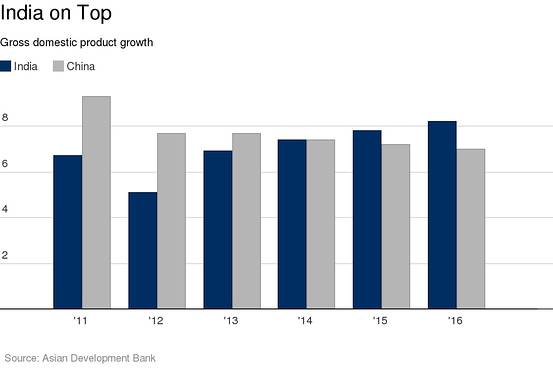
How seriously will China's economic slowdown affect the global economy? Stock markets around the world, including India's, have reacted with deep panic.
China's GDP growth in 2015-16 could dip to as low as five per cent - the lowest in decades. The yuan has so far fallen by less than four per cent but the housing and banking bubble in China could drive it down further. The Shanghai Composite index continued to skid on Tuesday (August 25), falling below the crucial 3,000 mark.
With Chinese demand slowing, steel, cement, auto and other Indian exports could face a domino effect as China cuts down on imports. The governor of the Reserve Bank of India (RBI), Dr Raghuram Rajan, is not a naturally grim man. But his prescription for the Indian economy has often been grim. However, after Monday's global stock market crash, he said India was in "a good condition" compared to other economies. He added that the RBI would not hesitate to defend a falling rupee.
Dr Rajan, chief economist at the International Monetary Fund from 2003 to 2007, made his global reputation by predicting the financial meltdown of 2008. To turn adversity into opportunity, both the RBI and the finance ministry must now think out of the box. India's economy, as finance minister Arun Jaitley said on Black Monday, remains robust. Tax collections are up 37 per cent and industrial production is rising steadily. Cheaper global commodity prices will help reduce input costs of finished Indian products though a weak rupee will neutralise some of that advantage.
Dr Rajan's term, which ends in September 2016, has been controversial. His singleminded focus has been to control inflation. By keeping monetary policy tight and interest rates high, Dr Rajan has squeezed consumer inflation down to below four per cent and wholesale inflation into negative territory: (-) four per cent.
The RBI has cut rates thrice in the past year by a parsimonious 25 basis points (0.25 per cent) each. That's clearly too little, too late. An impetus to Indian GDP growth needs at least two factors: one, more corporate investment; and two, higher consumer consumption.
Lower interest rates would cut corporate debt and interest outgo. Company profits would rise. Corporate investment across sectors - from infrastructure to health - would increase sharply, setting off a virtuous cycle of economic growth.
Simultaneously, lower interest rates would cut EMIs on home, car, scooter, tractor and consumer loans, putting more money into peoples' hands. Consumption would get a boost. Fast moving consumer goods (FMCG) companies complain of subdued demand. The automotive industry too has shown slow growth. Lower interest rates would catalyse demand across urban and rural India.
Once consumer demand picks up though, some economists warn, inflation could again rise. Not, however, if the supply-side is taken care of - ie, increased output in manufacturing and services following lower corporate debt and interest outgo. Lower interest rates would strengthen company balance sheets, enabling them to borrow from banks (which are shortly to be recapitalised). A combination of higher consumer demand and increased corporate investment will lead to a spike in manufacturing and get the economy back to an eight per cent growth trajectory.
Moody's has lowered its India growth forecast to seven per cent from the earlier 7.5 per cent. It cities uncertain global conditions and lack of economic reforms. By pursuing a more balanced monetary policy that places equal importance on controlling inflation and spurring economic growth, India can escape a deflationary cycle - low inflation, low growth - which Japan and much of Europe are battling.
The United States Federal Reserve has used low interest rates for several years to spur growth and jobs, create new manufacturing assets and keep inflation down. As a result, the US economy today is in the best shape it has been in seven years - low unemployment, steady GDP growth and moderate inflation.
Obviously, with the dollar as the world's reserve currency the US can print money at will. However, the Federal Reserve has consistently shown toughness, flexibility and pragmatism in getting the US economy back on its feet after the financial meltdown of 2008.
India's foreign exchange reserves are at a comfortable $355 billion, covering nine months of imports. Companies with dollar debt, however, will face a crunch: the rupee has depreciated by 13.9 per cent against the dollar in 2015-16. This makes lower interest rates to cut corporate debt even more imperative.
This is a crucial time for the Indian economy. With exports falling for eight consecutive months, largely due to global demand contraction, the trade deficit has remained stubbornly over $100 billion. Oil prices are trending below $40 per barrel. Once extra Iranian crude (an estimated 5,00,000 barrels per day) comes into the market following the gradual withdrawal of Western sanctions, oil prices could remain at these depressed levels for at least two years till global demand increases.
...
India's Chinese takeaway: Turning adversity into opportunity