I'm tired of anemic guitar amps!

What kind would you recommend?

Scuttlebutt is, the 2c is a nice one.


I get mad when the sound I want isn't in the amp. :p


They like it when you tell em to stick a 57 in front of the speaker.
Line amps have effects built right in.
I just use a chorus pedal, & one distortion.
 
What kind would you recommend?

Scuttlebutt is, the 2c is a nice one.


I get mad when the sound I want isn't in the amp. :p


They like it when you tell em to stick a 57 in front of the speaker.
I do that, small amp, sound reinforcement.
57 is still my mic if choice, even In the studio.
 
I'm going to build an amp. And post the whole thing on YouTube. Show the world how it's done.

My ear has had it with anemic amps. I like thump, I like an authoritative sound. I like the power tubes to break up at full volume, none of that saggy blues stuff.

My other requirement is it has to be bulletproof. It has to be able to fall out the back of a truck and survive. So no PC boards, all old school point to point wiring. The worst thing that happens is a tube blows and then you replace it and you're done.

If you're into guitar amps, check out the schematic of this 200 watt Marshall. Notice the 12AU7 driver, in front of the power tubes. That's there because the KT-88's require 50 V rms to reach full power. They sound great when they do, they're thumpy and they have great dynamics, but they need some beef backing them up.


So I'm going to have a 400 VA toroid that can supply almost an amp at 560 volts (the tubes draw 640 mils at full power), but it weighs less than half as much as a big metal power transformer.

And I'm going to make it a dial-an-amp, so you can get any sound you want just by flipping a few switches. If you want a Fender sound with reverb and the tone stack up front you can get that, and if you want a Marshall sound with the tone stack in back you can get that too. And anything in between, and above and beyond.

By using a 12AU7 as a phase inverter, ahead of the driver, I get a combined gain of about 60 for the power amp, which is just about perfect, that means about 0.8 volts will drive it to full power. With a long tailed pair, it'll have the same sparkle as a Marshall Major about halfway up, and then it'll get really aggressive when it's cranked.

I want to blow some windows out this year. It's one of my New Year's resolutions. :p
Back to the future.
 
Ddesigned by Haarp
 

Attachments

  • Screenshot_20251022_102833_Chrome.webp
    Screenshot_20251022_102833_Chrome.webp
    53.4 KB · Views: 19
I lost a pair of KT-88's in testing. :p

I wanted to see how far I could push the ultralinear power amp. I think it was the screen current that destroyed the tubes.

It's okay for now, thankfully I kept the old 6550's for testing.
 
So, I'm going to change the screen stoppers to 1k. And put in some protection diodes so the OT won't blow if a tube happens to short. Thankfully these didn't, just don't pass current any more. Beautiful B+ on plate and screen, required bias voltage is present, but zero cathode current. Oh well... the 6550's work fine for continued testing.

There are two issues to debug, there's a bad connection in the master tone stack, and an ocçasional scratchy noise in the reverb return. The rest of the amp works fine, it's ready to be voiced. So far there is no specific need for the driver stage, the 12au7 PI is handling things just fine.

You get mondo signal level with 3 preamp stages, but that's the recipe for the killer sound. Put that result into your 3 high-gain stages (cold clipper, cathode follower, and extra hot biased straight stage for added rattiness), and switch and voice accordingly. Cut the signal back down as needed, before it enters the PI, either with a master volume or voltage divider. 20 volts of signal is required at the input to the gain stages. 3 cascaded preamp stages can provide that with plenty of headroom.
 
Of all the discoveries made in this exercise, the PI is the most important one. People just copy circuits, Mesa copies from Soldano who copies from Marshall who copies from Fender. They just look at a circuit, go "well, it works", so they copy it and use it.

You can look at the PI circuits out there, there's two kinds: concertina and long tailed pair. Concertina is what they use in the Princeton Reverb and in the Marshall Major, it's a single stage half 12ax7. It doesn't provide much current, so often there's a driver stage after it, like in the Major. Concertina has a sweet spot at about half volume, and the grit is soft, cushy, there's not much of it but it's pleasing to the ear.

The other one, the long tailed pair, is what's used in most amps since the mid-50's, because it's more aggressive and breaks up nicely (it usually works well with the output tubes). And among these, there's a 12ax7 circuit that uses 82k/100k load, and a 12at7 circuit that uses a pair of 47k's. The AT is mostly used in high power amps, you can trace it's lineage over the years as supply voltage kept increasing - the thing about the AT is the original circuit had a 22k tail, which puts the cathode into dangerous territory at 115 volts or so which is 20% over spec and stresses the tube - and people have just copied this circuit and continually raised the supply voltage as the amp got bigger with more tubes and more watts, the result being I've seen some AT cathodes running at 160 volts and in that case the tube won't last more than a month (and it doesn't sound any better that way).

Also the AT circuit has a weirdo tail, you'll notice that none of the AT amps have a presence control, and that's because of that idiotic 100 ohm resistor that's supposed to put "almost no" negative feedback back into the tail.

The solution is, you use the time tested AX circuit (with the presence control), and you adjust the load resistors so you can use an AT instead. I've done the math, and it works - and you can check it yourself using the amp calculators on ampbooks.com. Instead of 82k/100k, you use 47k/51k, and then you can run the PI at 450 volts and your tail voltage will be 90 volts (within spec) and your plate voltage will be about 310 volts which will give you a robust 100 volt signal swing in either direction. That's more than enough juice to supply a quad of KT-88's, even in ultralinear mode - and the PI will stay clean all the way up meaning the output tubes will overdrive before the PI does.

So that's all you have to do, use the PI from the original 5F6A design and change the load resistors and use a 12at7 instead of a 12ax7, and make sure the supply voltage is high enough. In many amps 450 is plate voltage, and in those cases you can supply the PI straight from the screen tap (after the choke). In for instance an ultralinear Twin Reverb running at 530 volts you'll need a resistor to take it down to 450.

IF you do this as a mod to an existing amp, you may have to adjust the upstream resistors in your power supply chain, because the AT draws more current than an AX does.

But this circuit, is a "universal" PI for anything south of 300 watts. It'll give you a presence control and you can use all the standard feedback and resonance circuitry, and your AT7 tube will be happy and have a good long life.
 
Here is a picture of the mother amp with the reverb tank installed.

IMG_20251023_134841126_AE.webp


This is the front panel with all the knobs attached, ready for the faceplate.

IMG_20251023_134904230_AE.webp


The reverb works a little differently on this amp. It uses a mixer, for your reverb and clean signals. On the top row of knobs, counting from the left, numbers 3 and 4 are your mixer knobs, for reverb and raw signal levels respectively.

Again counting from the left, column 3 of knobs is your reverb column. On the bottom is the dwell control, so you can adjust how hard you're hitting the springs. In the middle is the reverb level, which you can change without changing your mix - or you can change the mix without changing the reverb level. On top is the mix - you can use the mix knobs to get all reverb and no raw signal ("reverb only"), or you can set the raw signal level to any small amount for all kinds of interesting reverb behavior.

If you pull on the reverb mix knob it's a mute, and same for the raw mix knob. If you pull on the reverb level control it's a "bright switch" for the reverb. You can plug an 8 ohm speaker into a jack in back of the amp and it will disconnect the reverb and send the reverb signal out the jack instead (it'll be about a 3 watt level). When you do this you can pull on the dwell switch and get some extra brightness through the monitor.

Then if you don't want to hear the amp you can just turn the master volume down, everything else stays the same and it doesn't affect the level coming out of the monitor jack.
 
As promised here is some more of the schematic. This is the input section (stages 1, 2, and 3) and the gain section (stages 4 and 5).

IMG_20251023_152902263_AE.webp


IMG_20251023_152918516_AE.webp


As you can see it's very vanilla. Each stage only does one thing. The first stage selects your cathode cap, which determines how much bass gets retained. Then there is a gain control, with some selectable tone shaping circuitry around it. Next, stage 2 has the up-front tone stack. When you're in high gain mode this stack is mainly used to set the desired midrange fatness.

Everything else can be bypassed. You can take the stage 2 output and feed it straight to the power amp, that way you have one gain control and one tone stack and that's it. You can even bypass the tone stack by pulling on the bass knob, then you have just a gain control and a few tone switches.
 
Here is a picture of the mother amp with the reverb tank installed.

View attachment 1176651
https://img.freepik.com/premium-photo/smiling-bear-hyperdetailed-cartoon-game-with-realistic-rendering_899449-26106.jpg


This is the front panel with all the knobs attached, ready for the faceplate.

View attachment 1176652
Wow, complicated. All of these non-essential stages, switches, knobs, modes, and controls with combination pots with switches built in for duel function.

It'll take an operator's manual to learn how to use it. I'm intrigued. All I can say at this point is that I think I would have opted for black knobs with white indicator lines. But maybe not.
 
https://img.freepik.com/premium-photo/smiling-bear-hyperdetailed-cartoon-game-with-realistic-rendering_899449-26106.jpg


Wow, complicated. All of these non-essential stages, switches, knobs, modes, and controls with combination pots with switches built in for duel function.

For a guitar player, dual function means clean or gritty. It's notoriously difficult to get an amp to do both - so they give you a clean "channel" and a high gain "channel", both of which suffer from the same problem as most other amps - they only have one sound!

So people buy multiple amps. They have a Twin for clean and a Marshall for gain. Or they use pedals to make the amp do things it doesn't like doing.

This is a different idea. Put all the amps into one case, and let the user switch between them and decide what's best. Yes, it's a little more complicated, and it assumes the user knows how an amp works.

It'll take an operator's manual to learn how to use it. I'm intrigued. All I can say at this point is that I think I would have opted for black knobs with white indicator lines. But maybe not.

To use this amp, you do two things:

1. You define a topology. You decide how many stages you want and what you want your preamp to look like.

2. You voice your chosen amp. This is where the knowledge comes in. Or, you can just play around.

The power amp is cast in stone, it can't be changed. So I spent time on the power section and tried a couple different designs. I like my AT PI in the non ultralinear mode the best so far.
 
For a guitar player, dual function means clean or gritty. It's notoriously difficult to get an amp to do both - so they give you a clean "channel" and a high gain "channel", both of which suffer from the same problem as most other amps - they only have one sound!

Well, that is an interesting point. Maybe some day if I feel like trying to explain it, I'll write something explaining the transconduction slope and how, depending on how and where you hit it determines that shape of the sound of the amp (in large part) due to wide swings in linearity.

I don't play guitar (I played a little acoustic) so I'm not accustomed to amps with dialable sound. Also, any time you involve high gain, you are going to at least factor in a certain level of distortion, probably why Class A used to be so popular.

My claim to fame was long ago befriending a pro guitarist who involved me in some of his technical issues and I ended up repairing and/or redesigning a couple of effects boxes for him he used on the floor (pedal boxes).

The one I redesigned started out life as an op amp circuit but when I gave it back, it ran on a 12ax7 tube. He loved it.
 
Well, that is an interesting point. Maybe some day if I feel like trying to explain it, I'll write something explaining the transconduction slope and how, depending on how and where you hit it determines that shape of the sound of the amp (in large part) due to wide swings in linearity.

I don't play guitar (I played a little acoustic) so I'm not accustomed to amps with dialable sound. Also, any time you involve high gain, you are going to at least factor in a certain level of distortion, probably why Class A used to be so popular.

My claim to fame was long ago befriending a pro guitarist who involved me in some of his technical issues and I ended up repairing and/or redesigning a couple of effects boxes for him he used on the floor (pedal boxes).

The one I redesigned started out life as an op amp circuit but when I gave it back, it ran on a 12ax7 tube. He loved it.

A property of tube circuits often overlooked is "recovery time". Sometimes external circuit elements are involved, sometimes it's the tube itself (sometimes both).

For example - this amp can become smoother or more attacky (more dynamic) just by changing the values of some filter caps. When you hit a loud note the B+ sags for a short while, which lowers the peak amplitude and also lengthens the decay (it's a form of compression). With zero sag you get a harsh and somewhat annoying amp, but too much sag is undesirable too because your dynamics get lost. I'm not aware that anyone's actually quantified what's optimal, or even provided a range on a graph. To get an attacky amp, put huge filter caps (500 uF) on the primary DC and use a choke. To get a smoother amp use smaller filter caps (50 uF) and a smaller or non existent choke.

During a loud note the magnetism in the OT will build up, and when the note is released the magnetism will try to discharge back into the tubes in the form of a back-EMF which can be very dangerous. You can see it very clearly on a scope with a square wave signal. How fast your amp responds to this current dramatically changes your overdrive sound. Part of why ultralinears break up less/later is the screen recovery time is much faster. Otherwise you wait for chokes to discharge and filter caps to recharge. The ultralinear amp with a 12au7 PI sounds very fast, very dynamic. It has 175 uF primary filter cap and no choke. The non ultralinear practice amp is smoother, it only has 100 uF on the B+ and a 5H choke. To get the most sag we could cathode bias the output stage, typically that's a 100 uF bypass cap and about a 1k cathode resistor. That would sound lovely (very bluesy) with a lush reverb and a smooth cathode follower. Not so much with a cold clipper because that's a fast unbypassed stage, the instant your note stops the sound will stop too. With a fast amp you depend on your preamp to smooth things out. A cathode follower is real good at that because of the negative feedback and compression.

Guitar amps mostly run in overdrive, distortion becomes a good thing and the amp does everything an amp's not supposed to do. Even more than harmonic distortion, players use the intermodulation distortion to get pleasing grit. One of the reasons you can safely cut all the bass out of your high gain signal is you get it back later, in the form of subharmonics derived from IMD. THD in a push pull 100 watt KT-88 amp might be around 2%, but IMD could be ten times that, usually around 12-15% at full power. IMD is colorful for regular playing, and essential in high gain mode.
 
Well, that is an interesting point. Maybe some day if I feel like trying to explain it, I'll write something explaining the transconduction slope and how, depending on how and where you hit it determines that shape of the sound of the amp (in large part) due to wide swings in linearity.

I don't play guitar (I played a little acoustic) so I'm not accustomed to amps with dialable sound. Also, any time you involve high gain, you are going to at least factor in a certain level of distortion, probably why Class A used to be so popular.

My claim to fame was long ago befriending a pro guitarist who involved me in some of his technical issues and I ended up repairing and/or redesigning a couple of effects boxes for him he used on the floor (pedal boxes).

The one I redesigned started out life as an op amp circuit but when I gave it back, it ran on a 12ax7 tube. He loved it.

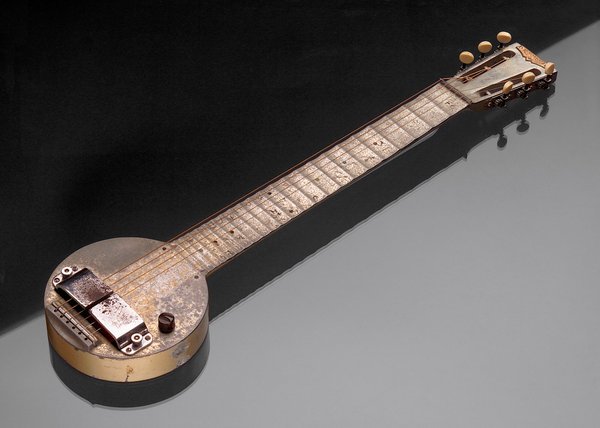
Found this interesting article, about the first electric guitar. It was called the "Frying Pan".


1761280566854.webp
 
As promised here is some more of the schematic. This is the input section (stages 1, 2, and 3) and the gain section (stages 4 and 5).

View attachment 1176660

View attachment 1176661

As you can see it's very vanilla. Each stage only does one thing. The first stage selects your cathode cap, which determines how much bass gets retained. Then there is a gain control, with some selectable tone shaping circuitry around it. Next, stage 2 has the up-front tone stack. When you're in high gain mode this stack is mainly used to set the desired midrange fatness.

Everything else can be bypassed. You can take the stage 2 output and feed it straight to the power amp, that way you have one gain control and one tone stack and that's it. You can even bypass the tone stack by pulling on the bass knob, then you have just a gain control and a few tone switches.
Old School Freehand!

I love it.
 
15th post
I found the godliest negative feedback setting. Heavenly tone now. Turns out, the best setting is just enough to make the presence control work. It's subtle, not dramatic - but you can clearly hear the effect of the NFB, it tightens up the bass and takes a little off the high end too. The feedback level now is less than 3 dB, I had calculated 360-ish k for 6 dB, and I'm actually using 803k.

With the pair of 12au7's acting as my PI and driver, there is a very pronounced but narrow sweet spot in the NFB setting. The NFB is going to the traditional place in the tail of the PI, but the phases are swapped from PI to driver because of the extra stage. When it's dialed into the sweet spot, the presence control brings out the high mids in the reverb, and you can control it with your playing volume. It's perfect, you hear exactly what you need to hear, and nothing you don't.

So now I'm ready to start voicing the gain stages. They already sound good, but they can sound even better. Most of the effort is maintaining consistency as you're switching stages in and out. Stages 3 and 4 are easy, you're just cutting highs, you can use a classic passive tone control. The cathode follower is a little trickier, you want to cut lows instead. A judicious choice of cathode bypass cap is better than mucking with the coupling caps. The cathode follower has an input level control, so it is possible to put some tone shaping circuitry around that too.

What's left is just the reverb section, and that already sounds so damn good with those old springs, I might just leave it alone. It's impossible to tell if any tone shaping is really "needed" there until I get the chance to turn the amp up in a live setting. (That old tank is a treasure, they just don't make em like that any more).

At the risk of being premature (one never knows, the amp might blow up at a gig), I'm going to call this project a success.
 
And here is Scruffy's world famous phase inverter.

IMG_20251024_170235999.webp


That's not a mistake, there are two 820 ohm resistors in parallel to give you 410 ohms, which is exactly the right value to put your plates at 300 volts.

Cathode voltage is exactly 90 volts. It's in spec and you get 150 volts clean peak to peak on each output (assuming sufficient drive). Gain in this circuit is a tad over 13 (per leg), so you'll need about 8 volts drive to power a pair of KT-88's. (Note this is about double the drive provided by a Fender Twin Reverb).

You can use this circuit with B+ as low as 430 volts. I wouldn't go much lower than that without adjusting component values. Higher than 450 is not good, don't do it.

Since the gain of an AT is considerably different from a 12ax7, you'll have to play with the value of the NFB resistor. Generally its value will be slightly over half of the value for a 12ax7.

Use this circuit for a cleaner amp at high volumes. Anything that currently uses a 12ax7 PI is a candidate. That would include all of your Marshalls, Mesas, Soldanos, etc. (And Orange, like that). You can also use this circuit in a silver face Fender if you want to add a presence control, with the caveats already mentioned about B+ and NFB.
 
This is the circuit (above) in the practice amp. It drives the KT-88's clean all the way up, no problem.

The mother amp uses a different arrangement, a pair of 12au7's in a PI-driver configuration which together have four times as much gain as a 12at7. An AU is capable of driving four pairs of KT-88's, so 800 watts. An AT can't quite do that, but it'll handle one pair nicely, maybe even two.
 
I'll draw your attention to this Ampeg schematic, which has the little balloons that show you the signal voltages.


You can see what they're doing, every tone circuit takes a big bite out of the signal, and then they restore it with a gain stage, and at the very end they boost the hell out of it to get 140 v p-p, and after the reverb, that results in 5v at the input to the PI.
 

New Topics

Back
Top Bottom