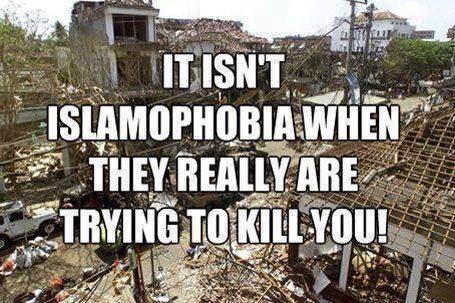
I think we've got it..........................BitchBoi is one a bit insecure.
No wonder he hates those that go against him...........................
Insecure? Muslims were not on my radar a few weeks ago. Then, the facts on the Boston Marathon bombers came out. Then, I looked back and researched 9/11. Then, I found the following list of violent actions by Muslims on Wiki. After reading this list one would have to be blind deaf, and dumb not to know Muslims are enemies of western culture. Muslims are prepared to kill anyone who disagrees with them. American Muslims who do nothing to stop the violence are as guilty as those who perform it. We must fight fire with fire.
Read this ******* list, moron! Here are many solid reasons to feel insecure about Muslims.
Islam's doctrines and texts have in some cases been associated with violence. This article deals with the juxtaposition in Islamic law and theology of violence and non-violence by groups and individuals. Attitudes and laws towards both violence and peace exist within the Islamic tradition.
Contents
Perception of Islam
Western perceptions
Sutton and Vertigans describe Western views of Islam as based on a stereotype of it as an inherently violent religion, characterizing it as a 'religion of the sword'. They characterize the image of Islam in the Western world as "dominated by conflict, aggression, 'fundamentalism', and global-scale violent terrorism."
[1]
Juan Eduardo Campo writes that, "Europeans (have) viewed Islam in various ways: sometimes as a backward, violent religion; sometimes as an Arabian Nights fantasy; and sometimes as a complex and changing product of history and social life."
[2] Robert Gleave writes that, "at the centre of popular conceptions of Islam as a violent religion are the punishments carried out by regimes hoping to bolster both their domestic and international Islamic credentials.
[3]
The
9/11 attack on the US and other[
when?] attacks since then associated with people who follow the Islamic faith, have led many non-Muslims to indict Islam as a violent religion.
[4] According to Corrigan and Hudson, "some conservative Christian leaders (have) complained that Islam (is) incompatible with what they believed to be a Christian America."
[5] Examples of Christian leaders who have expressed such sentiments include Franklin Graham and Pat Robertson.
[6] According to a survey conducted by a research group affiliated with the
Southern Baptist Convention, two out of three Protestant pastors believe Islam is a "dangerous" religion.
[7]
Islamic views on violence
In response to these charges, Ram Puniyani assert that, "Islam does not condone violence but, like other religions, does believe in self-defence".
[8]
Mark Juergensmeyer describes the teachings of Islam as ambiguous about violence. He asserts that, like all religions, Islam occasionally allows for force while stressing that the main spiritual goal is one of nonviolence and peace.
[9] Hood, Hill and Spika write that "(a)lthough it would be a mistake to think that Islam is inherently a violent religion, it would be equally inappropriate to fail to understand the conditions under which believers might feel justified in acting violently against those whom their tradition feels should be opposed."
[10]
Similarly, Chandra Muzaffar asserts that, "(t)he Quranic exposition on resisting aggression, oppression and injustice lays down the parameters within which fighting or the use of violence is legitimate. What this means is that one can use the Quran as the criterion for when violence is legitimate and when it is not."
[11]
Islamic sources
Qur'an
Main article:
Qur'an and violence
The Qur'an's teachings on matters of war and peace have become topics of heated discussion in recent years. On the one hand, some critics claim that certain verses of the Qur'an sanction military action against unbelievers as a whole both during the lifetime of Muhammad and after. The Qur'an says, "Fight in the name of your religion with those who fight against you."
[12] On the other hand, other scholars argue that such verses of the Qur'an are interpreted out of context,
[13][14] and argue that when the verses are read in context it clearly appears that the Qur'an prohibits aggression,
[15][16][17] and allows fighting only in self-defense.
[18][19]
Jihad
Main article:
Jihad
Jihad, an
Islamic term, is a religious duty of
Muslims. In
Arabic, the word
jihād translates as "struggle".
Jihad appears 41 times in the
Quran and frequently in the idiomatic expression "striving in the way of Allah
(al-jihad fi sabil Allah)".
[20][21][22]
Jihad is an important religious duty for Muslims. A minority among the
Sunni scholars sometimes refer to this duty as the sixth
pillar of Islam, though it occupies no such official status.
[23] In
Twelver Shi'a Islam, however, Jihad is one of the 10
Practices of the Religion.
There is controversy regarding the extent of correlation between
jihad and violence, and whether some have used confusion over the definition of the term to their advantage.
[24]
Middle East historian
Bernard Lewis argues that "the overwhelming majority of classical theologians, jurists, and traditionalists (specialists in the hadith) understood the obligation of jihad in a military sense."
[25] Furthermore, Lewis maintains that for most of the recorded history of Islam, from the lifetime of the Prophet
Muhammad onward, the word jihad was used in a primarily military sense.
[26] Although some Islamic scholars
have different perspectives on the implementation of Jihad, there is strong consensus amongst them that the concept of jihad will always include armed struggle against what they see as persecution and oppression.
[27][28]
Qur'anic verses in favor of violence
Qur'an that claims it is the "clear truth and the best explanation"[
Quran 25:33], a revelation that was sent down "to make everything clear"[
Quran 16:89] and the
eternal word of Allah[
Quran 56:80], commands its adherents in chapter no. 47,
Quran in
chapter 9 says,
“Freedom from (all) obligations (is declared) from Allah and His Messenger to those of the Mushrikun
(polytheists, pagans, idolaters, disbelievers in the Oneness of Allah), with whom you made a treaty.[1]
So travel freely (O Mushrikun) for four months (as you will) throughout the land, but know that you cannot escape (from the Punishment of) Allah, and Allah will disgrace the disbelievers.[2]
And a declaration from Allah and His Messenger to mankind on the greatest day (the 10th of Dhul-Hijjah — the 12th month of Islamic calendar) that Allah is free from (all) obligations to the Mushrikun and so is His Messenger. So if you (Mushrikun) repent, it is better for you, but if you turn away, then know that you cannot escape (from the Punishment of) Allah. And give tidings (to Muhammad) of a painful torment to those who disbelieve.[3]
Except those of the Mushrikun with whom you have a treaty, and who have not subsequently failed you in aught, nor have supported anyone against you. So fulfill their treaty to them to the end of their term. Surely Allah loves Al- Mattaqun (the pious — see V.2:2).[4]
Then when the Sacred Months (the Ist, 7th, 11th, and 12th months of the Islamic calendar) have passed, then kill the Mushrikun wherever you find them, and capture them and besiege them, and prepare for them each and every ambush. But if they repent and perform As-Salat (Iqamat-as-Salat), and give Zakat, then leave their way free. Verily, Allah is Oft-Forgiving, Most Merciful.[5]
And if anyone of the Mushrikun (polytheists, idolaters, pagans, disbelievers in the Oneness of Allah) seeks your protection then grant him protection, so that he may hear the Word of Allah (the Quran), and then escort him to where he can be secure, that is because they are men who know not.[6]”
—
Muhsin khan translated
Quran,
verse 9:1-6
“O you who believe (in Allah's Oneness and in His Messenger (Muhammad)! Verily, the Mushrikun (polytheists, pagans, idolaters, disbelievers in the Oneness of Allah, and in the Message of Muhammad) are Najasun (impure). So let them not come near Al-Masjid-al-Haram (at Makkah) after this year, and if you fear poverty, Allah will enrich you if He will, out of His Bounty. Surely, Allah is All-Knowing, All-Wise. [28] Fight against those who
(1) believe not in Allah,(2) nor in the Last Day,(3) nor forbid that which has been forbidden by Allah and His Messenger(4) and those who acknowledge not the religion of truth (i.e. Islam) among the people of the Scripture (Jews and Christians), until they pay the Jizyah with willing submission, and feel themselves subdued. [29] And the Jews say: 'Uzair (Ezra) is the son of Allah, and the Christians say: Messiah is the son of Allah. That is a saying from their mouths. They imitate the saying of the disbelievers of old. Allah's Curse be on them, how they are deluded away from the truth! [30]”
—
Muhsin khan translated
Quran,
verse 9:28-30
Quran
chapter 8 says,
“(Remember) when your Lord inspired the angels, "Verily, I am with you, so keep firm those who have believed. I will cast terror into the hearts of those who have disbelieved, so strike them over the necks, and smite over all their fingers and toes."[12]
This is because they defied and disobeyed Allah and His Messenger. And whoever defies and disobeys Allah and His Messenger, then verily, Allah is Severe in punishment.[13]”
—
Muhsin khan translated
Quran,
verse 8:12-13
“Say to those who have disbelieved, if they cease (from disbelief) their past will be forgiven. But if they return (thereto), then the examples of those (punished) before them have already preceded (as a warning).[38]
And fight them until there is no more Fitnah (disbelief and polytheism: i.e. worshipping others besides Allah) and the religion (worship) will all be for Allah Alone [in the whole of the world]. But if they cease (worshipping others besides Allah), then certainly, Allah is All-Seer of what they do.[39]”
—
Muhsin khan translated
Quran,
verse 8:38-39
In his tafsir,
Ibn Kathir, one of the most well-renown Islamic scholars, explains the verses further:
“Allah then commanded fighting the disbelievers when He said:
(...until there is no more Fitnah) meaning, Shirk. This is the opinion of Ibn `Abbas, Abu Al-`Aliyah, Mujahid, Al-Hasan, Qatadah, Ar-Rabi`, Muqatil bin Hayyan, As-Suddi and Zayd bin Aslam.
Allah's statement:
(...and the religion (all and every kind of worship) is for Allah (Alone).) means, `So that the religion of Allah becomes dominant above all other religions.' It is reported in the Two Sahihs that Abu Musa Al-Ash`ari said: "The Prophet was asked, `O Allah's Messenger! A man fights out of bravery, and another fights to show off, which of them fights in the cause of Allah' The Prophet said:
(He who fights so that Allah's Word is superior, then he fights in Allah's cause.) In addition, it is reported in the Two Sahihs:
(I have been ordered (by Allah) to fight the people until they proclaim, `None has the right to be worshipped but Allah'. Whoever said it, then he will save his life and property from me, except for cases of the law, and their account will be with Allah.)”
—Tafsir of
Ibn Kathir,
The Order to fight until there is no more Fitnah
(c. 1445-1505 AD) was a famous Egyptian writer, religious scholar, juristic expert and teacher wrote:
“Fight those who don't believe in God nor in the Last Day [Unless they believe in the Prophet God bless him and grant him peace] nor hold what is forbidden that which God and His emissary have forbidden [e.g., wine] nor embrace the true faith [which is firm, and abrogates other faiths, i.e., the Islamic religion] from among [for distinguishing] those who were given the Book [i.e., the Jews and Christians] unless they give the head-tax [i.e., the annual taxes imposed on them] (/'an yadin/) humbly submissive, and obedient to Islam's rule.”
—Suyuti, Durr al-Manthur (Beirut Edition), vol. 3, p. 228
About Jihad, leader of the Afghan Jihad, Abdullah Yusuf Azzam wrote:
“Jihad Against the Kuffar is of two Types: Offensive Jihad (where the enemy is attacked in his own territory) ... [and] Defensive Jihad. This is expelling the Kuffar from our land, and it is Fard Ayn [personal religious obligation on Muslim individuals], a compulsory duty upon all ... ...Where the Kuffar [infidels] are not gathering to fight the Muslims, the fighting becomes Fard Kifaya [religious obligation on Muslim society] with the minimum requirement of appointing believers to guard borders, and the sending of an army at least once a year to terrorise the enemies of Allah. It is a duty of the Imam (Caliph) to assemble and send out an army unit into the land of war once or twice every year. Moreover, it is the responsibility of the Muslim population to assist him, and if he does not send an army he is in sin.- And the Ulama have mentioned that this type of jihad is for maintaining the payment of Jizya. The scholars of the principles of religion have also said: " Jihad is Daw'ah [Islamic preaching] with a force, and is obligatory to perform with all available capabilities, until there remains only Muslims or people who submit to Islam.”
—A. Y. Azzam,
Offensive Jihad Vs. Defensive Jihad
Shaykh Aḥmad Sirhindī (d. 1624) was an Islamic scholar and a prominent Sufi. He is regarded as having rejuvenated Islam, due to which he is commonly called "Mujadid Alf Thani", meaning "revival of the second millennium". He wrote,
“Shariat can be fostered through the sword. Kufr and Islam are opposed to each other. The progress of one is possible only at the expense of the other and co-existences between these two contradictory faiths in unthinkable.
The honor of Islam lies in insulting kufr and kafirs. One who respects kafirs, dishonors the Muslims. To respect them does not merely mean honouring them and assigning them a seat of honor in any assembly, but it also implies keeping company with them or showing considerations to them. They should be kept at an arm's length like dogs. ... If some worldly business cannot be performed without them, in that case only a minimum of contact should be established with them but without taking them into confidence. The highest Islamic sentiment asserts that it is better to forego that worldly business and that no relationship should be established with the kafirs.
The real purpose in levying jizya on them is to humiliate them to such an extent that, on account of fear of jizya, they may not be able to dress well and to live in grandeur. They should constantly remain terrified and trembling. It is intended to hold them under contempt and to uphold the honor and might of Islam. . . .
Whenever a Jew is killed, it is for the benefit of Islam”
—A. Sirhindi, Excerpted from Saiyid Athar Abbas Rizvi, Muslim Revivalist Movements in Northern India in the Sixteenth and Seventeenth Centuries (Agra, Lucknow: Agra University, Balkrishna Book Co., 1965), pp.247-50; and Yohanan Friedmann, Shaykh Ahmad Sirhindi:
An Outline of His Thought and a Study of His Image in the Eyes of Posterity (Montreal, Quebec: McGill University, Institute of Islamic Studies, 1971), pp. 73-74.
Narrated Anas bin Malik: Allah's Apostle said, "I have been ordered to fight the people till they say: 'None has the right to be worshipped but Allah.' And if they say so, pray like our prayers, face our Qibla and slaughter as we slaughter, then their blood and property will be sacred to us and we will not interfere with them except legally and their reckoning will be with Allah." Narrated Maimun ibn Siyah that he asked Anas bin Malik, "O Abu Hamza! What makes the life and property of a person sacred?" He replied, "Whoever says, 'None has the right to be worshipped but Allah', faces our Qibla during the prayers, prays like us and eats our slaughtered animal, then he is a Muslim, and has got the same rights and obligations as other Muslims have."
—
Sahih al-Bukhari,
1:8:387 and
Sahih al-Bukhari,
1:2:24 see also
Sahih Muslim,
1:30,
Sahih Muslim,
1:31,
Sahih Muslim,
1:32,
Sahih Muslim,
1:33,
Sahih Muslim,
1:34
On the day of Al-Ahzab (i.e. clans) the Prophet said, (After this battle) we will go to attack them (i.e. the infidels) and they will not come to attack us."
Narrated Abu Huraira: I heard Allah's Apostle saying, "The example of a Mujahid in Allah's Cause-- and Allah knows better who really strives in His Cause----is like a person who fasts and prays continuously. Allah guarantees that He will admit the Mujahid in His Cause into Paradise if he is killed, otherwise He will return him to his home safely with rewards and war booty."
Narrated Anas bin Malik: The Prophet said, "Nobody who dies and finds good from Allah (in the Hereafter) would wish to come back to this world even if he were given the whole world and whatever is in it, except the martyr who, on seeing the superiority of martyrdom, would like to come back to the world and get killed again (in Allah's Cause)." Narrated Anas: The Prophet said, "A single endeavor (of fighting) in Allah's Cause in the afternoon or in the forenoon is better than all the world and whatever is in it. A place in Paradise as small as the bow or lash of one of you is better than all the world and whatever is in it. And if a houri from Paradise appeared to the people of the earth, she would fill the space between Heaven and the Earth with light and pleasant scent and her head cover is better than the world and whatever is in it."
It has been narrated on the authority of Abu Huraira that the Messenger of Allah (may peace be upon him) said: One who died but did not fight in the way of Allah nor did he express any desire (or determination) for Jihid died the death of a hypocrite. 'Abdullah b. Mubarak said: We think the hadith pertained to the time of the Messenger of Allah (may peace be upon him)
A man whose face was covered with an iron mask (i.e. clad in armor) came to the Prophet and said, "O Allah's Apostle! Shall I fight or embrace Islam first? "The Prophet said, "Embrace Islam first and then fight." So he embraced Islam, and was martyred. Allah's Apostle said, A Little work, but a great reward. "(He did very little (after embracing Islam), but he will be rewarded in abundance)."
Narrated 'Abdullah bin Abi Aufa: Allah's Apostle said, "Know that Paradise is under the shades of swords."
Narrated Abu Said Al-Khudri: Somebody asked, "O Allah's Apostle! Who is the best among the people?" Allah's Apostle replied "A believer who strives his utmost in Allah's Cause with his life and property." They asked, "Who is next?" He replied, "A believer who stays in one of the mountain paths worshipping Allah and leaving the people secure from his mischief."
Narrated Abu Musa: A man came to the Prophet and asked, "A man fights for war booty; another fights for fame and a third fights for showing off; which of them fights in Allah's Cause?" The Prophet said, "He who fights that Allah's Word (i.e. Islam) should be superior, fights in Allah's Cause."
Narrated Abu Huraira: A man came to Allah's Apostle and said, "Instruct me as to such a deed as equals Jihad (in reward)." He replied, "I do not find such a deed." Then he added, "Can you, while the Muslim fighter is in the battle-field, enter your mosque to perform prayers without cease and fast and never break your fast?" The man said, "But who can do that?" Abu- Huraira added, "The Mujahid (i.e. Muslim fighter) is rewarded even for the footsteps of his horse while it wanders bout (for grazing) tied in a long rope."
Main article:
Islam and domestic violence
The relationship between
Islam and domestic violence is disputed. These ideas are vaguely justified with reference to the
Qur'an, in one Surah,
An-Nisa, 34, which discusses forms of beating in certain circumstances. Some of the scholars allowing "beating" stress that it is a last resort, discountenanced, and must be done lightly so much so not to cause pain or injury.
[29]
Modern violence
This section
may require cleanup to meet Wikipedia's quality standards. No
cleanup reason has been specified. Please help
improve this section if you can.
(June 2011) See also:
Criticism of Islam
According to Islamic scholar
Khaleel Mohammed, throughout the world, Muslim intellectuals are punished for criticizing various aspects of traditional and contemporary Islam, citing the case of
Muhammad Said al-Ashmawy, who is being held in Egypt under house arrest for his own protection;
Abdel Karim Soroush who was beaten in Iran for raising the voice of inquiry, and
Mahmoud Tahawho was killed in Sudan.
Rifat Hassan,
Fatima Mernissi,
Abdallah an-Na'im,
Mohammed Arkoun, and
Amina Wadud were all vilified by the imams for asking Muslims to use their intellect.
[30]
Other examples:
- Hashem Aghajari, an Iranian university professor, was initially sentenced to death because of a speech that criticized some of the present Islamic practices in Iran being in contradiction with the original practices and ideology of Islam, and particularly for stating that Muslims were not "monkeys" and "should not blindly follow" the clerics. The sentence was later commuted to three years in jail, and he was released in 2004 after serving two years of that sentence.[31][32][33]
- Christoph Luxenberg feels compelled to work under a pseudonym to protect himself because of fears that a new book on the origins of the Qur'an,[34][35] may make him a target for violence.[36][37] he goes/went by this assumed name in order to protect himself.[38]
- In recent times fatwas calling for execution have been issued against novelist Salman Rushdie and activist Taslima Nasreen for pejorative comments on Islam.[39]
- On 2 November 2004, Dutch filmmaker Theo van Gogh was assassinated by Dutch-born Mohammed Bouyeri for producing the 10-minute film Submission critical of the abusive treatment of women by Muslims. A letter threatening the author of the screenplay, Ayaan Hirsi Ali, was pinned to his body by a knife. Hirsi Ali entered into hiding immediately following the assassination, and now is protected by bodyguards.[40]
- On 30 September 2005, the Danish newspaper Jyllands-Posten published editorial cartoons, many of which caricatured the Islamic prophet Mohammed. The publication was intended to contribute to the debate regarding criticism of Islam and self-censorship;[41] objectives which manifested themselves in the public outcry from Muslim communities within Denmark and the subsequent apology by the paper. However, the controversy deepened when further examples of the cartoons were reprinted in newspapers in more than fifty other countries. This led to protests across the Muslim world, some of which escalated into violence, including setting fire to the Norwegian and Danish Embassies in Syria, and the storming of European buildings and desecration of the Danish and German flags in Gaza City.[42] Globally, at least 139 people were killed and 823 injured.[43]
- On 19 September 2006 French writer and philosophy teacher Robert Redeker wrote an editorial for Le Figaro, a French conservative newspaper, in which he attacked Islam and Muhammad, writing: "Pitiless war leader, pillager, butcher of Jews and polygamous, this is how Mohammed is revealed by the Qur'an." He received death threats and went into hiding.[44] The teacher was forced into hiding after describing the Qu'ran as a "book of extraordinary violence" and Islam as "a religion which ... exalts violence and hate."[45]
- On 4 August 2007, Ehsan Jami was attacked in his hometown of Voorburg in The Netherlands by three men. The attack is widely believed to be linked to his activities for the Central Committee for Ex-Muslims. The national anti-terrorism coordinator's office, the public prosecution department and the police decided during a meeting on 6 August that "additional measures" were necessary for the protection of Jami, who subsequently received extra security.[46]
"Hatred towards people who follow other religions such as Jews and Christians, as well as Hindus and other polytheists, are a part of the teachings of the Islamic holy book, the Qur'an."
[47]