It would be wiser to consult this:
Rothbard was right-wing? I'm sure he would be pissed off to see that.
Left and Right: The Prospects for Liberty - Murray N. Rothbard - Mises Daily
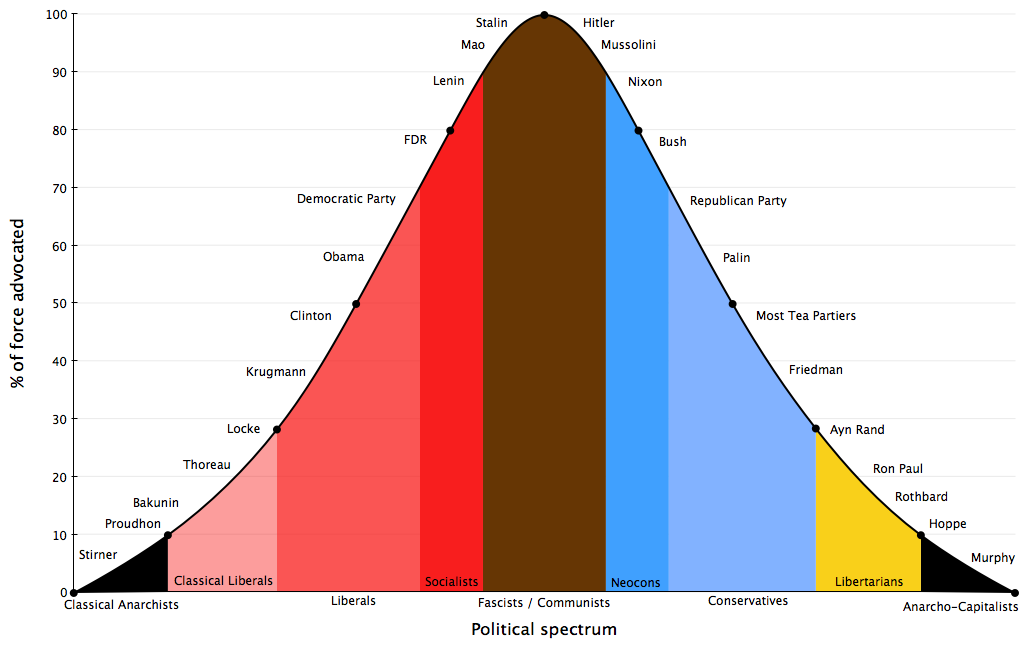
The problem here is that the author of that graph defines Left and Right differently from conventional and accepted definitions. You'll need to check out his website.
For instance, as much as I love Rand Paul and Ron Paul, I fall on the opposite side of Classical Liberalism, because I believe in a LIMITED concept of Positive Rights.
For instance, I believe that government has an OBLIGATION to provide the monetary resources for education to its citizens, because uneducated citizens who are ignorant of their rights, are abused by their government; thus as a barrier against tyranny, I consider education to be right behind the Right to Bear Arms (negative liberty) in opposing tyranny.
However, I also believe that the government
shall have no authority to prescribe, suggest or influence the curriculum. The curriculum would be decided upon by the teachers (respective to their subject), such that all teachers
in a school district are teaching a uniform curriculum.
Certain subjects on the curriculum, that are vulnerable to religious/belief controversy, can be
individually nullified with the Consent of both the parents and the child; such that, the child would be exempt from going to class that day, would be absolved from homework responsibilities concerning the subject, and would be exempt from testing on the subject afterwards. However, this would have to be supplemented by learning an alternate topic of their choosing (within the subject area and appropriate grade/age level). This testing examination would also apply to any State or National testing requirement (enter some sort of code on the scantron/booklet).
Although the system that I described is neither polished nor perfect, it certainly a much more agreeable alternative to what we have today. I have been noticing a trend towards "silent censorship" by omission in American schools, for instance, how is it that I took AP US government (and honors history classes before that), taken two introductory courses in United States history and government at Stony Brook University, and I NEVER HEARD ABOUT THE ANDREW JACKSON BANK WAR? SERIOUSLY WTF! Or pretty much ALL history that relates to the struggles between private (debt) vs government (no debt) centralized banking? It makes people practically impossible to to converse with on these subjects, since they have zero knowledge of them, sometimes making them think that you're making shit up, since they also had the same formal education that you did.
This censorship is also not limited to Centralized Banking, for instance, my highschool AP US history textbook, We the People, The Citizens and the Constitution, talks about Amendments 1, 4, 5, 6, 7, 8 in GREAT DETAIL. Whereas the 2nd Amendment is simply cited as "the right to bear arms." The only other time they mention firearms was about some Supreme Court Case ruling the "interstate commerce clause," and they don't even mentioned the Second Amendment.
Granted that perhaps most people think its best not to talk about firearms in High School (I personally think ever able bodied young boy at age 13 should receive public gun usage and education, AND any females that voluntarily apply), so perhaps that's why its not mentioned there.
So what about my college text book,
American Government, The Essentials, 11th Edition? You'd think that a textbook that is used in 100 and 200 level classes would at least have one paragraph in at least one chapter on the Second Amendment, would you not? Nope.
Then the topic of the 10th Amendment, the textbooks seem to celebrate its death, and they speak incredible praise of the 17th Amendment (popular election of Senators) as if it benefited the nation and produced unheard of results.
Now what about that Ninth Amendment, that wonderful thing that our Founders put their to educate citizens that their Rights are Endowed upon them at Birth by their Creator, that the government can not manufacture rights, but that the government (which at its very best is but a necessary evil) can only deny and disparage your Natural Rights.The Ninth Amendment is only referenced in both books briefly, the "right to marry" is discussed to facilitate discussion concerning the the second implication of the Amendment (we have many many many rights not enumerated), but that's it.
Finally, the Third Amendment. Perhaps it is not mentioned because there are only very few instances of Case Law involving the Third Amendment. Perhaps if we studied the reasons that the Amendment was written, the committees and journal entries concerning it, we would learn more.
For instance, on one ruling of the Third Amendment, the Supreme Court replaces the world "Soldier" with "Agent of the Government." The word agent was CAREFULLY chosen, as it can imply either a Person or Thing: Agent is defined as (from the dictionary):
a·gent -[ey-juhnt] - noun - a person or thing that acts or has the power to act.
Then they interpreted "quartered" and extend it to "unreasonably extended/unlimited stay."
So this is interesting, because if a piece of computer software is installed on your computer (the software is an agent of the government), and remains their to spy on you for an unreasonably extended/unlimited amount of time, would it be covered by the Third Amendment? I cannot honestly answer that question at the moment, for instance, suppose it was a violation of the Third Amendment, would an external (outside the home) form of long-term information gathering, like a wiretap, also be subject to this Amendment?
Perhaps one could further the understanding by declaring that the Software case is a violation of your rights, because it also violates the 4th Amendment, as it acts as a General Search Warrant; whereas the wiretap is specific, it describes the thing (phone) and the objective (to determine who you are talking to and why
However, that would imply that the 4th Amendment was somehow superior to the 3rd Amendment, since the 4th Amendment determines the validity of 3rd Amendment Cases under that precedent, thus relegating the 3rd Amendment as a subset of 4th Amendment Law.
At the same time, one could argue that the case could not originate based on the 4th Amendment alone, thus the 3rd Amendment is at least equal to the 4th Amendment in that particular type of case, and could be seen as an intersection of 3rd and 4th Amendment Law.
Perhaps it looks like I'm an activist judge with these opinions, and guess what, I am. However, judicial activism should only be done to EXTEND the rights of citizens, extend the rights of States against the Federal Government, or to LIMIT the power of federal/state government over citizens, limit the power of State government vs citizens; as
instructed by the Ninth and Tenth Amendments.
Any for of judicial activism that does the following, is
Judicial Tyranny, as they violate the Ninth and Tenth Amendments: Limits the rights of citizens, limit the rights of States vs the Federal Government, expands the power of the federal government over the States or citizens or expands the powers of the State government over the citizens.
----------------------
So anyway, why all this bullshit talk about the 3rd Amendment? Because its appears to be the most censored of all subjects, and the discussions raised above are certainly worth consideration, and in this modern age of rapidly developing and evolving technology, should be a conversation that we're having.
Long story short, I believe that the government should not prescribe, suggest nor influence curriculum, but should supply the general resources, this does not include the textbooks or any educational material. The local taxes would pay for that (and the teachers decide which textbooks).
This is why I differ from Ron Paul and that graph (and several other deep issues).


 )
)