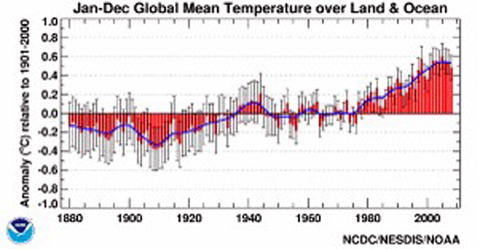
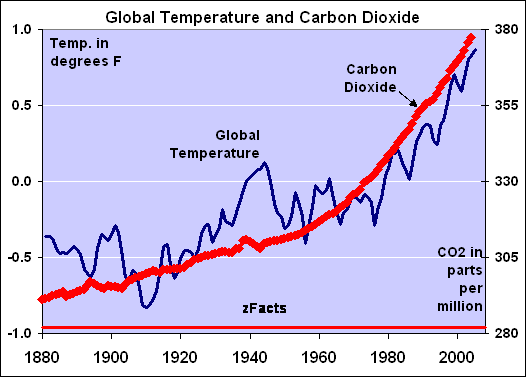
It hasn't "taken a pause". *It is still within the bounds of the predicted variance. *What you can't explain is over 100 years, 1880 to 2000+, of warming that is caused by increasing CO2. *
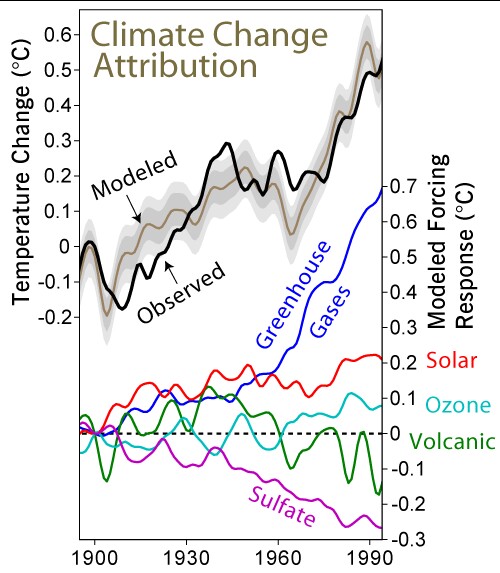
I get it at 0.00922 with Excel, at a p-value that is almost zero, and 76% R^2. *When the IPCC does it, including El Nino, volcanos, sulfates, solar output, and CO2, their's is way better than I could ever hope for. And I know what they are doing, because I know how the science works.
All you have is some rough calculations of based on solar output that the IPCC already includes, and no predictions, no confidence levels, and cherry picking of data. *And you still have, by your calculations, 66% to go.
Why not do it the right way and do the multivariate regressions? *The statistics was developed decades ago.
Horseshit... Complete and utter horseshit...*
The warming HAS taken a pause.. BY ANY measure of significance over at LEAST the last 12 years. We are looking at the 0.0XdegC/decade digit to see any significance.
The only P-value you've ever taken is on the poddy..*
You "get it at 0.00922" FOR WHAT???? exactly..*
If you're talking about the 33% figure that I tossed for TSI influence on surface radiative forcing.. I don't have 66% to go.. I can pull the exact same horseship that your AGW heroes pull and claim that my 33% is AMPLIFIED by their projected Climate Sensitivity amplifications of 4 and 5 that they pulled out of their P-Values on the poddy.
What works for amplifying CO2 --- works to amplify ANY OTHER RADIATIVE FORCING function don't it???
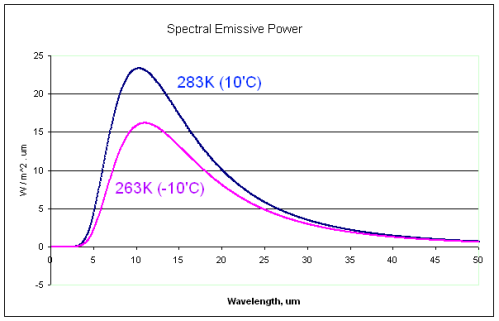
That's the whole point, that CO2 is the major factor in containing the radiative balance between incoming and outgoing heat. *Otherwise, we'd be living on a big snowball.
And while you are simply saying that you can make up any damn number you like, the IPCC says,
Which assigns a probability distribution to both individual and combined anthropogenic values.
Figure TS.5 - AR4 WGI Technical Summary
It specifically says, " (a) Global mean radiative forcings (RF) and their 90% confidence intervals in 2005 for various agents and mechanisms. "
Because, obviously, a) it is a big globe, b) they change with time as the amount of each component has changed over time, c) few things, in this world, are known with absolute precision, especially when they vary according to instantaneous quantity.
And while they do shorten it from "anthropegenic global mean radiative forcing" to simply "global mean radiative forcing", they explicitly state "The net anthropogenic radiative forcing and its range are also shown. Best estimates and uncertainty ranges
can not be obtained by direct addition of individual terms due to the asymmetric uncertainty ranges for some factors;"
And, if we read the glossary of terms, referenced below, they define it as net ... retative to 1750, which makes hardly the absolute value that you would like to use. *There is nothing wrong with your approach, or the words you are using, it just isn't what the IPCC is using.
The difference is that where they, the IPCC, actually puts numbers to individual components, including a 90% confidence level, you simply hide behind vague generalities and completely misrepresent their models.
So, if you are so sure that it is all accounted for by solar variance, then put some numbers where your mouth is. *Come up with a function for temp vs time with a stable radiative forcing factor, one that accounts for the time varing components, that produces*
from
or whatever more recent data you can come up with.
No one doubts that the global mean temperature is primarily driven by solar irradiation. That is where the energy comes from. *It doesn't come from geothermal energy. This is obvious, and not the issue.
**The issue is that the Earth isn't a snowball in space because the atmosphere holds the heat in. *This is apparent for no other reason than the fact that an overcast night stays warmer than a clear and starry night. (clouds, another contribution not fully accounted for).*And, the temperature has risen more than just TSI can account for. *And that increase is due to increasing CO2, offset and added to by other lesser factors, all of which yields the unmistakable conclusion of AWG.
The question is one of accurately determining why the Earth has a reasonably stable temperature and accurately determining how it varies with solar output, CO2, volcanic eruptions, ozone, sulfates, and whatever other causal factors can be determined so we get a prediction as accurate and precise as
And, when different future scenarios are considered, the predicted future temperature is;
instead of some vauge statememts of;
" the 33% figure that I tossed for TSI influence on surface radiative forcing.. I don't have 66% to go.. I can pull the exact same horseship that your AGW heroes pull and claim that my 33% is AMPLIFIED by their projected Climate Sensitivity amplifications of 4 and 5"
Because you may be just pulling 4-5 out of your ass, but the IPCC has a specifically determined value of
"TSI is estimated to be 0.3+/-0.2 Wm-2 for the period of 1750 to the present". Unsuprisingly, it has varied over the century, so their generalized summary value simply reports a range, a range that says nothing about, what exact value they use, at what particular time, in which of a dozen individual models, that combinen to produce an overall estmate of the future climate.
"The understanding of anthropogenic warming and cooling influences on climate has improved since the TAR, leading to
very high confidence that the effect of human activities since 1750 has been
a net positive forcing of +1.6 [+0.6 to +2.4] W m2"
and*
"
The LLGHGs together contribute +2.63 ± 0.26 W m2, which is the dominant radiative forcing term and has the highest level of scientific understanding. *
In contrast, the total direct aerosol, cloud albedo and surface albedo effects that contribute negative forcings are less well understood and have larger uncertainties."
And while they do say,*
"In the TAR,
no estimate of the total combined RF from all anthropogenic forcing agents was given because: a) some of the forcing agents did not have central or best estimates; b) a degree of subjectivity was included in the error estimates; and c) uncertainties associated with the linear additivity assumption and efficacy had not been evaluated. Some of these limitations still apply. However, methods for objectively adding the RF of individual species have been developed (e.g., Schwartz and Andreae, 1996; Boucher and Haywood, 2001). In addition, as efficacies are now better understood and quantified (see Section 2.8.5), and as the linear additivity assumption has been more thoroughly tested (see Section 2.8.4), it becomes scientifically justifiable for RFs from different mechanisms to be combined, with certain exceptions as noted below. Adding together the anthropogenic RF values shown in panel (A) of Figure 2.20 and combining their individual uncertainties gives the probability density functions (PDFs) of RF that are shown in panel (B)."
Which yields,
and with some effort I may be able to find a qualified value of 4-5 with a pdf and confidence interval, it isn't the same as the 4-5, a number that you apparently pulled out of your ass, because unlike the IPCC, you do exactly what you claim everyone else does, make shit up. *You are the only one pulling shit out of your ass.
And on any given day, the IPCC's "
less well understood and have larger uncertainties" is a hell of alot more accurate then your supposed
"exact same horseship ".
And I'm not defending my "AGW heroes". *I couldn't give a crap about whomever they are. I'm simply telling you that you are clueless about how science works. *And, when you finally do the work, and get a clue, you will simply end up doing exactly the same thing as the IPCC because they are using the science that I am "defending".
What I am saying is that any value for total radiative forcing is a backward looking metric that changes constantly due to changes in the compsition of the atmosphere. The IPCC models do not use some overall, constant, number of 4-5. *And any value that might be used, as a first order approximation, to get a general idea idea of things, would be in the form of a pdf. *So you might consider studying the hundred pages, or so, of science behind this 4-5 number that someone else pulled out of their ass.
And while I am certainly ready to entertain the idea of an estimate of global mean radiative forcing pdf, I can find no reference, on the IPCC website, that suggests they use such an animal in their models.
Rather, I get the sense that, instead of reading what the IPCC actually publishes, you bought into some second hand bs that someone else claims the IPCC does, or simply misinterpreted what you read. Because there is simply no scientific case to be made for a single global mean radiative forcing value that can be used for every moment of time over a century of global climate. At best, a mean value for radiative forcing is a backward looking, instantaneous, and over simplified parameter that isn't used in the models.
So I will tell you before hand, that if you manage to find a published IPCC value for instantaneous global mean radiative forcing, unless you show the actual code for the models, my answer will be it isn't what they actually use in the models and they don't use a single overall value.
TS.2.5 Net Global Radiative Forcing, Global Warming Potentials and Patterns of Forcing - AR4 WGI Technical Summary
http://www.grida.no/climate/ipcc_tar/wg1/pdf/TAR-06.pdf
http://www-ramanathan.ucsd.edu/files/pr72.pdf
http://www.ipcc.ch/pdf/glossary/ar4-wg1.pdf