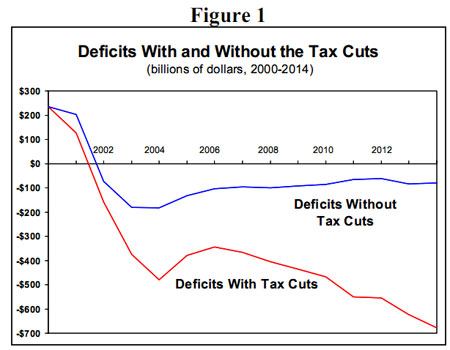
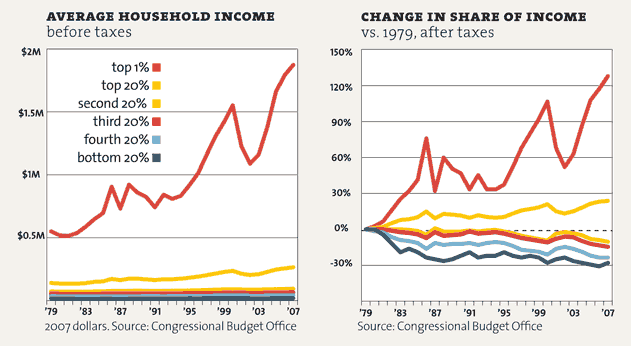
Tax cuts for the wealthy is OK if the country can afford them. When borrowing from foreign banks to fund them.....NOT SO MUCH!
This includes the expenditures associated with the two wars...one totally unnecessary
.................................Total U S Debt.......................................
09/30/2009 $11,909,829,003,511.75
(80% Of All Debt Across 232 Years Borrowed By Reagan And Bushes)
09/30/2008 $10,024,724,896,912.49
(Times Square Debt Clock Modified To Accommodate Tens of Trillions)
09/30/2007 $9,007,653,372,262.48
09/30/2006 $8,506,973,899,215.23
09/30/2005 $7,932,709,661,723.50
09/30/2004 $7,379,052,696,330.32
09/30/2003 $6,783,231,062,743.62
(Second Bush Tax Cuts Enacted Using Reconciliation)
09/30/2002 $6,228,235,965,597.16
09/30/2001 $5,807,463,412,200.06
(First Bush Tax Cuts Enacted Using Reconciliation)
09/30/2000 $5,674,178,209,886.86
(Administration And Congress Arguing About How To Use Surplus)
09/30/1999 $5,656,270,901,615.43
(First Surplus Generated...On Track To Pay Off Debt By 2012)
09/30/1998 $5,526,193,008,897.62
09/30/1997 $5,413,146,011,397.34
09/30/1996 $5,224,810,939,135.73
09/29/1995 $4,973,982,900,709.39
09/30/1994 $4,692,749,910,013.32
09/30/1993 $4,411,488,883,139.38
( Debt Quadrupled By Reagan/Bush41)(President Clinton raised tax rates while he still had a Democrat congress)
09/30/1992 $4,064,620,655,521.66
09/30/1991 $3,665,303,351,697.03
09/28/1990 $3,233,313,451,777.25
09/29/1989 $2,857,430,960,187.32
09/30/1988 $2,602,337,712,041.16
09/30/1987 $2,350,276,890,953.00
09/30/1986 $2,125,302,616,658.42
09/30/1985 $1,823,103,000,000.00
09/30/1984 $1,572,266,000,000.00
09/30/1983 $1,377,210,000,000.00
09/30/1982 $1,142,034,000,000.00
(Total Debt Passes $1 Trillion)((Reagan Slashed Tax Rates To Pre Depression Levels)
09/30/1981 $997,855,000,000.00
Between 1981 and 1992, the national debt held by the public quadrupled. The annual budget deficit grew to $290 billion in 1992, the largest ever, and was projected to grow to more than $455 billion by Fiscal Year (FY) 2000. As a result of the tough and sometimes unpopular choices made by President Clinton, and major deficit reduction legislation passed in 1993 and 1997, we have seen eight consecutive years of fiscal improvement for the first time in America's history.
- Largest Surplus Ever: The surplus in FY 2000 is $237 billion—the third consecutive surplus and the largest surplus ever.
- Largest Three-Year Debt Pay-Down Ever: Between 1998-2000, the publicly held debt was reduced by $363 billion—the largest three-year pay-down in American history. Under Presidents Reagan and Bush, the debt held by the public quadrupled. Under the Clinton-Gore budget, we are on track to pay off the entire publicly held debt on a net basis by 2009.
- Lower Federal Government Spending: After increasing under the previous two administrations, federal government spending as a share of the economy has been cut from 22.2 percent in 1992 to 18 percent in 2000—the lowest level since 1966.
- Reduced Interest Payments on the Debt: In 1993, the net interest payments on the debt held by the public were projected to grow to $348 billion in FY 2000. In 2000, interest payments on the debt were $125 billion lower than projected.
- Americans Benefit from Reduced Debt: Because of fiscal discipline and deficit and debt reduction, it is estimated that a family with a home mortgage of $100,000 might expect to save roughly $2,000 per year in mortgage payments, like a large tax cut.
- Double Digit Growth in Private Investment in Equipment and Software: Lower debt will help maintain strong economic growth and fuel private investments. With government no longer draining resources out of capital markets, private investment in equipment and software averaged 13.3 percent annual growth since 1993, compared to 4.7 percent during 1981 to 1992.
To Establish Fiscal Discipline, President Clinton:
- Enacted the 1993 Deficit Reduction Plan without a Single Republican Vote. Prior to 1993, the debate over fiscal policy often revolved around a false choice between public investment and deficit reduction. The 1993 deficit reduction plan showed that deficit and debt reductions could be accomplished in a progressive way by slashing the deficit in half and making important investments in our future, including education, health care, and science and technology research. The plan included more than $500 billion in deficit reduction. It also cut taxes for 15 million of the hardest-pressed Americans by expanding the Earned Income Tax Credit; created the Direct Student Loan Program; created the first nine Empowerment Zones and first 95 Enterprise Communities; and passed tax cuts for small businesses and research and development.
- Negotiated the Balanced Budget Agreement of 1997. In his 1997 State of the Union address, President Clinton announced his plan to balance the budget for the first time in 27 years. Later that year, he signed the Balanced Budget Act of 1997, a major bipartisan agreement to eliminate the national budget deficit, create the conditions for economic growth, and invest in the education and health of our people. It provided middle-class tax relief with a $500 per child tax credit and the Hope Scholarship and Lifetime Learning tax credits for college. It also created the Children's Health Insurance Program to serve up to 5 million children and made landmark investments in education initiatives including educational technology, charter schools, Head Start, and Pell Grants. Finally, it added 20 more Empowerment Zones and 20 more rural Enterprise Communities, included the President's plan to revitalize the District of Columbia, and continued welfare reform though $3 billion in new resources to move welfare recipients to private-sector jobs.
- Dedicated the Surplus to Save Social Security and Reduce the National Debt. In his 1998 and 1999 State of the Union addresses, President Clinton called on the nation to save the surplus until the solvency of Social Security is assured. He also repeatedly vetoed large Republican tax cut bills that would have jeopardized our nation's fiscal discipline. The President's actions led to a bipartisan consensus on saving the surplus and paying down the debt.
- Extended Medicare Solvency from 1999 to 2025. When President Clinton took office, Medicare was expected to become insolvent in 1999, then only six years away. The 1993 deficit reduction act dedicated some of the taxes paid by Social Security beneficiaries to the Medicare Trust Fund and extended the life of Medicare by three years to 2002. Thanks to additional provisions to combat waste, fraud and abuse and bipartisan cooperation in the 1997 balanced budget agreement, Medicare is now expected to remain solvent until 2025.
OH am I so glad you offered this because NOT ONE Place in your one sided diatribe did YOU mention all these things that occurred THAT if we had NOT the tax cuts or George Bush as president not only would the economy really really be bad but Americans would have been in such a total state of despair ...i.e. what would have happened if we had Obama as President WhO BLAMES Americans for everything!
But of course NOTHING else was happening in the USA from 2001 to 2008.
Just the big bad Bush not reigning in the big bad banks! YUP all that dummy Bush's fault right?
But wait... seems to me there were a few other events going on during this time. Events that had never happened in one presidency in USA history.
Just as a reminder as I've had to do numerous times because people forget!
Recession Are you aware that a recession started under Clinton and became official 3/01 ended 11/01?
Because you don't seem to comprehend... RECESSIONS are like football length tankers... it takes miles to turn one...i.e. so does
a "RECESSION"... it doesn't just start the day NBER states... it is a slow degradation and it started under CLINTON!!!
Source:
USATODAY.com - It's official: 2001 recession only lasted eight months
A Major $5 trillion market loss Are you aware that the dot.com bust occurred and cost $5 trillion in market losses?
AND GUESS WHAT LOSSES shelter other income from taxes! So during the past few years these $5 trillion in losses have been against tax payments!
Again Clinton laid claim BUT someone had to pay and it occurred during Bush's first year!
$5 trillion in market losses MEAN lost tax revenue
PLUS JOBS!!!!
According to the Los Angeles Times, when the dot-com bubble burst, it wiped out $5 trillion dollars in market value for tech companies. More than half of the Internet companies created since 1995 were gone by 2004 - and hundreds of thousands of skilled technology workers were out of jobs.
Source:
The dot-com bubble: How to lose $5 trillion
The worst attacks on the USA in History.. 3,000 deaths!!!
Obviously most of you are UNAWARE 9/11 cost 3,000 lives,
$2 trillion in lost businesses,market values assets.
Jobs lost in New York owing to the attacks: 146,100 JUST in New York.
Are you aware this happened???
Year 2001: September 11 Terrorist Attacks
The 9/11 terrorist attacks were the events that helped shape other financial events of the decade. After that terrible day in September 2001, our economic climate was never to be the same again. It was
only the third time in history that the New York Stock Exchange was shut down for a period of time. In this case, it was closed from September 10 - 17. Besides the tragic human loss of that day, the economic loss cannot even be estimated. Some estimate that there was over $60 billion in insurance losses alone.
Airlines didn't fly for 3 days!
Approximately 18,000 small businesses were either displaced or destroyed in Lower Manhattan after the Twin Towers fell. There was a buildup in homeland security on all levels. 9/11 caused a catastrophic financial loss for the U.S.
Source:
10 Events That Rocked the Financial World
SO AGAIN you totally ignorant people like you don't seem to know THOSE ARE BUSINESS LOSSES as well as NO INCOME coming in to the
companies!
Remember the Anthrax Attacks...
The 2001 anthrax attacks in the United States, also known as Amerithrax from its Federal Bureau of Investigation (FBI) case name, occurred over the course of several weeks beginning on Tuesday, September 18, 2001, one week after the September 11 attacks. Letters containing anthrax spores were mailed to several news media offices and two DemocraticU.S. Senators, killing five people and infecting 17 others.
I lived through it and like millions had hesitation to open any suspicious envelope. That happened millions of times!
$1 trillion in losses due to the WORST Hurricane SEASONS in history.
Again idiots like you TOTALLY forget these were the worst hurricane SEASONS in history! The worst! No presidency every faced the following:
The worst, Katrina made landfall in Louisiana as a Category 3 in 2005.
It took 1,836 lives and caused $81.2 billion in damages.
It quickly became the biggest natural disaster in U.S. history, almost destroying New Orleans due to severe flooding.
Rank Disaster Year Deaths Damage* $250 Billion in damages in the 8 disasters of the top 15 disasters in history!
1. Hurricane Katrina (LA/MS/AL/FL) 2005 1833 $133,800,000,000
6. Hurricane Ike (TX/LA/MS) 2008 112 $27,000,000,000
7. Hurricane Wilma (FL) 2005 35 $17,100,000,000
8. Hurricane Rita (TX/LA) 2005 119 $17,100,000,000
9. Hurricane Charley (FL) 2004 35 $16,500,000,000
12. Midwest Floods 2008 24 $15,000,000,000
13. Hurricane Ivan (FL/AL) 2004 57 $13,000,000,000
14. 30-State Drought 2002 0 $11,400,000,000
Costliest U.S. Weather Disasters | Weather Underground
THESE events OCCURRED!
YET in SPITE of :
a) 400,000 jobs lost due to Hurricanes Katrina/Rita ,
b) 2,800,000 jobs lost in alone due to 9/11,
c) 300,000 jobs lost due to dot.com busts...
In spite of nearly $8 trillion in lost businesses, market values, destroyed property.. IN SPITE of that:
AFTER the tax cuts Federal Tax REVENUES Increased an average of 9.78% per year!!!
http://www.usgovernmentrevenue.com/yearrev2008_0.html#usgs302
2000 $236.2 billion surplus
2001 $128.2 billion surplus
2002 $157.8 billion deficit.. also 9/11 occurred and tax revenues lowered for years later
2003 $377.6 billion deficit.. BRAND new cabinet Homeland Security, plus loans made to businesses.. again tax revenues down..affect of 9/11
2004 $412.7 billion deficit.. Revenues up by 5.5% spending increased and economy getting back.
2005 $318.3 billion deficit.. revenues up by 14.5% deficit decreasing at rate of 22%
2006 $248.2 billion deficit.. revenues up by 11.7% deficit decrease 22%
2007 $160.7 billion deficit.. revenues up by 6.7% deficit decrease 35%
2008 $458.6 billion deficit.. revenues down and deficit INCREASED TARP loan mostly...
Historical Federal Receipt and Outlay Summary
Largest Gross Domestic Product in history!!
When Bush took office in 2001 GDP was $12.355,271,000,000
when Bush left office in 2008 GDP was $14,359,490,000,000
A 16% increase in GDP or $2 TRILLION.
So how did those 4 gigantic events affect the Gross Domestic Product from 2000 to 2009?
So starting in 2001 132,548,000 people were working.
At the end of 2008 138,056,000 people working..
So I would say GWB was fairly involved in the above YET his administration tried:
"Over the past six years, the President and his Administration have not only warned of the systemic consequences of failure to reform GSEs but also put forward thoughtful plans to reduce the risk that either Fannie Mae or Freddie Mac would encounter such difficulties.
President Bush publicly called for GSE reform at least 17 times in 2008 alone before Congress acted.
Unfortunately, these warnings went unheeded and even ridiculed :
, as the President's repeated attempts to reform the supervision of these entities were thwarted by the legislative maneuvering of those who emphatically denied there were problems.
Many prominent Democrats, including House Finance Chairman Barney Frank, opposed any legislation correcting the risks posed by GSEs.
* House Financial Services Committee Chairman Barney Frank (D-MA) criticized
the President's warning saying:
"these two entities - Fannie Mae and Freddie Mac - are not facing any kind of financial crisis .
The more people exaggerate these problems,
the more pressure there is on these companies, the less we will see in terms of affordable housing."...
(Stephen Labaton, "New Agency Proposed To Oversee Freddie Mac And Fannie Mae," New York Times, 9/11/03)
* Senate Committee on Banking, Housing and Urban Affairs Chairman Christopher Dodd also ignored the President's warnings and
called on him to "immediately reconsider his ill-advised" position. Eric Dash, "Fannie Mae's Offer To Help Ease Credit Squeeze
Is Rejected, As Critics Complain Of Opportunism," New York Times, 8/11/07)
Barney Frank's Fannie and Freddie Muddle
Setting the Record Straight: The Three Most Egregious Claims In The New York Times Article On The Housing Crisis