You know, where you said that the world had been cooling for 5,000 years and then infer that the world was going to cool for another 20,000 years
No, I showed you the studies that said that, causing you to cut and run.
Here, I'll post it again, so you can run from it again. I'd prefer you had addressed it in the original thread, but if you're going to threadstalk me, I'll have to demonstrate your propensity to run on each new thread. Hopefully, you'll eventually figure out that threadstalking me is a bad idea.
---
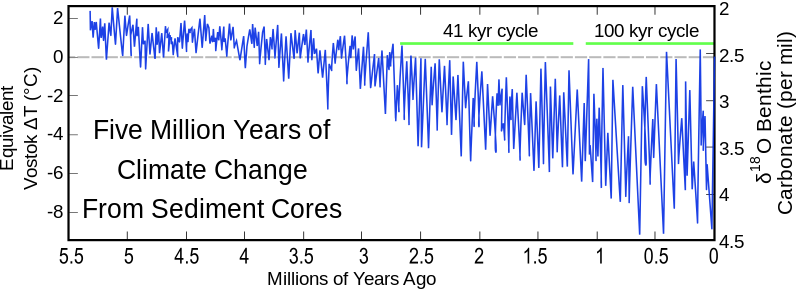
This image comes from
http://lorraine-lisiecki.com/LisieckiRaymo2005.pdf
Note the current 100 kyear ice age cycles. That would give us 50 kyears.
This Nature article places it at 28,000 years for the interglacial length. Note that I said cooling, not interglacial length, and that the cooling would go on after the interglacial was over.
WebCite query result
---
The interglacial stage following Termination V was exceptionally long -- 28,000 years compared to, for example, the 12,000 years recorded so far in the present interglacial period. Given the similarities between this earlier warm period and today, our results may imply that without human intervention, a climate similar to the present one would extend well into the future
---
This paper calls for a much longer period, a 100kyear cycle, giving us at least 50k years until the next ice age.
https://pangea.stanford.edu/research/Oceans/GES290/Rial1999.pdf
Pacemaking the Ice Ages by Frequency Modulation of Earth’s Orbital Eccentricity
---
Evidence from power spectra of deep-sea oxygen isotope time series suggests
that the climate system of Earth responds nonlinearly to astronomical forcing
by frequency modulating eccentricity-related variations in insolation. With the
help of a simple model, it is shown that frequency modulation of the approx-
imate 100,000-year eccentricity cycles by the 413,000-year component ac-
counts for the variable duration of the ice ages, the multiple-peak character of
the time series spectra, and the notorious absence of significant spectral am-
plitude at the 413,000-year period. The observed spectra are consistent with
the classic Milankovitch theories of insolation, so that climate forcing by
100,000-year variations in orbital inclination that cause periodic dust accretion
appear unnecessary.
---




 of stupid to keep repeating what the Koch brothers paid a specific people to repeat.


