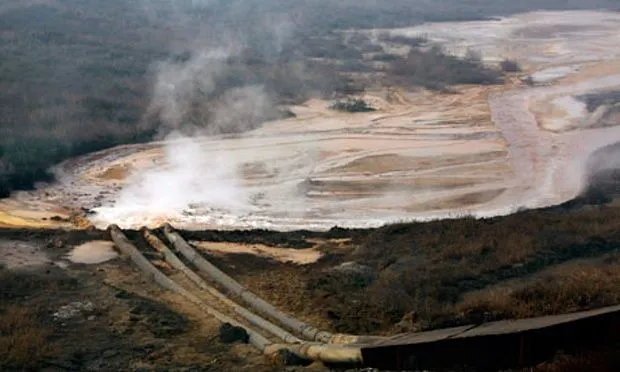
‘It turned into a mountain that towered over us,’ says Mr Su. ‘Anything we planted just withered, then our animals started to sicken and die.’
People too began to suffer. Dalahai villagers say their teeth began to fall out, their hair turned white at unusually young ages, and they suffered from severe skin and respiratory diseases. Children were born with soft bones and cancer rates rocketed.
Official studies carried out five years ago in Dalahai village confirmed there were unusually high rates of cancer along with high rates of osteoporosis and skin and respiratory diseases. The lake’s radiation levels are ten times higher than in the surrounding countryside, the studies found.
As the wind industry grows, these horrors will likely only get worse. Growth in the wind industry could raise demand for neodymium by as much as 700 percent over the next 25 years, while demand for dysprosium could increase by 2,600 percent, according to a recent
MIT study. The more wind turbines pop up in America, the more people in China are likely to suffer due to China’s policies. Or as the
Daily Mail put it, every turbine we erect contributes to “a vast man-made lake of poison in northern China.”
Big Wind’s Dependence on China’s “Toxic Lakes”
The wind industry requires an astounding amount of rare earth minerals, primarily neodymium and dysprosium, which are key components of the magnets used in modern wind turbines. Developed by
GE in 1982,
neodymium magnets are manufactured in many shapes and sizes for numerous purposes. One of their most common uses is in the generators of wind turbines.
Estimates of the exact amount of rare earth minerals in wind turbines vary, but in any case the numbers are staggering. According to the
Bulletin of Atomic Sciences, a 2 megawatt (MW) wind turbine contains about 800 pounds of neodymium and 130 pounds of dysprosium. The MIT study cited above estimates that a 2 MW wind turbine contains about 752 pounds of rare earth minerals.
To quantify this in terms of environmental damages, consider that mining one ton of rare earth minerals produces about one ton of
radioactive waste, according to the Institute for the Analysis of Global Security. In 2012, the U.S.
added a record 13,131 MW of wind generating capacity. That means that between 4.9 million pounds (using MIT’s estimate) and 6.1 million pounds (using the Bulletin of Atomic Science’s estimate) of rare earths were used in wind turbines installed in 2012. It also means that between 4.9 million and 6.1 million pounds of radioactive waste were created to make these wind turbines.
For perspective, America’s nuclear industry produces between
4.4 million and 5 million pounds of spent nuclear fuel each year. That means the U.S. wind industry may well have created more radioactive waste last year than our entire nuclear industry produced in spent fuel. In this sense, the nuclear industry seems to be doing more with less: nuclear energy comprised about
one-fifth of America’s electrical generation in 2012, while wind accounted for just
3.5 percent of all electricity generated in the United States.
While nuclear storage remains an important issue for many U.S. environmentalists, few are paying attention to the wind industry’s less efficient and less transparent use of radioactive material via rare earth mineral excavation in China. The U.S. nuclear industry employs numerous safeguards to ensure that spent nuclear fuel is stored safely. In 2010, the Obama administration withdrew funding for
Yucca Mountain, the only permanent storage site for the country’s nuclear waste authorized by federal law. Lacking a permanent solution, nuclear energy companies have used specially designed pools at individual reactor sites. On the other hand, China has cut mining permits and imposed export quotas, but is only now
beginning to draft rules to prevent illegal mining and reduce pollution. America may not have a perfect solution to nuclear storage, but it sure beats disposing of radioactive material in
toxic lakes like near Baotou, China.
Not only do rare earths create radioactive waste residue, but
according to the Chinese Society for Rare Earths, “one ton of calcined rare earth ore generates 9,600 to 12,000 cubic meters (339,021 to 423,776 cubic feet) of waste gas containing dust concentrate, hydrofluoric acid, sulfur dioxide, and sulfuric acid, [and] approximately 75 cubic meters (2,649 cubic feet) of acidic wastewater.”