Three
Last step. Now there is a third critique, lead by Andrew Bigg of AEI, which says that doesnt get the entire costs of providing benefits because most state and local employees also become eligible for defined-benefit pensions and health benefits in retirement. But state and local governments havent come close to fully funding these obligations. That means that the amount government employers spend today may be well less than what employees will actually receive when they retire. He believes this is not the case for private employers, hence government workers are likely overpaid.
Lets hand the microphone to the National Institute on Retirement, which is specifically addressing Biggs claims (my bold):
Some have argued that because many public pension plans around the country are not fully funded, the entire cost of defined benefit (DB) pension benefits is not recognized in the data we used in our study, which comes from the National Compensation Survey (NCS). While the NCS, like any survey, does have some limitations, it remains the definitive source researchers use for assessing the cost to employers of non-wage benefits
In other words, if an employer fails to fully pay for the benefits accrued in any given year, than it is possible that the cost of the pension benefitand therefore, the full cost of employee compensationmay be slightly understated in the data. The corollary to this is that if an employers contributions to a pension plan exceed the cost of benefits accrued in that year, the NCS will overstate the cost. Because employer contributions can vary with the funded status of the plan, which in turn, is driven by macro-economic factors like theperformance of stock and bond markets, there may be a cyclical bias in the data. Over time, though, these over- or under-estimates should average out, which is why we used an average (from 2004 to 2008) of benefit costs, rather than a point estimate in our analysis. Moreover, it is important to note that any bias (positive or negative) would apply equally to public or private sector employers.
So, claims that our analysis systematically understates costs for public employers are invalid on this basis.
Similarly, claims that our study should have added the value of the entire unfunded liability (of state and local government DB plans) onto a single years compensation costs are completely off base. Any analysis that does so will reach conclusions that are equally inappropriate and flawed.
First, an unfunded liability represents all accrued benefits, from all years past, that are not currently funded. Yet the point of the analysis is to compare the cost of annual compensation. Therefore, it is inappropriate to include the entire unfunded liability from all prior years into the calculation of the cost of benefits in a single year.
Second, even if one felt that incorporating the cost of unfunded liabilities served a purpose (notwithstanding that this is not how economists define current compensation), one would have to apply the same standard to the private sector side of the analysis, too. Currently, many private sector DB plans have unfunded liabilitiesa result of the recent stock market downturn that affected investors of all stripes. If the idea is to compare public and private pension costs in a fair, apples to apples manner, then the unfunded liabilities of private sector pensions should be calculated as well.
Third, adding the expected annual cost of paying off unfunded liabilities (even under the worst-case scenario) would not change the result.
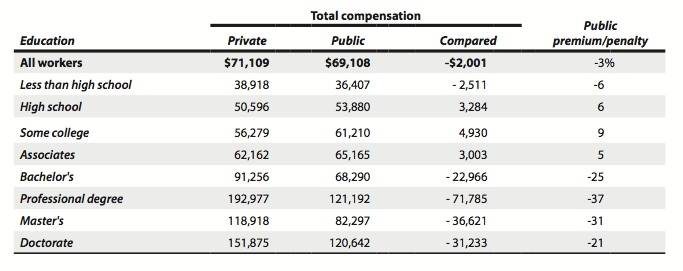
The Center for Retirement Research at Boston College recently calculated that it will cost states on average just 2.2% of payrolls to pay off their entire unfunded liability over 30 years. In the Out of Balance report, we found that total compensation is 6.8% lower for state government employees and 7.4% lower for local government employees than for comparable private sector workers. So, even if we were to add 2.2% of payroll to state and local employee compensationwhich would pay off the entire unfunded liabilitystate and local workers would still be paid 4.6% and 5.2% less, respectively, than their private sector counterparts.
In conclusion, the results of the Out of Balance study stand up to scrutiny. Even acknowledging the additional contributions that will be required to restore pensions to full funding does not alter the ultimate findings of the study. State and local employees still receive significantly less total compensation than their counterparts in the private sector.
Posted on July 19, 2010 by: Keith A. Bender, Associate Professor and John S. Heywood, Distinguished Professor; Department of Economics, University of Wisconsin-Milwaukee.
The idea that the private market pensions are in tip-top shape doesnt strike me as accurate, and piling on the entire unfunded liability into a single year is, of course, going to distort the scales and not focus on the specific hypothesis testing that is being carried out. And yes, even if we were expecting to pay off the entire unfunded liability we are talking about 2.2% of payroll, still less than what NIR, EPI and others found as the pay gap.