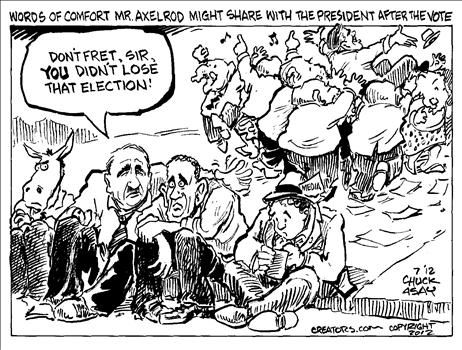
"Clearly, in his Virginia speech, President Obama was making a point about the way infrastructure supports business and the interconnectedness of the economy and government with personal success and hard work. But, you see, he accidentally said "that" at one point when he meant "those." So release the hounds."
"...hanging your attack on a person's slight grammatical misstep is what people do in an argument when they're completely fucked and know they have no argument."
Jon Stewart Slams You-Didn't-Build-That-Gate In Romney, Fox News' Faces (VIDEO)
Again -- the context in the speech makes it EXTREMELY unlikely that this was misinterpreted. He started out by asserting that "a lot of folks work hard" and that all sweat equity is approximately equal.. Same thing with "there's a lot of smart folks".. Thus minimizing the focus, risk, resolution and creativity of folks that DRIVE a biz to success.
NONE OF THE FOLLOWING comments about who provides "roads and bridges" or "you didn't build that" would mean anything --- until you make the Collectivist assertion that biz leaders contribute nothing special to the venture.
NOT out of context.. Not " a slight grammatical misstep".. It was a complete Collectivist primer of all Hard Work is equal, risk and creativity don't matter, and you owe the Collective more money.. The bill is in the mail.
You really don't understand the context. The comments are in the context of arguing against what Romney and the Republicans are offering to solve our problems. Tax cuts for the rich, privatization of Medicare, and more of the failed 'trickle down' voodoo economics that has not worked, and never will. The President was arguing that, while he was willing to cut government waste, he would not gut investments that grow the economy or give tax breaks to the likes of himself or Romney...AGAIN.
Bush's tax cuts had a expiration date. It is past time to end them. Bush's first Treasury Secretary Paul O'Neill, was fired for disagreeing too many times with Bush's policy on tax cuts.
60 Minutes
The president had promised to cut taxes, and he did. Within six months of taking office, he pushed a trillion dollars worth of tax cuts through Congress.
But O'Neill thought it should have been the end. After 9/11 and the war in Afghanistan, the budget deficit was growing. So at a meeting with the vice president after the mid-term elections in 2002, O'Neill argued against a second round of tax cuts.
"Cheney, at this moment, shows his hand. He says, 'You know, Paul, Reagan proved that deficits don't matter. We won the mid-term elections, this is our due.'
O'Neill is speechless."
"It was not just about not wanting the tax cut. It was about how to use the nation's resources to improve the condition of our society," says O'Neill. "And I thought the weight of working on Social Security and fundamental tax reform was a lot more important than a tax reduction."