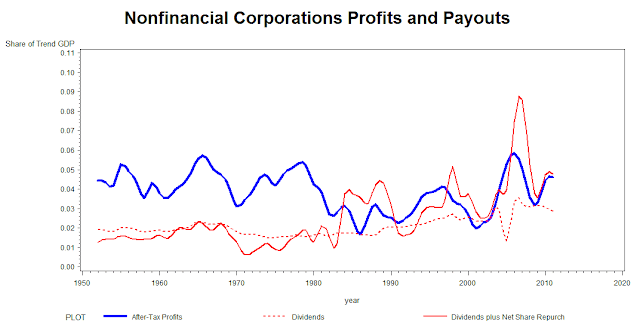
If more businesses were reinvesting their profits maybe the argument to keep profits high would be more convincing, but as a group corporations are not finding anything useful to spend their money on
First, businesses do not "owe"
their money, to anybody, for anything. If others have such "good" ideas, for what to do with those businesses' money; then they could put together a proposal; and woo funding for their entrepreneurial innovation. "Hey man, they've got lots of money" amounts to casing, and robbing, a bank. "Plundering" others' earnings is not productive, nor a sustainable long-term solution. Until somebody innovates another "good idea", should businesses waste their money, on known-to-be 'bad ideas" ?
Second, since 1980, owners (stock-holders) have often made their companies buy back their stock, at bubble-peak prices. From the article you cited:
At the top of every boom [since 1980], there's been a massive round of stock buybacks, which you could think of as shareholders cashing out their bubble wealth.... when shareholders use businesses as ATMs, those businesses' workers and customers get to share the pain.
Thereby, those owners chose to spend
hundreds of billions of dollars, of their businesses' money, to themselves. That is perfectly
legal -- they legally
owned the business. They
could have shut down operations, entirely, and liquidated the entire enterprise. Now, cashing out is not very business-minded.
Hundreds of billions of dollars, which could have been used to expand operations, were used instead to pay off owners. That would not help the businesses, or the workers. But it doesn't directly harm workers either -- they still had jobs, and they still earned their pay. The money used, to buy back stock, came only from retained earnings, after payrolls. Wages were not "raided".
Inexpertly, owners would only be able to cash out once. Perhaps they could make their companies buy back half of their stock; and then make the company do a stock split; and repeat the process. Whilst that does not "raid" wages, that does "raid" the businesses' retained earnings. i guess that is legal; such is neither business minded, nor economically competitive. And if domestic or foreign competition used their retain earnings, to grow their businesses, and capture more market share; then such "selfish" owners would eventually be driven from the market. But owners
own the business. Can they not dispose of the business' assets, as they see fit? As long as wages were not "raided"; then unless "raiding retained earnings" posed a threat to national security, short-business-sited owners mis-managing their businesses, is
legal; does not physically or economically
harm workers. It's not good business, but every manager is not a "Bill Gates". And if workers banded together, and bought stock, then they could influence decisions, and could even own the company themselves, after the next buy-back.
money tends to circulate among the rich instead of trickling down as it is expected to. For example, golf courses might look for employees with a college education
Again, no person or business "owes"
their money, to anybody else. If others want more of their money, then they can offer some valuable good or service in exchange. If i understand your argument, wealthy persons & businesses have lots of money; but do not perceive any profitable projects to spend on. If so, then the current recession reflects allot of "nobody is offering any valuable good or service". If everybody across the country went on strike, and refused to do anything, for anybody; then the US economy would enter a similar recession. Meanwhile, even as "nobody is offering anything valuable", "everybody is eyeing O.P.M." That is not economically legitimate. Perhaps people perceive that "voting" take over of O.P.M. is easier than "working" for the same?
More profitable, yes... but I don't think it would make them more competitive unless they actually have something to invest that money in. For many businesses, it's just a zero-sum game between employees and stockholders, which is why many people were upset about the Bain Capital thing.
If all wage & salary workers took pay cuts, then their businesses could cut prices, thereby being more economically competitive, against domestic & foreign alternatives. That could boost US exports, keeping jobs at home, instead of losing them abroad.
There is no zero-sum game between workers & owners. Workers earn their pay. Owners built the company, when they bought their shares (at IPO). They hold legal title to the company. That legal title says they get dividends, and voting rights. As long as they do not "raid" wages & salaries, then they own the business, and can dispose of it to their whim & fancy (unless their exists some pressing Public or national security interest in the business). Ideally, US business owners would care about US businesses remaining economically competitive. If not, then Americans are not good business owners, and they won't wind up owning any businesses. That is economics & business. If US workers think they can do better, then they can buy stock, and become owners, and "do things right". Perhaps some may need to.
It is actually usually banks or venture capitalists who make the decisions on what to invest in; the money could just as easily come from the 'middle class' letting banks take care of their money. And if people just hid their money under their mattress instead of lending to banks, the government could easily and instantly create more money for people to use to invest, as it did in the ineffective "Quantitative easing" programs which injected trillions of dollars into the economy.
... The 'eddies' of money that result when rich people spend their money would just be disrupted so it would trickle down as people expect it should.
i may have been confused. Most of the "savings" in the US economy is accumulated by businesses. Even with the huge increase in personal savings after 2008 (perhaps from people forgoing spending, to pay down home & credit-card debt), businesses still account for three-quarters of all savings; and businesses normally account for much more. Inexpertly,
businesses are the primary
savers, and
investors.
However, although business have a higher rate of
savings (dollars per year), persons have four times the total
net worth (dollars). Businesses earn & save allot more money per year. But businesses soon spend most of those savings, into new capital investments. Meanwhile, persons may have slowly but steadily accumulated more net assets. Foreign dollar holdings are also large. Perhaps banks could offer "pooled CD deposit accounts", wherein many smaller depositors, could combine smaller deposits, as "shares" of larger jumbo CD accounts, which allow banks to lend to businesses (buying their bonds, with the money set aside, in the CD account)? Finding ways, of increasing the supply of loanable funds, to businesses, would reduce interest-rates, increase borrowing, and expand the growth of the private sector.
Taxes and welfare are what is currently used to give the poor money, because the private sector has not created enough jobs. ... If there was no unemployment, there would be no need for unemployment benefits as anyone who lost their job could easily get another one, even if it was just working at a fast food restaurant.
Minimum wage laws prohibit low-pay jobs. Decriminalizing outlawed jobs, by eliminating the minimum wage, could regenerate
millions of jobs.
People can't work for $1 per hour the way they do in China because housing is too expensive in the US.
earning
some income is better than earning
no income. Some is always better than none. Poor people cannot be harmed, by offering them "at least something". Perhaps businesses could hire workers at minimum wage, and pay them for fewer hours, than they actually worked?
there are 18 million empty homes in the US
The US Census Bureau reports "household income" (HI). Evidently, "households" implies home dwellers, 75 million of whom are owners, and 40 million of whom are renters. If so, then perhaps HI excludes apartment renters?