about 1/3 of the income of the top 1% is from capital gains, the rest is earned from work..? Not sure exactly how much of those capital gains would be from corporate profit. For example, if someone gets advice from a financial company like Goldman Sachs, buys some stocks for $100k, and then those stocks are bought by another company for $120k... I believe that stock purchase would be included in that company's cost of business and would decrease profit?
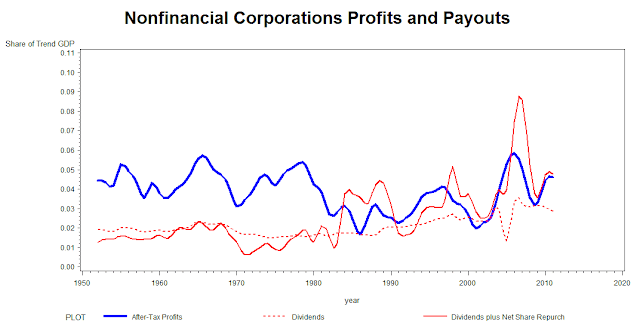
borrowing terms from international economics, buying shares of stock is a "portfolio investment", buying up legal titles to (partial) shares of businesses. Those monies would be spent from the business' "corporate profits, after tax, un-distributed [as dividends]",
i.e. "retained profits" (for lack of better words). If, instead, they bought a factory or machines; then such expenditures would be "direct investment", directly (?) into "capital assets" (machines, factories). Either way, the purchase of "capital assets" (machines, factories), or "portfolio assets" (stock), would come from "retained profit".
So the reason that the spending of the rich does not 'trickle down' to the rest of the economy... is that other rich people end up with money from corporate profits AND also from working and getting high salaries (like the $200k+ at many financial companies).
inexpertly, money "
trickles down" from rich to poor, when the rich
spend (tips at expensive restaurants & golf courses, fancy clothes, luxury cars). But, by definition, the rich are those who earn so much money, that they
cannot spend it all. So, they wind up with official "
savings". Ideally,
entrepreneurs innovate "good ideas"; borrow money from those "savings" (S) as "investment" (S --> I) in their startup; and everybody winds up making products, and generating wealth:
- trickle down = spending of wealthy (limited)
- venture capitalism = (re-invested) saving of wealthy (less limited)
Somebody needs to innovate another "good (and
productive) idea", worthy of rich peoples'
saved money, as an
investment. Until they do, unproductive,
ipso facto unprofitable,
speculation may run rampant. Speculation is non-profitable; does not generate wealth; merely transfers wealth, to the "starters of the fad", from the "last suckers in". Rampant speculation seemingly implies, that there is more money accumulated in savings, than actually-productive-and-profitable "good ideas", of entrepreneurs.
(Meanwhile, all the "Mr. Ponzi's" know where to go.)
The only reason corporate profits are not higher is that companies pay some people very high salaries.
reductions in wages & salaries, "from factory floor to office high-rise", would make US businesses more profitable, and more competitive
wealth travels from the poor to the rich
money flows to rich & poor. But, more money flows to rich, than to poor. And, the poor live "hand to mouth", re-
spending their incomes, almost as fast as they earn them. So, poor have a
low savings rate. Meanwhile, rich earn
much more, and spend only
some more. So, rich have a
high savings rate.
Saying that "wealth travels from the poor to the rich" seems mis-leading. Rich people don't mug poor people, and take their money.
Money flows to everybody;
more money flows to the rich; the rich
save more money ("they earn more than they know how to spend").
Entrepreneurs innovate "good ideas", to produce profitable products, generating jobs & wealth. Rich savers then invest in those "good ideas", actualizing those profits, jobs, & wealth. Inexpertly, the crucial requirement, is the recycling & recirculation of savings (of 'rich' people, by definition), as investment, back into the economy:
S --> I
Precisely, because if the government did not poor people would have no money.
you describe a "public sector approach", taking rich people's savings as taxes, and spending them on welfare:
S --> T --> C
previously i described a "private sector approach", wooing rich people's savings as investment, and spending them on innovative entrepreneurial "good ideas":
S --> I
The former promotes
personal consumption spending, on "more small stuff" (haircuts, shoes, TVs). The latter promotes
investment, on "
big stuff" (machines, factories). The former promotes "more of the same" (more shoes, more TVs). The latter promotes "something
new & different" (new machines, new factories, for new products).
Now, the "public sector approach"
can be productive, and profitable, when the taxes taken are spent on large-scale
Public Investments,
e.g. highways & internet:
S --> T --> I
The
profitable Public programs, to which Pres. Obama & Senator-candidate Elizabeth Warren have referred recently, are
Public Investments, on productive-and-so-profitable "
huge stuff" (thousands of miles of roads & computer cables). The net value of
Public Investments (
S --> T --> I), into productive-and-profitable assets, does not logically imply the net value, of
welfare (
S --> T --> C). "Huge new & different Public Investments have been good" does not imply that "more welfare transfers for shoes, clothes, & TVs" will be worth the while.
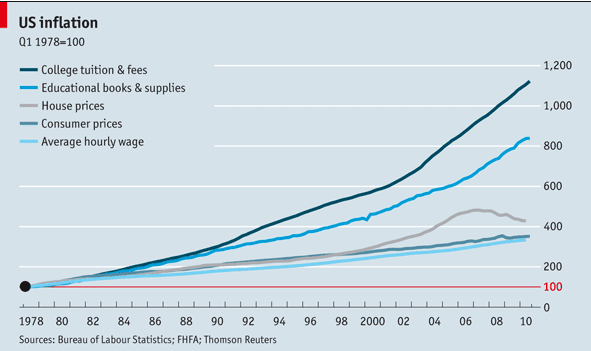
Wages have kept pace with prices. Even house prices are returning to historic trend levels, from their 2006 "bubble" peak. College costs are not necessary. Or, if college is necessary for a "modern workforce", then perhaps Public Education could be extended, to college level. Such a proposal would require careful consideration.
It DOES hurt the average person if the top 1% of wealth go from having 131 times as much as the median wealth (1983) to having 225 times as much wealth (2009).
you getting mugged, and losing your money,
hurts you. Somebody "way over their winning the lottery"
helps them. But their boon is not your bain, and their gain is not your loss -- except for some psychological sensation of "Envy".
wasn't there a more recent study that found that only the top 10% of income have benefited during the recovery, and the income of everyone else has actually fallen?
On average, over the past year, real wages (adjusted for inflation) have increased +2%, whilst some measures of inflation report +3% rise in prices. So, perhaps real wages have fallen by a
penny per dollar. During a "Great Recession", with millions of people out of work entirely, the working majority complaining about
pennies on dollars is
not legitimate.
The minimum wage outlaws millions of low-paying jobs. Eliminating minimum wages would regenerate those jobs, earning
many people
some money.
I will note that the top 10% of income get 47% of all income so the bottom 90% is left with the rest, with most of that in turn concentrated in the upper half of the population (meaning that 3% of consumer expenditures can be quite high as a proportion of income for certain population segments)
that's good thinking
from 2007 to 2010, there was an increase of 2.3 million households paying more than half of their income for housing (what they define as "severly burdened"); that brings it to a total of 20.2 million.
27 percent of renters fall into this severly burdened category, with homeowners roughly half that number.
In the US, there are 115 million
households, of which 75 million are
homeowners. If the remainder are
renters (40 million), then about 10 million
renters are "severely burdened". That would leave (the other) 10 million "severely burdened"
households, as
homeowners. And, indeed, 10 million homeowners is about 13% (half of 27%) of the aforesaid 75 million homeowners. So, these numbers seem to jive. In the US, more than
one in six legal
households is "severely burdened" by housing costs (
one in four renters,
one in eight homeowners).
Meanwhile, due to the countrywide housing bubble in the mid 2000s, millions of now-foreclosed homes were built, across the country. Somehow, there is an over-supply of rentable homes, which is not reducing housing
costs, relative to
incomes. Either all the homes were built in "all the wrong places", or incomes are not recovering from the recession. Eliminating minimum wages would regenerate millions of jobs, giving
many low-income renters & leasers
some money.
"Woe is me" does
not imply "you (or anybody) owe(s) me". Eliminating minimum wages would regenerate millions of ways for impoverished people to improve their lot, at least a little.