rylah
Gold Member
- Jun 10, 2015
- 24,355
- 5,238
- 290
- Thread starter
- #441
New study: BDS activists hostile toward Jewish students, not just Israel
For many years we’ve been documenting anti-Israel activity on U.S. university and college campuses, typically part of the Boycott, Divestment and Sanctions (BDS) movement and carried out by student groups like Students for Justice in Palestine.
In these prior posts we’ve described many instances when this Israel-related activism has crossed over the line into blatant anti-Jewish animus, including at schools as diverse as Vassar, Oberlin, and University of Illinois.
It’s important to “unmask” the SJP student chapters, including how many of them launch attacksagainst Jewish and Zionist students, try to shut down programming about Israel and even Jewish-themed events and guest speaker events involving non-Jews that are hosted by Hillel and other Jewish campus groups, and deliberately work to ostracize and exclude pro-Israel students from various campus activities.
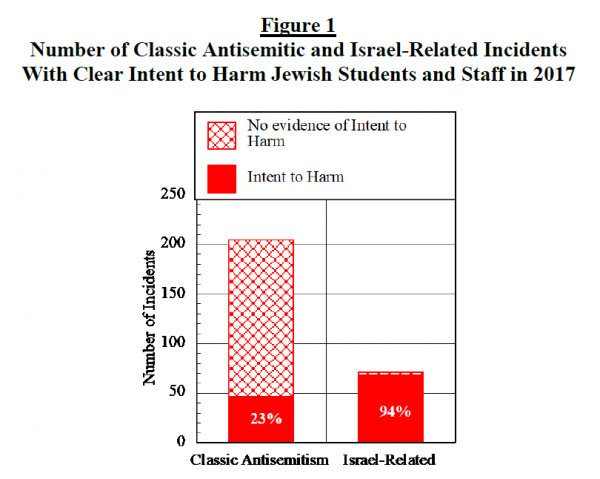
Now a new AMCHA Initiative study (pdf.) released last week provides further empirical confirmation of how this Israel-related harassment and intimidation is contributing to an increasingly hostile campus environment for Jewish students—even more so than do incidents involving ‘classic’ antisemitism (i.e., instances of Nazi swastika graffiti).
This new AMCHA study is important because it highlights how BDS isn't only directed against Israeli academic institutions but also targets individuals for harm. As the report shows, an increasingly prominent feature of BDS on American campuses is not only the promotion of the boycott of Israel, but also the boycotting of actual Jewish students and student groups
Researchers differentiated between incidents that deliberately and directly intended to cause harm to Jewish students—like bullying, speech suppression, physical attacks and threats, destruction of property—and incidents where bigoted and prejudicial opinions about Jews and/or Israel were expressed, but without any evidence of an intention to harm.
In addition, AMCHA also coded for whether an incident was carried out by a person acting on his or her own or by more than one person—and whether perpetrators were affiliated with particular campus or off-campus groups.
In addition, AMCHA also coded for whether an incident was carried out by a person acting on his or her own or by more than one person—and whether perpetrators were affiliated with particular campus or off-campus groups.
2.Israel-related incidents are becoming “significantly more flagrant” and are increasingly characterized by a shift from a focus on anti-Israel boycotts and
divestment campaigns to actual boycotts of Jewish students and student groups.
For many years we’ve been documenting anti-Israel activity on U.S. university and college campuses, typically part of the Boycott, Divestment and Sanctions (BDS) movement and carried out by student groups like Students for Justice in Palestine.
In these prior posts we’ve described many instances when this Israel-related activism has crossed over the line into blatant anti-Jewish animus, including at schools as diverse as Vassar, Oberlin, and University of Illinois.
It’s important to “unmask” the SJP student chapters, including how many of them launch attacksagainst Jewish and Zionist students, try to shut down programming about Israel and even Jewish-themed events and guest speaker events involving non-Jews that are hosted by Hillel and other Jewish campus groups, and deliberately work to ostracize and exclude pro-Israel students from various campus activities.
Now a new AMCHA Initiative study (pdf.) released last week provides further empirical confirmation of how this Israel-related harassment and intimidation is contributing to an increasingly hostile campus environment for Jewish students—even more so than do incidents involving ‘classic’ antisemitism (i.e., instances of Nazi swastika graffiti).
This new AMCHA study is important because it highlights how BDS isn't only directed against Israeli academic institutions but also targets individuals for harm. As the report shows, an increasingly prominent feature of BDS on American campuses is not only the promotion of the boycott of Israel, but also the boycotting of actual Jewish students and student groups
Researchers differentiated between incidents that deliberately and directly intended to cause harm to Jewish students—like bullying, speech suppression, physical attacks and threats, destruction of property—and incidents where bigoted and prejudicial opinions about Jews and/or Israel were expressed, but without any evidence of an intention to harm.
In addition, AMCHA also coded for whether an incident was carried out by a person acting on his or her own or by more than one person—and whether perpetrators were affiliated with particular campus or off-campus groups.
"Annual report on anti-Semitic activity on U.S. campuses: Israel-related anti-Semitic incidents were considerably more likely to contribute to a hostile environment for Jewish students than incidents involving classic anti-Semitism Campus Antisemitism Report 2017 – AMCHA Initiative"
— Shmuel Rosner (@rosnersdomain) August 8, 2018
Researchers differentiated between incidents that deliberately and directly intended to cause harm to Jewish students—like bullying, speech suppression, physical attacks and threats, destruction of property—and incidents where bigoted and prejudicial opinions about Jews and/or Israel were expressed, but without any evidence of an intention to harm.— Shmuel Rosner (@rosnersdomain) August 8, 2018
In addition, AMCHA also coded for whether an incident was carried out by a person acting on his or her own or by more than one person—and whether perpetrators were affiliated with particular campus or off-campus groups.
Key Findings of AMCHA’s New Report
Three key findings emerge from the data:
- Israel-related antisemitic incidents are considerably more likely to contribute to a hostile campus atmosphere for Jewish students than are incidents which involve ‘classic’ types of antisemitic expression.
2.Israel-related incidents are becoming “significantly more flagrant” and are increasingly characterized by a shift from a focus on anti-Israel boycotts and
divestment campaigns to actual boycotts of Jewish students and student groups.
- 44% of Israel-related incidents involved behavior designed to silence Jewish and Zionist students, including disrupting or defacing Israel-related events, displays, and trips;
- 76% of Israel-related incidents involved behavior that personally targeted Jewish and Zionist students or groups, denigrating and demonizing them so as to exclude them from campus activities.
Last edited: