An old beast re-awoken, anti-Semitism stalks Europe, US once more
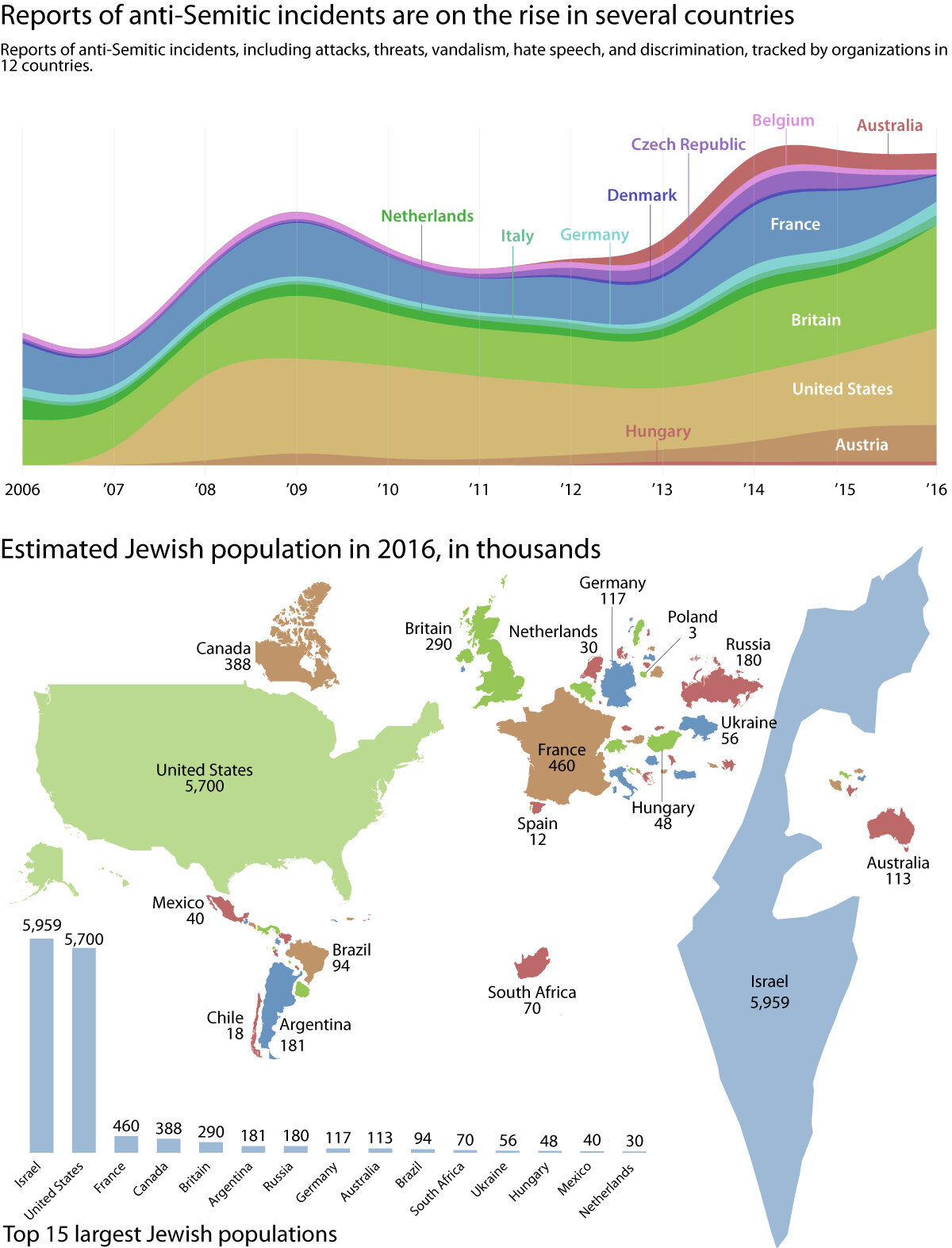
Britain, France, the US, and Hungary have seen upticks in anti-Jewish invective and assaults in recent years. The resurgence of overt anti-Semitism stems from both an awakening of repressed prejudice and a byproduct of anti-Zionism.
An online incubator
In the United States, hundreds of tiki torch-wielding men chanted “Jews will not replace us” and openly displayed Nazi symbols at a “Unite the Right” rally in Charlottesville, Va., last August – even as the number of anti-Semitic incidents in the United States surged nearly 60 percent in 2017.
That was the largest single-year increase on record,
according to a February report by The Anti-Defamation League (ADL), which noted that all 50 states saw an increase in anti-Semitic incidents for the first time in at least a decade.
“Charlottesville was definitely a tipping point, and definitely a wake-up call,” says Cooper.
But having launched a digital “report card” that surveys the amount of hate speech and terror-related content online more than two decades ago, Cooper continues to see the web as the most fertile space for spreading anti-Semitic ideas.
“The internet is a great incubator,” he says. “You can keep ‘The Protocols of Zion’ on life support, and there are new strategies and new languages, new ways to formulate old hatreds. And for the person who once upon a time would never think of saying anything this like this, the internet gives them a chance to express those views without any accountability whatsoever.”
“Remember the bad old days when you just spray painted a church or a synagogue or a mosque, and there was at least a chance that you’d get caught?” Cooper continues. “Today? Do whatever you want, and maybe, if places the Wiesenthal Center and others are doing their jobs, we can get a couple hundred thousand accounts suspended. Well, in a world in which Facebook has 1.5 billion, that’s just a drop in the bucket.”
‘We share a common fate’
Still, over the past year, even in the midst of one of the most significant surges in both anti-Semitic and anti-Muslim violence in the United States, Dr. Afridi has marveled at the corresponding surges in her own work to counteract it.
As a Muslim, she notes her unusual position as head of the
Holocaust, Genocide, and Interfaith Education Center at a Catholic college like Manhattan. And as a scholar who analyzes the tangled intersections of religion and personal identity, she’s made it her ambitious goal to try “to eradicate anti-Semitism in the Muslim community,” she says.
In many ways, Afridi, author of “Shoah through Muslim Eyes,” has focused so much of her life to a typically Jewish cause because of her commitment to one of the most difficult of civic virtues in a liberal democracy: the value of sharing a common life together as equals, even amid the unavoidable human tensions that arise from difference.
Yet despite the growing sense of alarm that has followed the increasing number of anti-Semitic incidents in the US and Europe, there has been a new sense of purpose around the globe, she says.
“I believe what’s remarkable, as Jews are under attack, as Muslims are under attack, instead of segregating our two communities, it has galvanized us to recognize how we must be fighting for the other – and that is a very, very unique phenomenon,” says Rabbi Marc Schneier, who launched the
Foundation for Ethnic Understanding in 1989 to help foster better relations between Muslims and Jews around the globe.
An old beast re-awoken, anti-Semitism stalks Europe, US once more