That they do.
Markets hate uncertainty - and they are starting to hate this president.
Quite frankly, as far as market players and makers are concerned right now, Trump has served his usefulness. He got corporations their nearly 20% statutory tax rate cut.
One need only look at the retaliatory tariffs China has proposed to see who's going to pay for them:
Of the 128 items on the Chinese list:
- ~90 are luxury agricultural products such as dried fruit, nuts and ginseng.
- 32 items involve specialised steel products used in oil and gas production and transport -- an area in which influential Chinese state-owned mills have invested in recent years.
- The rest target pork and scrap aluminium.
While China's soybean tariff has the potential to hike inflation because soybean oil is used fairly broadly for cooking and the beans themselves are a material element in pig feed. That said, I suspect, given the highly focused (well thought out) nature of the tariffs China has proposed, that the demand for soybean is macroeconomically elastic rather than inelastic, thus the incidence of the tax will fall on producers notably more so than on Chinese consumers.
Too, it wouldn't surprise me to discover that those areas that contribute China's overall soybean yield have excess capacity. The unknown factor is the comparative advantage impact. Land used to boost soybean production in China cannot be used for other purposes that return higher gross profits and gross profit margins; however, because China has a command economy, the need for profits isn't at all similar to what it is in the U.S. Lower profits simply mean slower overall economic growth, but slow growth is still growth, and the Chinese culture, unlike Western culture, doesn't scoff at slow-but-steady. After all, China's been growing slowing since the 1950s. A slight drop in their economic expansion isn't going to irk the citizenry there like it annoys Americans, most especially not now that Xi Jinping is leader for life and not subject to the political whims and beefs of the citizenry.
As goes pork, it's worth noting that
Smithfield, the worlds largest pig products company, is predominantly a Chinese firm. That's a lot of soybean eating pigs that won't be eating soybeans subject to China's tariff on U.S. soybeans. Be that as it may, tariffs on American pork exports help breeders
in China, where pig prices are at a cyclical low. But they hit hard in Iowa, home to one-third of US pork production and the
US ambassador to China, former governor Terry Branstad.
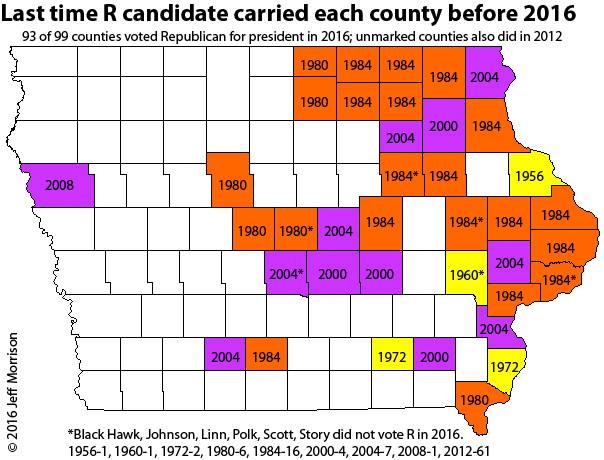
Every county in Iowa saw sharp gains for the GOP/Trump compared to 2012.
But what about other tariffs China has proposed? Well, almonds, and other dried fruits and nuts hit by the Chinese tariffs, are staple products of California’s fertile but drought-prone Central Valley. Farmers there voted heavily for Mr Trump despite the state of California as a whole leaning Democrat.
Clearly, the potential political impact of China's tariff on almonds won't be near what is the one on pork or soybeans. That said, Americans will need to eat a whole lot of Almond Joys and
green bean almondine to make up the difference.
Almond Joy has nuts. Trump just is nuts.
-- Xelor