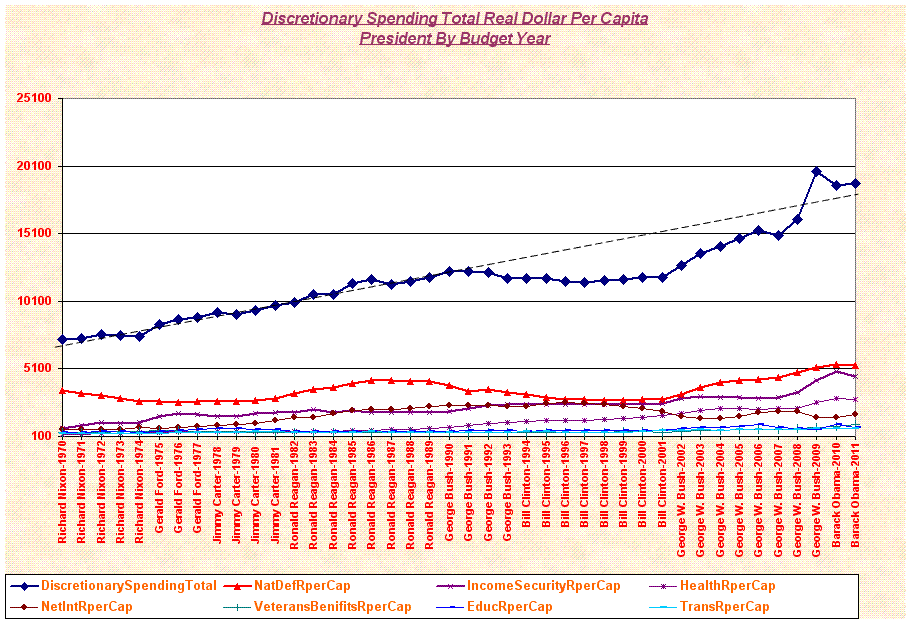
Obviously, more people requires more government to generate the same services, unless they get really efficient along the way.
Oddly, only Bush I and Clinton managed to level off discretionary spending. We went right into a bit of a recession after Clinton was done.
To get the private sector back up and running, Bush II jacked that spending right back up again. And, curiously, by the time Bush and Obama were done, it was right back to the same linear trend it was on at the end of Reagan's term.
Is there a reason why the thing appears to require a constantly expanding govt? I believe there is.
There is an error in thinking in the belief that taxes have any real aggregate negative effect on consumption. It is very simple. What matters is that people are employed. That produces output. We know, obviously, that prices are simply a function of the money supply and the quantity of available goods. More specifically, the prices are a function of after tax, spendable money supply. (After savings too, if there were an aggregate drive towards savings.) Why? Because no one can spend what they don't have to spend.
So, very simply, if everyone pays 10% in taxes, prices adjust to that 90% remaining spendable income. If taxes are 50%, prices adjust to the 50% spendable income. Obviously, there is a wierd limit when it gets closer to 100%.... There has to be some tokens to pass around.
And, obviously, there is an impulse effect when they are raised or lowered. In the economy, rate of change of any factor is far more important than the levels themselves.
Lower taxes by 2% is the same as increasing the money supply by 2%. Everyone suddenly has 2% more to spend and, until the system goes around a couple of cycles, production can increase if there are underutilized production factors. But, after a couple of cycles and after the production factors have become fully utilized, prices simply increase to use up the available spendable money. Prices always increase to consume all available money.
The only time that taxes make a difference is if your taxes are lower than the other guys, lower than the average. Or, when a tax is higher on one good than on another good. The only thing that matters is the relative difference between taxes, not the absolute tax level. (as long as there is enough money floating about to be called a "money supply").
What does matter is what the employment is producing. Obviously, we wouldn't want to shut down food production to have everyone maintaining very clean streets. That is rather dumb. So there can be a crowding out if the gov't draws too much from the labor force.
The only reason that deficit and debt exists is in a failure to collect taxes.
And, according to the actual evidence, the constant and nearly linear historical increase in government expenditures, it looks like it is required.
I really don't know why that is. But ignoring reality seems a bit ignorant.
I'll bet my bottom dollar that, when all is said and done, government expenditures are right on that trend line. The Pubs will have some "reason" that they "had to". And, as always, their constituency will deny it's existence. But the reality is that every congress and presidency, except Bush I and Clinton, have cranked up spending. Eventually, they will figure out that they have to raise taxes to balance the books.
Until then, I wouldn't worry about it. Money, after all, is made of cotton and linen, so it literally grows on bushes. And the electronic kind are created out of thin air.
Here is a longer view of real dollars per cap
[/URL][/img]
Like it or not, since the time of JFK, the government has always had to increase outlays per capita. This is the reality of it.


