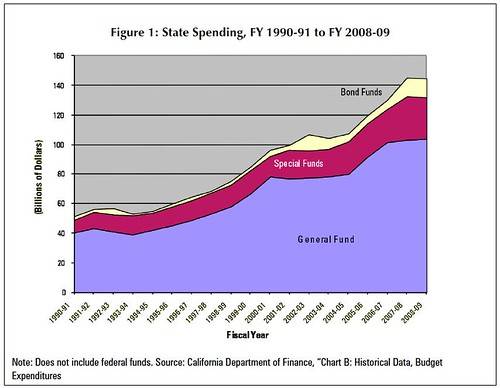
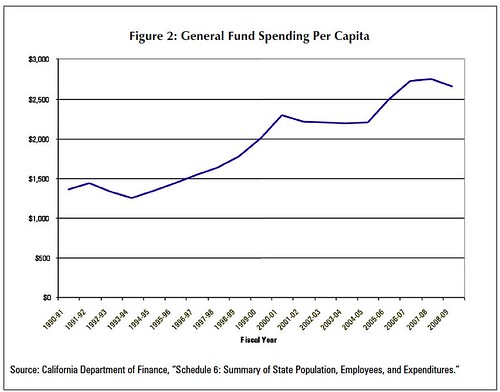
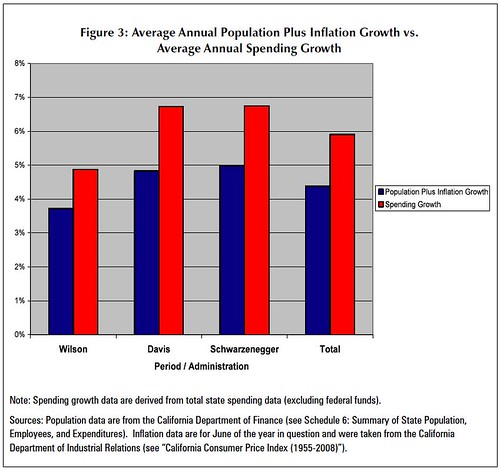
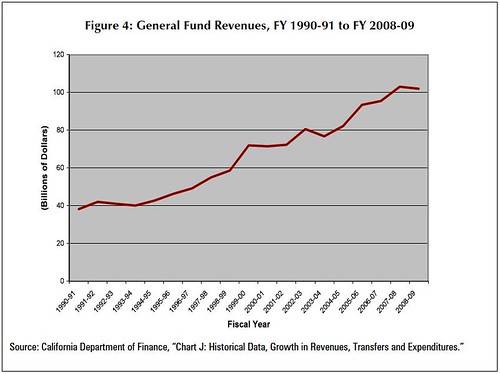
I am trying to get what you mean exactly. They have a 20 billion year to year budget deficit, which all agree is much higher as creative bookkeeping has hid another 3-4 billion.The shortfalls are already forecast out to 2016.
They have set in stone payments that eat up 18-20% (roughly depending on their yearly revenue), so that % can easily go up as revenue continues to sink, bond payments, interest on loans from the feds etc.
Then there's the pension fund obligations, they have underfunded them for the last several years AND they were creatively finagled calculating higher income from the funds accruals than they realized or ever will. They are not sure how much that is exactly but can be between 450 and 500 billion ( Stanford study 6 months ago), thats 6 times the yearly state budget btw, this is defined locked in liability. They have a cash payment due to calpers for 55 billion this coming year.
where is this money you seem to think they have?
I am sure you realize that the study was found flawed by the very people who benefit from that view. the state didn't want to shovel anymore cash than they had/have to into the funds, that they needed elsewhere and don't have spooking the horses or wakjing the rubes whatever anology you wish to employ. Hey let say tit is flowed every study contains some fudge factor, okay lets give them a die variance , of say an incredible 50%..thats still 250 billion.
Calpers job is to keep the herd calm and make/keep the atmosphere conducive to more of the same, more pension spending i.e. raising benefit allowances , pay etc. there by setting up collection of payments they need ( which their investment don't realize and we are on the hook for) at a pace that doesn't shock anyone.
the horse is out of the barn. the state deferred or short paid the system for several years based on the last forecast which didn't exactly stand up, now going forward.......
After crash, one-two punch for pension funds?
By Ed Mendel
Lower investment earnings forecast for CalPERS and CalSTRS could lead to higher costs for state and local governments and an accounting change could put similar pressure on all public pension funds.
The new burdens loom as CalPERS and other public pensions begin to impose higher costs on government employers to cover investment losses in a historic stock market crash.
The giant California Public Employees Retirement System received 10-year earnings forecasts last week (p. 97) from its staff and four consultants averaging 7.29 percent, well below the current assumed rate of 7.75 percent a year.
Investment earnings provide most of the CalPERS revenue, about 75 percent in recent years. Lowering the expected earnings rate would create a gap in the projection of assets needed to meet future pension obligations.
Among the options for closing the gap are higher annual payments to the pension fund from state and local government, riskier investments to get higher yields, higher contributions from workers, and lower pension benefits for new hires.
In the past, the CalPERS staff is said to have worked out earnings forecasts with consultants and presented them to the investment committee with little debate or public discussion.
Now the CalPERS board, which critics say has masked debt with overly optimistic earnings assumptions, is making a point of holding public sessions while preparing to adjust its investment strategy early next year.
We want to be transparent, challenge our assumptions and listen to contrasting views, so we can arrive at a well-considered decision, George Diehr, the CalPERS investment committee chairman, said at a workshop last week.
The CalPERS board, like most public pensions in California, has the power to impose a contribution rate increase that must be paid by employers. Employee contributions usually are determined by labor negotiations.
An exception is the California State Teachers Retirement System, the nations second largest public pension fund, which lacks the power to set employer contribution rates, instead needing legislation.
In a staff recommendation to the board next week, the CalSTRS assumed rate of return on investments would be dropped from 8 percent to 7.5 percent. A consultant, Milliman, had suggested a reduction of a quarter or half percent in February.
CalSTRS has needed a contribution increase equal to 14 percent of pay to reach full funding, nearly doubling the current contribution: school districts 8.25 percent of pay, teachers 8 percent, and state 2 percent.
Lowering earnings to 7.5 percent would boost the contribution increase needed for full funding to 20 percent. Under a 1990 law, the staff report said, lower earnings could produce a shortfall triggering a 0.5 percent state contribution increase, $150 million.
Critics such as the governors pension adviser, David Crane, cite expert investor Warren Buffet and others while arguing that a more realistic earnings rate would be much lower, perhaps around 6 percent.
Corporate pension funds are required to assume earnings based on corporate bond rates, which were averaging 6.4 percent at the end of 2008. Some academics advocate an even lower risk-free government bond rate for calculating pension debt.
A Stanford graduate student study last month used a government bond rate of 4.1 percent to calculate that Californias three big state pension funds (CalPERS, CalSTRS and UC Retirement) have a hidden shortfall of more than $500 billion.
In a similar study last fall, Robert Novy-Marx of the University of Chicago and Joshua Rauh of Northwestern University concluded that the three California state retirement systems were underfunded by $475 billion.
Now the Governmental Accounting Standards Board reportedly will consider asking underfunded public retirement systems to use government bonds when calculating some of their ability to make future pension payments.
The pension funds could use their higher assumed earnings for estimating benefits that could be paid in the future by their current investments. But when the assets and their projected earnings are used up, the calculation switches to government bonds.
In addition, the board also reportedly will consider shortening the time period used in calculating the payment of pension debt, now often 30 years. That could be cut by half in a switch to corporate-style payment period.
Mathematically, it doesnt take a genius to figure out what all this means for public employers, Girard Miller, a pension fund consultant wrote in Governing magazine last week while describing the proposals.
Annual pension budget costs will increase significantly if these rules become effective (probably 2013 at the earliest, judging from the project timetable and past implementation practices), he said.
The tentative decisions posted on the GASB website will be considered at a meeting next month. If the board proceeds with the proposed changes, state and local government groups will be asked for comment.
Six years ago GASB shook up state and local governments by directing that the debt for retiree health care be calculated and reported. Many governments had not been setting aside money for future health care, ignoring mounting long-term obligations.
A governors commission in January 2008 issued the first calculation of the cost of retiree health care promised current stat and local government employees in California: $118 billion over 30 years, $48 billion for the state share.
At the CalPERS workshop last week, even the prospect of a relatively small reduction in the earnings rate was worrisome.
Board member Tony Oliveira, a Kings County supervisor and president of the California State Association of Counties, said local government have a limited ability to pay higher pension costs if earning assumptions are lowered.
Board member Dan Dunmoyer said the option of lowering pension benefits for future employees should be considered if higher pension costs force cuts in other programs or the fiscal health of the state.
rest at-
After crash, one-two punch for pension funds? Calpensions
The state - meaning the people of California - could pay if they chose to. But they choose not to.
Toro, frankly you can that about anything anywhere. choosing to pay for that and not choosing to pay for something else? its not that simple, its a matter of value for one thing, many people ask where is the value in raising taxes to pay for this? And since we have a crunch in just about every other sector why are they first ( well legally they are but just sayin') as compared to other things that need payments to be keep afloat. we can raise taxes but this isn't somehting i think most folks see as a priority. There is only so much money out there and so much of a tax burden you can put on the pop. and still maintain growth we must have.


 needlessly? so everything is hunky dory? so my readjusted 250 billion is no good either? okay, do you have a number? or is this all a about nothing?
  ...unreal man.