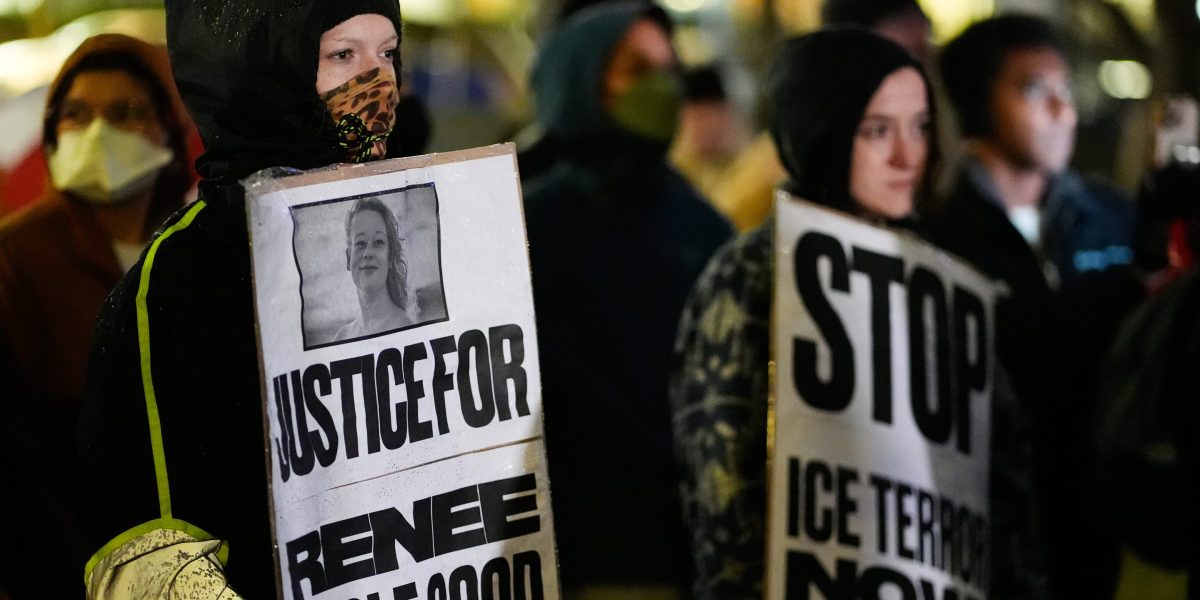
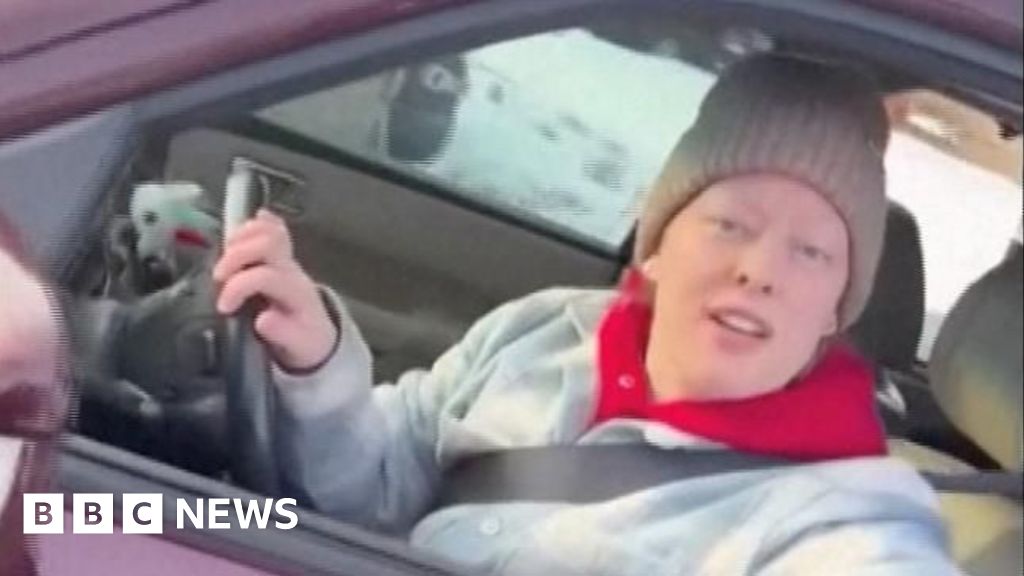
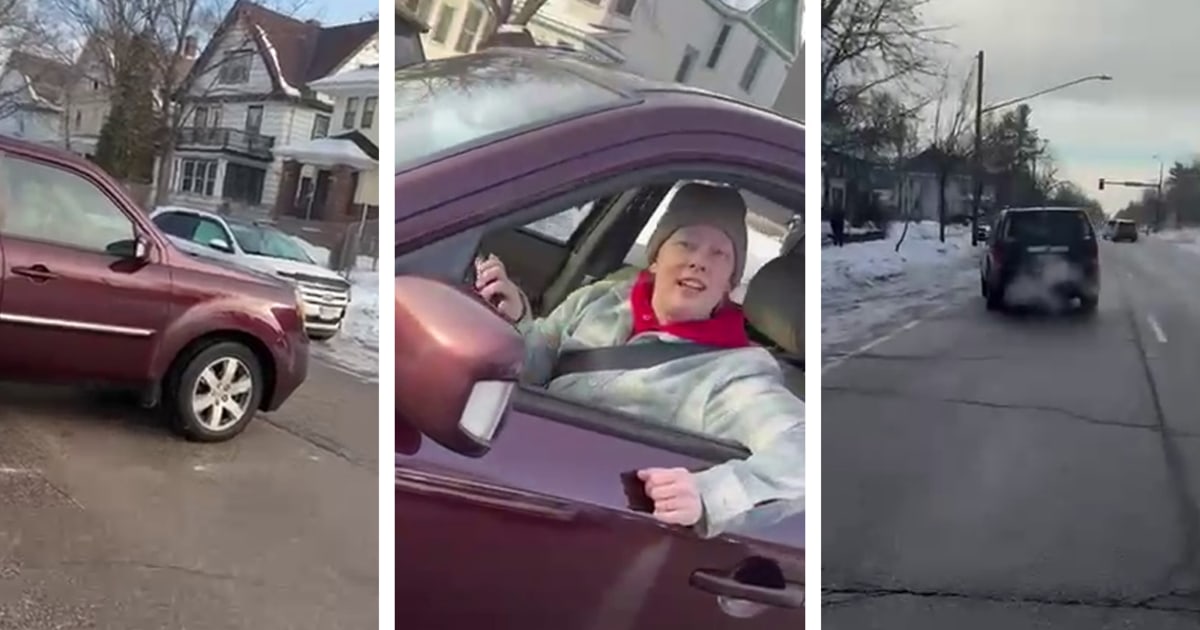
Breaking: Woman shot while trying to kill ICE agents in Minnesota

Ok, list the regulation, I bet you won't.
AI Overview:

U.S. Immigration and Customs Enforcement (ICE) regulations permit deadly force only when an officer reasonably believes it's necessary to prevent imminent death or serious injury to themselves or others, not solely to stop a fleeing person, though agents are trained to avoid situations like standing in front of moving vehicles to prevent danger.

Governed by DHS policy and federal law (8 CFR § 287.8), officers must use de-escalation and the minimum force necessary, but the Supreme Court has allowed broad discretion for split-second decisions, creating tension between policy and practice, especially in vehicle encounters where agents have been involved in shootings, as seen in recent events.


Key Regulations & Policies

Imminent Threat Standard: Deadly force is allowed only when an officer has a reasonable belief that a subject poses an imminent threat of death or serious physical injury to themselves or another person, according to DHS policy and federal regulation 8 CFR § 287.8.

No Solely to Prevent Escape: Deadly force cannot be used solely to prevent a fleeing suspect's escape, though agents may use it if there's a belief that such force is necessary to prevent escape and the person poses a significant threat, notes Time Magazine.


De-escalation & Minimum Force: Agents are trained to de-escalate, use less-lethal options first, and only use the minimum force necessary, says NPR.

Officer Discretion: The Supreme Court has granted leeway for officers' split-second decisions, leading to debates over whether actions meet policy standards, according to the BBC.


Context & Recent Issues

Training vs. Practice: While policies discourage actions like agents placing themselves in front of moving cars, some agents still do, potentially strengthening claims of self-defense after an incident, according to Time Magazine.

Controversial Incidents: Recent shootings, like one in Minneapolis, highlight the gap between policy and practice, with critics arguing that agents' actions may not align with de-escalation principles, notes_____________________
 

You support this crap
Trump wanted protesters in Washington shot during his first term but his aides & Gen. Milley refused.

The fact that Trump condones his ICE goons shooting people should surprise no one. He's a violent Fascist thru & thru.

They'll be more.
 
AI Overview:

U.S. Immigration and Customs Enforcement (ICE) regulations permit deadly force only when an officer reasonably believes it's necessary to prevent imminent death or serious injury to themselves or others, not solely to stop a fleeing person, though agents are trained to avoid situations like standing in front of moving vehicles to prevent danger.

Governed by DHS policy and federal law (8 CFR § 287.8), officers must use de-escalation and the minimum force necessary, but the Supreme Court has allowed broad discretion for split-second decisions, creating tension between policy and practice, especially in vehicle encounters where agents have been involved in shootings, as seen in recent events.


Key Regulations & Policies

Imminent Threat Standard: Deadly force is allowed only when an officer has a reasonable belief that a subject poses an imminent threat of death or serious physical injury to themselves or another person, according to DHS policy and federal regulation 8 CFR § 287.8.

No Solely to Prevent Escape: Deadly force cannot be used solely to prevent a fleeing suspect's escape, though agents may use it if there's a belief that such force is necessary to prevent escape and the person poses a significant threat, notes Time Magazine.


De-escalation & Minimum Force: Agents are trained to de-escalate, use less-lethal options first, and only use the minimum force necessary, says NPR.

Officer Discretion: The Supreme Court has granted leeway for officers' split-second decisions, leading to debates over whether actions meet policy standards, according to the BBC.


Context & Recent Issues

Training vs. Practice: While policies discourage actions like agents placing themselves in front of moving cars, some agents still do, potentially strengthening claims of self-defense after an incident, according to Time Magazine.

Controversial Incidents: Recent shootings, like one in Minneapolis, highlight the gap between policy and practice, with critics arguing that agents' actions may not align with de-escalation principles, notes_____________________
List the regulation, not an AI opinion.
 
Fk boy she wasn't trying to hit him, she didn't steer towards him. So SYBAU.

She very well may not have been 'trying' to hit him, but in her attempt to FLEE from a lawful command to exit the vehicle (psst, this is when you ask AGAIN 'what authority does ICE have over US citizens?') she point her van at an agent and accelerated. That agent reacted in the blink of a second that he had to assess the threat level. And he neutralized that threat.
 
Life is cheap in america. Pissing off officers should not be a death sentence.
They knew who she was and where she lived. They could easily have picked her up later.
But state sanctioned executions are the order of the day under trump.

Can you provide us with a specific copy of that order? Date and time maybe? Did the media report on it? I assume so, if Trump was ordering public executions, that had to make the news right?
 
Here you go.

A third officer, who had been out of the way on the passenger side of the car then walks around the Honda’s hood, stands just in front of the driver and appears to be holding his phone up like he’s filming.

“Why would he do that? Why would he put himself in a more dangerous position than he was already in?” asked Geoffrey P. Alpert, an expert on policing at the University of South Carolina, who called it “absurd” for an officer to use his body to try to block a 4,000-pound SUV.

Darrel W. Stephens, former chief of the Charlotte-Mecklenburg Police Department, also pointed to this moment as the baffling first step in a series of questionable actions that most police departments have discouraged for years. As a police chief, he prohibited officers from standing in front of cars in the early 1990s.

“I can’t explain why he would stand there and place himself in front of the car,” Stephens said. “That’s a dangerous decision to make.”


Administration officials have defended the ICE officer who shot Good as she pulled away in her SUV, saying multiple videos of the incident show that he acted in self-defense. But several former law enforcement officials who reviewed the footage and spoke to The Washington Post faulted the officer’s actions.

They said the officer — identified through court records as Jonathan Ross, an employee of the agency’s Enforcement and Removal Operations division — placed himself at needless risk, escalated the situation and went against best law enforcement practices during the incident. Law enforcement officers should not position themselves in front of vehicles, and they need to try to de-escalate confrontations and must generally avoid shooting into moving vehicles, these officials said.

“It was really an unnecessary shooting,” said Dennis Kenney, a former Florida police officer and a professor at the John Jay College of Criminal Justice in New York. “If you’ve got time to shoot, you’ve got time to get out of the way, which we saw in this case. The guy was clearly able to avoid being impacted by the car.”


No idea who Geoffrey P. Alpert is, but I do know that he hasn't watched the camera footage from Agent Ross. Ross did not 'put himself in a more dangerous position' as is clearly evident. As he walks around the vehicle he is careful to stay on the car's corners. He then stops on the passenger side of the car and moved towards his own vehicle. When he hears the other agent yelling at Good to exit the vehicle, he then begins to walk from one side of the car to the other - at which time Good reverses the car and whether intentionally or not, aims her car directly towards the agent and accelerates. IF Alpert can see this then I question his credentials as an 'expert.'
 
From that angle, he’s not getting killed. At worst, pushed out of the way. Or in this case, nudged.

Comparing this incident to all other casualties that result from vehicles is dishonest at best.

Or run over, considering they're on an icy road and the footing was already compromised.
 
The question was rhetorical and meant to make a point. The incident proved that she panicked and when in that state, she made a rash decision that could have gotten someone killed. But people are vilifying the officer for shooting in self defense when she very well could have struck an innocent bystander in her rush to get out of there.

She is as much at fault for her own death as the officer is.

I think it would have been impossible to accidentally lethally strike someone from that short of a distance away from the car.
 
Your empty comparison is what I am talking about in regard to political nonsense, which of course we have already covered several times by now.

The fact you think it has anything to do with what I may like or not like, when it has nothing to do with what happened in Minneapolis, or the topic of the thread, is an exact reflection of why you posted it, and a stellar example of how you keep proving you are nothing more than a political hack and a pathetic asshat.

Say something else stupid and see what happens.
You're just going to keep telling on yourself, asshat.

That’s your problem, not mine.

Keep crying. :)
 
Police exspurts have said differently.

Curious as to his reaction time?

Administration officials have defended the ICE officer who shot Good as she pulled away in her SUV, saying multiple videos of the incident show that he acted in self-defense. But several former law enforcement officials who reviewed the footage and spoke to The Washington Post faulted the officer’s actions.

They said the officer — identified through court records as Jonathan Ross, an employee of the agency’s Enforcement and Removal Operations division — placed himself at needless risk, escalated the situation and went against best law enforcement practices during the incident. Law enforcement officers should not position themselves in front of vehicles, and they need to try to de-escalate confrontations and must generally avoid shooting into moving vehicles, these officials said.

“It was really an unnecessary shooting,” said Dennis Kenney, a former Florida police officer and a professor at the John Jay College of Criminal Justice in New York. “If you’ve got time to shoot, you’ve got time to get out of the way, which we saw in this case. The guy was clearly able to avoid being impacted by the car.”
 
No idea who Geoffrey P. Alpert is, but I do know that he hasn't watched the camera footage from Agent Ross. Ross did not 'put himself in a more dangerous position' as is clearly evident. As he walks around the vehicle he is careful to stay on the car's corners. He then stops on the passenger side of the car and moved towards his own vehicle. When he hears the other agent yelling at Good to exit the vehicle, he then begins to walk from one side of the car to the other - at which time Good reverses the car and whether intentionally or not, aims her car directly towards the agent and accelerates. IF Alpert can see this then I question his credentials as an 'expert.'

Police experts disagree with you. He should have moved.
 
15th post
No idea who Geoffrey P. Alpert is, but I do know that he hasn't watched the camera footage from Agent Ross. Ross did not 'put himself in a more dangerous position' as is clearly evident. As he walks around the vehicle he is careful to stay on the car's corners. He then stops on the passenger side of the car and moved towards his own vehicle. When he hears the other agent yelling at Good to exit the vehicle, he then begins to walk from one side of the car to the other - at which time Good reverses the car and whether intentionally or not, aims her car directly towards the agent and accelerates. IF Alpert can see this then I question his credentials as an 'expert.'

I found it btw XChaos. Your link, which quotes 'expert' Alpert, was posted on January 9, 2026, at 929am. So most likely the quotes within the article were actually stated on January 8, 2026.

However, CNN did not first report on the Ross footage until January 9, 2026, 305pm.


Likewise, the BBC did not report on Ross' footage until 01.09 also, but without a specific time stamp that I can find.


NBC News also did not first report the Ross footage until 01.09.2026 until 347pm.


AlJazeera did not report the Ross footage until 01.10.2026.


The same with NPR, 01.10.2026 at 118am.


So, most likely, your EXPERT witness had not yet even seen ALL of the footage of the incident. Well done.
 
Back
Top Bottom