I sort of saw parallels, but this makes it more explicit.
Bernie Sanders Is George McGovern
And that's not the only article out there, but I thought the comparisons in this one were good. It does say that Trump is not Nixon, in a way disparaging to Trump's abilities. But imo the Trump Nixon comparison is close in some ways. The corruption of American govt of course. But more so in ways favorable to Trump.
The cred to Nixon was only he could open up to Red China. Who else but Trump could have (at least rhetorically) have ended free trade. (McConnell will protect his FIL to the death, so it ain't really happening). But Trump's made it center piece (along with closed immigration) to his campaign.
And Nixon's use of the dog whistle was legendary. He used the split in the dem party to win in 1968
The article implies that Trump is incapable of being ahead of Bernie by the 20 pts Nixon was up on McGovern even in the summer of 72. It's true that Trump trails EVERY dem in the polls. And Nixon really did govern from the middle, unlike Trump. But Nixon was a lousy campaigner. And Trump is the master of reality tv.
But with much more associated violence:
REMINDER:
A Bernie Bro Shot Steve Scalise. And was trying to massacre the entire Republican congressional leadership.
Whose side shot all those kids at Kent State?
Weren't there four shot by terrified national guardsmen. Not enough if I remember. It should have been 20 or 50 even better.
Yup. Unruly demonstration, large crowd, National Guard activated: 4 Students killed.
Day 1: 500 students demonstrated. They moved from the University to the Town. Trouble exploded in town around midnight, when people left a bar and began throwing beer bottles at police cars and breaking windows in downtown storefronts. In the process they broke a bank window, setting off an alarm. The news spread quickly and it resulted in several bars closing early to avoid trouble. Before long, more people had joined the vandalism.
By the time police arrived, a crowd of 120 had already gathered. Some people from the crowd lit a small bonfire in the street. Members of the crowd began to throw beer bottles at the police, and then started yelling obscenities at them. The entire Kent police force was called to duty as well as officers from the county and surrounding communities. Kent Mayor
LeRoy Satrom declared a
state of emergency, called the office of Ohio Governor
Jim Rhodes to seek assistance, and ordered all of the bars closed. The decision to close the bars early increased the size of the angry crowd. Police eventually succeeded in using
tear gas to disperse the crowd from downtown, forcing them to move several blocks back to the campus.
Day 2: City officials and downtown businesses received threats, and rumors proliferated that radical revolutionaries were in Kent to destroy the city and university. Several merchants reported they were told that if they did not display anti-war slogans, their businesses would be burned down. Kent's police chief told the mayor that according to a reliable informant, the
ROTC building, the local army recruiting station, and post office had been targeted for destruction that night. There were rumors of students with caches of arms, plots to spike the local water supply with
LSD, of students building tunnels for the purpose of blowing up the town's main store. Mayor Satrom met with Kent city officials and a representative of the
Ohio Army National Guard. Following the meeting, Satrom made the decision to call Governor Rhodes and request that the National Guard be sent to Kent, a request that was granted. Because of the rumors and threats, Satrom believed that local officials would not be able to handle future disturbances.
The National Guard arrived in town that evening until around 10 p.m. By this time, a large demonstration was underway on the campus, and the campus
Reserve Officers' Training Corps (ROTC) building was burning. The arsonists were never apprehended.
President's Commission on Campus Unrest: Railroad flares, a machete, and ice picks are not customarily carried to peaceful rallies.
Kent firemen and police officers were struck by rocks and other objects while attempting to extinguish the blaze. Several fire engine companies had to be called because protesters carried the fire hose into the Commons and slashed it. The National Guard made numerous arrests, mostly for curfew violations, and used tear gas; one student was slightly wounded with a
bayonet.
Day 3: They saw the most vicious form of campus-oriented violence yet perpetrated by dissident groups. Burning and destroying, throwing rocks at police and at the National Guard and the Highway Patrol. They gave the appearance of a strong, well-trained, militant, revolutionary group.
During the day, some students came to downtown Kent to help with cleanup efforts after the rioting, actions which were met with mixed reactions from local businessmen. Mayor Satrom, under pressure from frightened citizens, ordered a curfew until further notice.
Around 8 p.m., another protest was held on the campus Commons. By 8:45 p.m., the Guardsmen used tear gas to disperse the crowd, and the students reassembled at the intersection of Lincoln and Main, holding a sit-in with the hopes of gaining a meeting with Mayor Satrom and University President Robert White. At 11:00 p.m., the Guard announced that a curfew had gone into effect and began forcing the students back to their dorms. A few students were bayoneted by Guardsmen.
Day 4: Despite clearly communicated orders to cease the lawless protests, 2,000 people gathered on the university's Commons, near Taylor Hall. The first protester began to speak.
Companies A and C, 1/
145th Infantry and Troop G of the 2/
107th Armored Cavalry, Ohio National Guard (ARNG), the units on the campus grounds, attempted to disperse the students. The
United States Court of Appeals for the Sixth Circuit ruled that authorities did indeed have the right to disperse the crowd.
The dispersal process began late in the morning with campus patrolman Harold Rice riding in a National Guard Jeep, approaching the students to read an order to disperse or face arrest. The protesters responded by throwing rocks, striking one campus patrolman and forcing the Jeep to retreat.
Just before noon, the Guard returned and again ordered the crowd to disperse. When most of the crowd refused, the Guard used
tear gas. Because of wind, the tear gas had little effect in dispersing the crowd, and some launched a second volley of rocks toward the Guard's line and chanted "Pigs off campus!" The students lobbed the tear gas canisters back at the National Guardsmen, who wore
gas masks.
When it became clear that the crowd was not going to disperse, a group of 77 National Guard troops from A Company and Troop G, with bayonets fixed on their
M1 Garand rifles, began to advance upon the hundreds of protesters. As the guardsmen advanced, the protesters retreated up and over Blanket Hill, heading out of the Commons area. Once over the hill, the students, in a loose group, moved northeast along the front of Taylor Hall, with some continuing toward a parking lot in front of Prentice Hall (slightly northeast of and perpendicular to Taylor Hall). The guardsmen pursued the protesters over the hill, but rather than veering left as the protesters had, they continued straight, heading toward an athletic practice field enclosed by a chain link fence. Here they remained for about 10 minutes, unsure of how to get out of the area short of retracing their path. During this time, the bulk of the students congregated to the left and front of the guardsmen, approximately 150 to 225 ft (46 to 69 m) away, on the veranda of Taylor Hall. Others were scattered between Taylor Hall and the Prentice Hall parking lot, while still others were standing in the parking lot, or dispersing through the lot as they had been previously ordered.
While on the practice field, the guardsmen generally faced the parking lot, which was about 100 yards (91 m) away. At one point, some of them knelt and aimed their weapons toward the parking lot, then stood up again. At one point the guardsmen formed a loose huddle and appeared to be talking to one another. They had cleared the protesters from the Commons area, and many students had left, but some stayed and were still angrily confronting the soldiers, some throwing rocks and tear gas canisters. About 10 minutes later, the guardsmen began to retrace their steps back up the hill toward the Commons area. Some of the students on the Taylor Hall veranda began to move slowly toward the soldiers as they passed over the top of the hill and headed back into the Commons.

During their climb back to Blanket Hill, several guardsmen stopped and half-turned to keep their eyes on the students in the Prentice Hall parking lot. At 12:24 p.m., a sergeant named Myron Pryor turned and began firing at the crowd of students with his .45 pistol. A number of guardsmen nearest the students also turned and fired their rifles at the students. In all, at least 29 of the 77 guardsmen claimed to have fired their weapons, using an estimate of 67 rounds of ammunition. The shooting was determined to have lasted only 13 seconds.
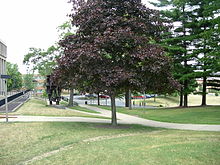
Photo taken from the perspective of where the Ohio National Guard soldiers stood when they opened fire on the students
The
adjutant general of the Ohio National Guard told reporters that a
sniper had fired on the guardsmen. Many guardsmen later testified that they were in fear for their lives. The
President's Commission on Campus Unrest harshly criticized both the protesters and the Guardsmen, but it concluded that "the indiscriminate firing of rifles into a crowd of students and the deaths that followed were unnecessary, unwarranted, and inexcusable."
The shootings killed four students. Two of the four students killed,
Allison Krause and
Jeffrey Miller, had participated in the protest. The other two,
Sandra Scheuer and
William Knox Schroeder, had been walking from one class to the next at the time of their deaths.
Only Military and Law Enforcement can be trusted with firearms.


