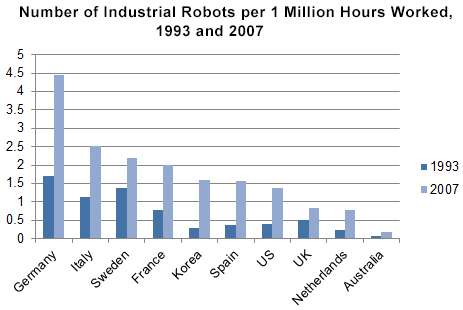
Germany has twice the level of manufacturing employment that we do.
FUnny how automation has had so much LESS impact over there...
That's a wee bit of an exaggeration.
German manufacturing employment as a percentage of GDP has fallen 2x compared to about 2.5x in the US.
Percent of Employment in Manufacturing in the United States (DISCONTINUED)
Percent of Employment in Manufacturing in Germany (DISCONTINUED)
Germany is no different.
Dis
Germany has twice the level of manufacturing employment that we do.
FUnny how automation has had so much LESS impact over there...
That's a wee bit of an exaggeration.
German manufacturing employment as a percentage of GDP has fallen 2x compared to about 2.5x in the US.
Percent of Employment in Manufacturing in the United States (DISCONTINUED)
Percent of Employment in Manufacturing in Germany (DISCONTINUED)
Germany is no different.
What is it you don't understand?
Manufacturing Sector: Real Output
US Manufacturing is "UP". Get it? "UP".
But Manufacturing jobs are "DOWN". Get it? "DOWN"!
Why do you think that is?
****, do I have to say it???????????
AUTOMATION!!!!!!!!!!!!!!
Yes, I know.
But it also occurred in Germany.
Germany lost just 19 percent of its manufacturing jobs between 1996 and 2012
And Germany has an even higher rate of automation than we do.
Don’t blame the robots for lost manufacturing jobs | Brookings Institution
(Sigh)
Many times, what the Brookings Institution does is present data. That doesn't always mean they are looking at the big picture in any single study. If robots replace jobs, then of course, jobs are lost. That's only common sense.
Here is another Brooking's Institution article presenting seemingly contradictory information to your article. While I post portions of the article, you really should read the entire thing.
----------------------------------------------
America’s advanced industries: New trends | Brookings Institution
Metropolitan Policy Program at Brookings has for the last several years been arguing that to truly rebuild America’s drifting economy, city and metropolitan area leaders—supported by their states and Washington—must work to build an “advanced economy that works for all.”
How might cities, metro areas, and the nation build such an economy? One step is certain: Along with improved innovation and training initiatives, stronger labor standards, and a rewoven social safety net, a key element of the needed reconstruction is a metro-by-metro rejuvenation of the nation’s high-tech “advanced industries” sector.
The importance of these high-value innovation and technology industries to any future shared prosperity is why the Metro Program began to focus on the sector in the wake of the 2008 economic crisis. Likewise, the centrality of these advanced industries’ progress to the nation’s long-run productivity and economic inclusion is why the program formally defined and began to track the growth of the sector, beginning with the 2015 report “America’s Advanced Industries: What They Are, Where They Are, and Why They Matter.” That report outlined 50 “advanced” industries that conduct inordinate amounts of R&D and employ large STEM (science, technology, engineering, and mathematics) workforces—key determinants of high-value economic enterprise.
Advanced robotics, artificial intelligence, and machine learning are making it possible to automate more and more worker tasks, opening the possibility of both productivity gains and labor market disruption.
STEM workers—from aerospace engineers and plant scientists to petroleum geologists, software developers, and skilled technicians—matter because they invent and install the technical innovations that sustain innovation and growth.
[iv] At the professional level, highly trained scientists and engineers keep firms and industries on the cutting-edge through inventions and entrepreneurship. At the sub-bachelor’s level, skilled technicians produce, install, maintain, repair, and operate the systems designed and patented by researchers, allowing firms and industries to reach their markets, maximize sales, create process innovations, and enhance productivity. That advanced industries employ 80 percent of the nation’s engineers underscores the sector’s role as America’s main storehouse of its most economically valuable technical workers.
------------------------------------------------------
If you actually read both articles, the one you linked to and the one I linked to, you begin to understand the bigger picture. Notice that neither study gives "bring jobs back from other countries" as a solution. The jobs that would come back wouldn't pay much anyway. Simple labor for low paid and unskilled workers.
Remember, manufacturing has been losing jobs in both China and Mexico.
New high paying jobs here don't come from overseas, they are developed here with people educated here. Get it? It's education and innovation that generally comes from research.
Donald Trump has no "education policy". He talks about bringing jobs back but to a thinking person, that is remarkably ridiculous for the reasons pretty much outlined by the Brooking's Institution.
What I've been saying for the last couple of years is we need education. Something USMB Republicans pretty much mock and dismiss.

 You are so ignorant on the issues discussion is not possible, you just spew one disconnected talking point after another. No matter how many facts or historical points are presented you just go on parroting the talking points so talk to the hand.