Pakistani Superhero

odanny

Diamond Member
Gold Supporting Member
Joined
May 7, 2017
Messages
26,277
Reaction score
21,658
Points
2,290
Location
Midwest - Trumplandia
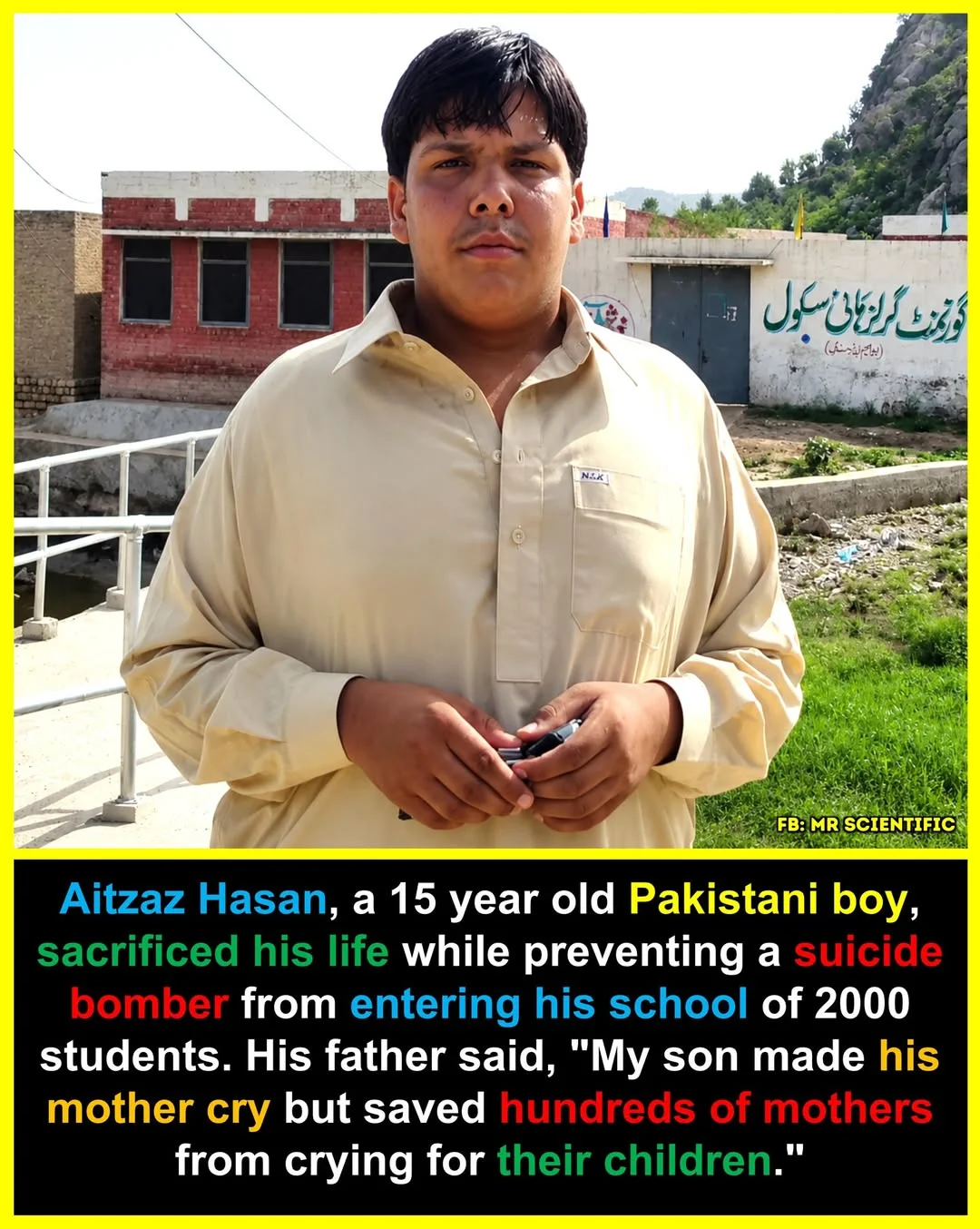
Heroes come in all shapes and sizes. Worth remembering them all on Memorial Day weekend.


In 2014, 15-year-old Aitzaz Hasan from Pakistan became a national hero after stopping a suicide bomber from entering his school in Hangu district.

According to reports, Aitzaz noticed a suspicious man approaching the school gates while thousands of students were inside. Instead of running away, he confronted the attacker and tried to stop him before he could reach the building.

The bomber detonated the explosives during the struggle, killing Aitzaz instantly, but preventing what could have been a devastating mass casualty attack. His bravery likely saved hundreds, possibly thousands, of students and teachers that day.

What deeply moved people around the world was the reaction from his family. His father said, “My son made his mother cry, but he saved hundreds of mothers from crying for their children.”

Aitzaz was later honored across Pakistan for his courage, and many people compared his actions to those of a real-life superhero.
705698831_1526083632218260_2303713123050690355_n.webp
 
""The majority of suicide bombings inside Pakistan are instigated by Tehreek-e-Taliban Pakistan (TTP), commonly known as the Pakistani Taliban. Along with the TTP and its breakaway factions, two other prominent extremist networks are responsible for most of the country's suicide terrorism:
1779677499411.webp
CSIS | Center for Strategic and International Studies +3
  • Islamic State–Khorasan Province (IS-KP): An Islamist militant group that aggressively uses suicide bombers to carry out mass-casualty sectarian attacks against the Pakistani government, religious minorities, and political figures.
  • Balochistan Liberation Army (BLA): An ethno-nationalist separatist group whose specialized "Majeed Brigade" deploys suicide bombers—including female attackers—primarily targeting Pakistani military personnel, infrastructure, and Chinese interests.
    1779677499414.webp
    CSIS | Center for Strategic and International Studies +4

Primary Perpetrators

1. Tehreek-e-Taliban Pakistan (TTP)
  • Profile: An umbrella organization of various Islamist militant groups operating along the Afghan–Pakistani border.
  • Methodology: They frequently target Pakistani security forces, police stations, and government installations.
  • Factions: Internal wings and splinter groups, such as Jamaat-ul-Ahrar, frequently claim responsibility for lethal bombings in major urban centers.
    1779677499417.webp
    Council on Foreign Relations +4

2. Islamic State–Khorasan Province (IS-KP)
  • Profile: A regional affiliate of ISIS operating across both Afghanistan and Pakistan.
  • Methodology: Unlike ethno-nationalist groups, IS-KP primarily targets political gatherings, mosques, and religious minorities to stoke deep sectarian divide and state instability.
    1779677499420.webp
    CSIS | Center for Strategic and International Studies +1

3. Baloch Separatists (BLA Majeed Brigade)
  • Profile: Secular, eth-nonationalist insurgents fighting for the independence of the resource-rich Balochistan province.
  • Methodology: They utilize suicide tactics strategically rather than religiously. Their attacks focus heavily on the China-Pakistan Economic Corridor (CPEC) projects, military convoys, and foreign nationals.
    1779677499424.webp
    Combating Terrorism Center at West Point +3

Key Tactical Dynamics
  • Geographic Centers: Most suicide bomber training and logistics historically trace back to the volatile border regions of Khyber Pakhtunkhwa (such as Waziristan) and Balochistan.
  • Exploitation Mechanisms: Instigating groups leverage local grievances, poverty, lack of education, and religious radicalization to groom and brainwash young recruits.
    1779677499427.webp
    Combating Terrorism Center at West Point +2
 
Back
Top Bottom