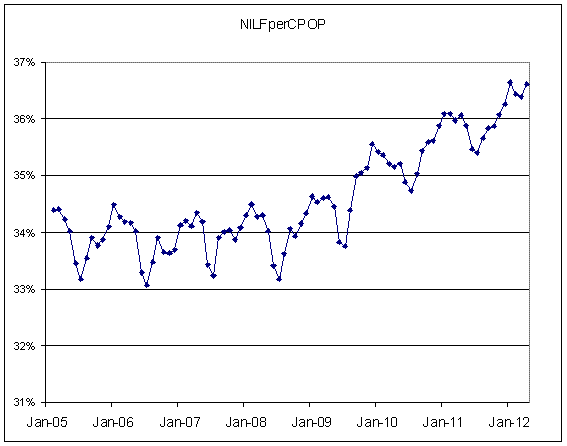
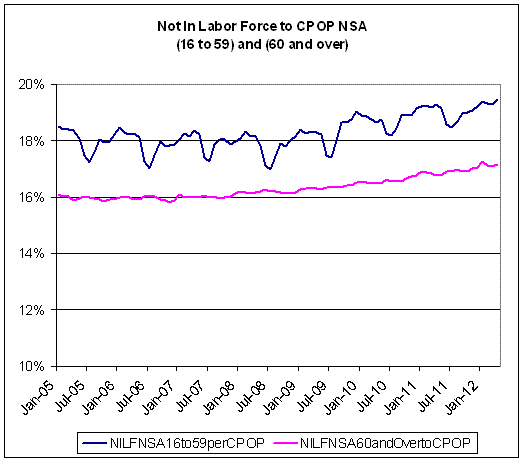
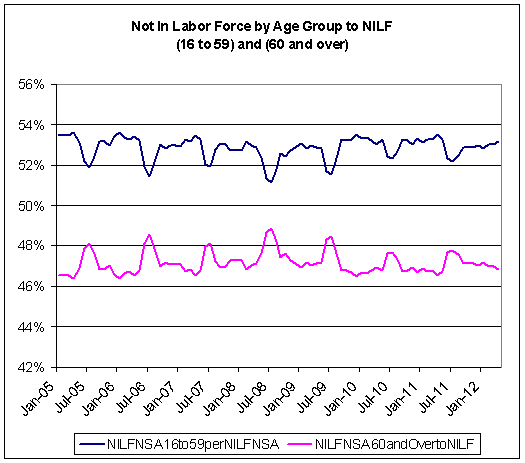
So here is NILFNSA normalized for CPOP. I've shown just 2005 and on.
It has three significant variations. The seasonal variation is obvious. It stands out clearly. At a lower frequency, the long term trends are apparent. From 2005 through to recessionary effect, the long term trend was flat. Once the recession kicked in, the long term trend was upward. The third variation is much higher frequency. It can be seen riding on top of the seasonal variation. It is just month to month noise. Some months, for no good reason, are higher or lower then other months.
It would be nice to separate these out then just eyeball them. The BSL does provide seasonal adjustment. I don't do it simply because I haven't created a tool for it. I can see it anyways and don't have the need for a number, so I don't have a reason.
It would be nice to take out the seasonal and random variation so that just the long term trend is apparent. The problem with trying to take out the random variation towards the end of the series is that there is no guarantee that the change is due to some randomness or is a change in the long term trend. The long term trend can only be determined after a long time. That the shits but it is also fairly obvious.
So if we look at that little upward tick in April, the compare it to the noise riding on the seasonal variation, it looks like it may very well be that it is just more noise.
The only thing we can really say is that the long term trend since the recession began has not demonstrated any serious change. Even if it does change considerably, we won't really be able to guarantee it has changed until at least an entire year has passed. Even then it is questionable.
So back to the question as to why the NILFNSA has "sky rocketed". Well, I don't have a measure for "sky rocketed". I would say that, since the beginning of the recession, it has "sky rocketed". I wouldn't classify the minor variability as "sky rocketing". Perhaps you consider the April uptick as "skyrocketing". If so, I've got to as, what about the same upticks that have occurred during the period of 2005 to the recession? How about the seasonal change, from like December to July? Are these changes "skyrocketing"? And if so, then what meaning does "skyrocketing" have if every seasonal and random variation is "skyrocketing", that is if it doesn't identify anything in particular?
Regardless of what this means, the question of why the NILFNSA to CPOP ratio increases can be numerous. It all depends on who they are.
One is simply that more people are entering the workforce then are getting jobs.
Jobs can be added at a rate faster then people graduate from school (or turn 16). I would imagine, in this job climate, that 16 year olds aren't going to find a lot of jobs. Unskilled labor over the age of 25 is thrilled to get that McDonald's job. I remember when news papers were delivered by paperboys. By 1985, they were delivered by adults.
The BLS has a shit load of finer detail on the NILF. The next step would be to look at the finer details and find out what the BLS CPS has to offer in terms of what category is the largest contributor to the NILFNSA trend.
Now it gets complicated because of the shit load of categories. There are a total of 645 individual categories for unadjusted not in labor force data. There is marital status, race, gender, age groups, job search categories (WAJN, Not looking, etc.), education enrollment, veteran status, health status, family responsibilities status, disability status, etc. If we add the flows categories, inflows and outflows, the number is 741. (To be clear, the 645 includes some "flows" as in "not in labor force flows". So the flows isn't 741 - 645. I just didn't notice the "not in labor force flows" when I did the first query on "not in labor force". It's would have been faster to redo the query then explain it, but I already committed to the explanation before I recognized this.) ;-)
So, the question becomes, what NILF categories to look at first and how long it will take to do all of them. Then the question becomes one of understanding what categories actually overlap. They are not all mutually exclusive.
Here are a couple of CPS categories that might answer the question;
ID series_id series_description
32751 LNU05024937 (Unadj) Not in Labor Force, 50-54 yrs.
32514 LNU05000094 (Unadj) Not in Labor Force, 55-59 yrs.
32516 LNU05000096 (Unadj) Not in Labor Force, 60-64 yrs.
32753 LNU05024938 (Unadj) Not in Labor Force, 65-69 yrs.
32759 LNU05024941 (Unadj) Not in Labor Force, 70-74 yrs.
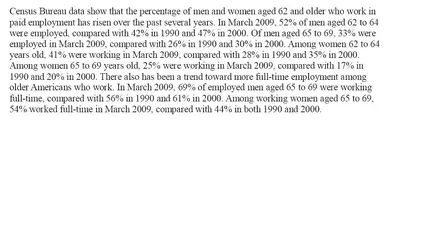
If those are increasing, more then anything else, then it seems like we are getting towards the concept of baby boomers retiring being the answer. If they aren't, it kind of kills the idea.
This is the only way to answer the question. There is no other way. Any other way is simply wrong.
Another easier way might be to simply email someone at the BLS and ask them to answer the question. Why not? It's our tax dollar.