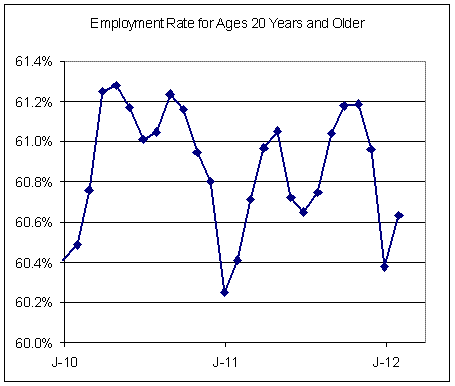
See, now your spinning things.
You say, "The Employment to population ratio has actually the same in the last 12 month"
Then you say, "we have created 0 jobs in the last year"
Which is it, either jobs have been added at a rate to keep up with pop or they haven't. You cannot have it both ways.
Spin was not my intent. My intent was to show that the UE rate has fallen well over 1% in the last 12 months, yet the rate of employment to the population is unchanged
Does it not make sense those leaving the work force for what ever reason is the only reason the UE rate has fallen?
Creating jobs to me means when the 6 million people that lost there jobs in 08-09 get back to 0, then we will have begun to create jobs
Keeping pace with the masses is not creation, it is by definition idle at best
2000...... 131,785 110,995 24,649 599 6,787 17,263
2001...... 131,826 110,708 23,873 606 6,826 16,441
2002...... 130,341 108,828 22,557 583 6,716 15,259
2003...... 129,999 108,416 21,816 572 6,735 14,509
2004...... 131,435 109,814 21,882 591 6,976 14,315
2005...... 133,703 111,899 22,190 628 7,336 14,227
2006...... 136,086 114,113 22,530 684 7,691 14,155
2007...... 137,598 115,380 22,233 724 7,630 13,879
2008...... 136,790 114,281 21,335 767 7,162 13,406
2009...... 130,807 108,252 18,558 694 6,016 11,847
2010...... 129,874 107,384 17,751 705 5,518 11,528
2011...... 131,359 109,254 18,021 784 5,504 11,733
ftp://ftp.bls.gov/pub/suppl/empsit.ceseeb1.txt
we are not there yet according to this data as noted below
B-1. Employees on nonfarm payrolls by major industry sector, 1962 to date
Look, I am very careful in my selection of words because other people have an understanding of what the words mean that is not defined according to what I want the words to me. Jobs being added is jobs being added. A flat employment to population ratio is a flat employment to population ratio and it is jobs being added at the rate of the population increase.
I agree, a flat employment to population while we are still above the natural UE rate of 5% surely is "idle". I get that and I have repeatedly said that emp/pop is flat. But it also isn't declining, and jobs are being added.
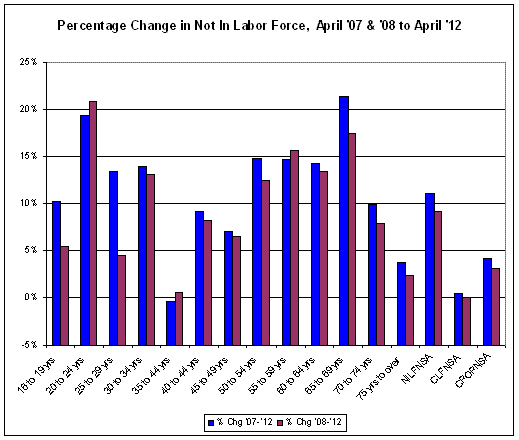
You point to the NILF increasing, which no one contests, and I go after why it is increasing.
But when you present a point of focus, reject the facts presented, change the question or focus, use words in a manner that is not the common definition, you gotta expect it's gonna piss someone off. It's hard enough to keep all this shit clear in mind without someone pissing all over solid reasoning.
You point out that the UE seems to be decreasing on an increasing NILF, then I'll go look at that. I ain't there yet and I haven't seen all the possibilities ironed out.
That the UE rate is decreasing is because either the unemployment is decreasing or the labor force is increasing, right? (is LF increasing? I don't remember. Can NILF increase while LF increases? Sure, population increases?)
Unemployment rate is the number of unemployed people divided by the labor force.
And I get the idea that the number of unemployed can decrease because people left the the rank of the labor force. But once we realize that, we also realize that this also means the the labor force, in the denominator decreases as well. It doesn't by the same amount, but the thing then opens up the whole issue that the UE rate is a bit fuzzy.
Sure, it can be simply that a shit load of people are getting discouraged and simply giving up. Hey, trust me, I know, I really know, okay? And those are entering the NILF.
So we start asking, why is the NILF increasing? Is is all just because of people leaving the LF? Well, it appears that one reason is that younger folks are entering the NILF force and not finding jobs and people of age 65 are retiring and exiting the LF.
So the NILF is increasing can be because the population growth is adding to it without the few folks even entering the labor force.
Then of course, the whole thing is churning. A decrease in LF isn't just those leaving. It is more than those leaving minus some less entering. But I'm not even ready to tackle that one or if it is even important.
In my experience, if we can think of a half dozen possibilities, it is generally that they are all in play. The most likely scenario is that the NILF is increasing because both new population and LF exits. And that is what the data suggests.
But, having looked at it in some detail surrounding the per population numbers, it also can be for simply odd mathematical reasons. I'm not saying it is, just that it is possible.
And then, fundamentally, I don't like the /LF numbers anyways. Per CPOP is much cleaner. the /LF numbers are fine when /LF is stable. But it isn't stable right now.
At least we have some solid footing to stand of with employment per population. That can't go wrong. We get that jobs better increase at least so much as to keep that ratio flat.
Understanding how it makes sense that UE is decreasing while emp to pop is flat is a damned interesting question.
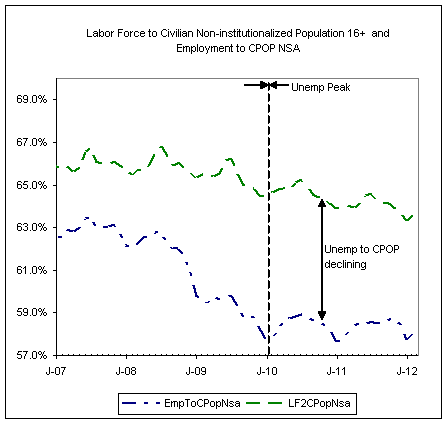
That's why I presented the equations and that /CPOP graph. It happens that, for the /CPOP ratios, there is something odd that happens when emp/CPOP is flat. CPOP is coming up underneath it all, so for emp/CPO to be flat and Unemp/CPOP to decrease, LF/CPOP must go down. It is really interesting. With regard to the /LF set, frankly, I don't know yet. I'm still working on how to separate out the individual effects in a manner that is clear. It just gets odd when dealing with ratios where the underlying baseline is changing. For one thing, it isn't intuitive. We are not use to ratios with a changing denominator.
Here is a possibility, both Unemp/CPOP and LF/CPOP both decreased at the same time.
The UE rate is (Unemp/CPOP)/(LF/CPOP). CPOP cancels and we get a simpler formula. But, fundamentally, what we have for a reference is CPOP and everything better be increasing proportionally. If we look at Unemp/CPOP and LF/CPOP separately, we find that both fell fro March to April.
Now that's interesting, a weird situation. See, that's why I don't really like /LF numbers. If we are looking over the history of labor utilization, LF has changed dramatically on structural changes (women, particularly in the early 70's and on). /LF factors out structural changes.
It seems like we have some weird shit happening that kind of messes up the stability of the numbers. 20-24 year olds are not finding jobs. People are retiring. The structure of the labor force is changing. Jobs are being created only so fast as population growth.
It's like any statement that can be made is true, in part. Yeah, the LF dropped on people leaving. Yeah, NILF increased on both increased pop without sufficient jobs to take them all while LF retirees added to it. On the other hand, 30-35 year olds are finding work. They are not to young, not to old.
And it is all happening on a backdrop of seasonal variation.
All in all, it's not just one single thing. It's a combination of things.
So here are the numbers for /LFs and /CPOPs
Date...........LftoCPOP..UnempToCPOP...UnempToLF... EmpToCPOP...EmpToLF
4/1/2012.....63.39%.......4.91%...............7.74%...............58.49%......92.26%
3/1/2012.....63.61%.......5.32%...............8.36%...............58.29%......91.64%
2/1/2012.....63.57%.......5.54%...............8.71%...............58.03%......91.29%
1/1/2012.....63.35%.......5.59%...............8.82%...............57.76%......91.18%
You should see how the LF to CPOP looks over the long run. Not good. In truth, due to the large seasonal variability, just four months isn't the best way to look at it.
Just looking at those numbers, the odd man out is LF/CPOP.
It all just leaves me all that more suspicious of LF and /LF stuff. Without futzing around with the equations, I'm not sure what the f' it really means these days. Not with LF/CPOP falling.
I agree, it's really friggin' odd. But I usually have found that when it's really odd, it ends up being just some funny math thing, not something nefarious.
And it bring me back to that LF/CPOP must fall in order for Emp/CPOP to be flat while Unemp/CPOP decreases.
If LF is increasing and it's all going into an increasing Emp, the Unemp/LF would decrease too. Same as it would if LF was decreasing on exits from Unemp.
What we really want is people leaving Unemp and going to Emp while LF stays constant. That's what makes sense intuitively. But that isn't what is happening, ever. What is happening is Emp, Unem, LF, and CPOP are all changing along with NILF.
The only thing I can come up with is, and it is demonstrated, that if Emp/CPOP is constant and Unemp/CPOP falls, then LF/CPOP must fall. In the same manner, Unemp/CPOP can fall with a bit of an increase in Emp/CPOP and LF/CPOP can also fall.
And it isn't that LF level is decreasing, just that isn't increasing at the same rate as CPOP.
In case of this last April, LF did decrease a bit. And so here is the thing, LF decreasing is it not increasing at the same rate as CPOP. So the same effect occurs. (I'm just thinking here.) I'm not seeing if this translates well to the /LFs.
All that said, here is the levels for the last four months.
Date .....UnempNSA CLFNSA CPOPNSA EmpLevelNSA
4/1/2012 11910 153905 242784 141995
3/1/2012 12904 154316 242604 141412
2/1/2012 13430 154114 242435 140684
1/1/2012 13541 153485 242269 139944
And yeah, LF did fall for March to April. And, so far, I am not terribly surprised. How many times has this happened? How many times has the weird, only LF/CPOP occurred and we just didn't notice? Any one care to search the data for it?
That's the odd man out, that LF falling March to April. But it's relative. Maybe it's a single instance of a data error. (Not my preferred explanation.)
More likely, this particular month, it actually fell on more people leaving the LF then joined. I just can't come up with a solid reason for caring if one month, with large numbers of people coming and going, if it is anything but that sooner or later, it's gotta happen.
What is that, Unemp fell by 1 mill while LF fell by 400k? So UE fell on both Unemp and LF levels, where Unemp fell more then LF. I mean , if it was just exists from LF, then Unemp and LF would fall the same amount for a falling UE. Right?
So, to your main question, "the UE rate has fallen well over 1% in the last 12 months, yet the rate of employment to the population is unchanged Does it not make sense those leaving the work force for what ever reason is the only reason the UE rate has fallen?"
The answer is, actually yes, just not intuitively and not on initial inspection. Emp/POP and Unemp/LF are only marginally related.
I'd have to figure out how they are related in order to show why it isn't completely non-sense.
LF = Emp + Unemp
We can divide it all by POP
LF/POP = Emp/POP + Unemp/POP
And I'm back to that graph. If emp/POP is flat and Unemp/POP decreases, then LF/POP must decrease. It couldn't happen any other way. And if LF is basically flat, then it is POP coming up underneath. LF could fall a tad, emp/pop remain flat, and Unemp/POP fall even more.
Right now, it's all I got for that issue. I'm not sure how to relate the two to see how it can occur. It is all about coming up with some algebra expression that relates Emp/POP to Unemp/LF. Without some expression, we just can't pin it down. But, perhaps, that is the issue, they are not as related as one would intuitively expect.