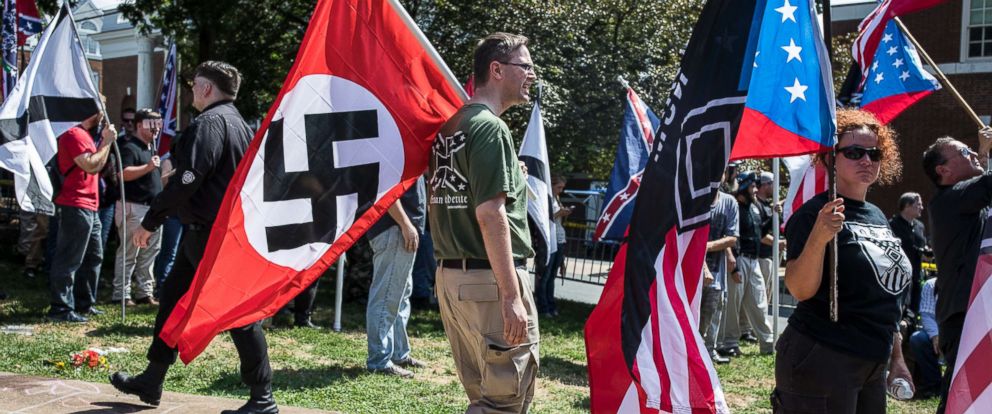
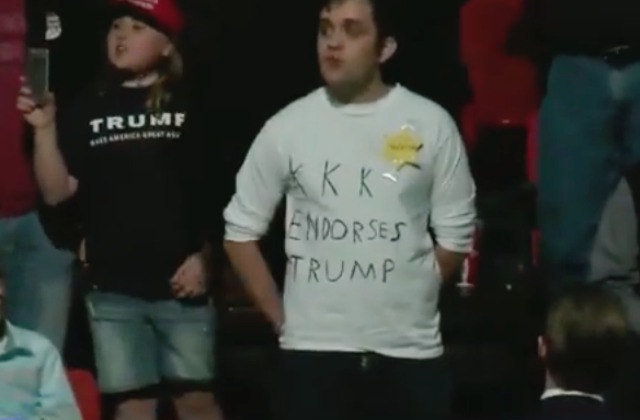
Is the GOP now the party of authoritarianism?
Donald Trump Poses an Unprecedented Threat to American Democracy
a
report circulated highlighting his 1990 interview with
Playboy in which he praised the brutality of the Tiananmen Square crackdown. This is not the first time I had seen Trump praise dictators.
My previous view of Trump was as a kind of vaccine. The Republican Party relies on the covert mobilization of racial resentment and nationalism. Trump, as I saw it, was bringing into the open that which had been intentionally submerged. It seemed like a containable dose of disease, too small to take over its host, but large enough to set off a counterreaction of healthy blood cells. But
the outbreak of violence this weekend suggests the disease may be spreading far wider than I believed, and infecting healthy elements of the body politic.
I remain convinced that Trump cannot win the presidency. But what I failed to account for was the possibility that
his authoritarian style could degrade American politics even in defeat. There is a whiff in the air of the notion that the election will be settled in the streets — a poisonous idea that is unsafe in even the smallest doses.
Here is another factor I failed to predict. Trump, as I’ve
noted, lies substantively within the modern Republican racial political tradition that seamlessly incorporates such things as the Willie Horton ads and the uncontroversial service of Louisiana representative Steve Scalise, who once
called himself “David Duke without the baggage,” as House Majority Whip. But Trump’s amplification of white racial resentment matters. His campaign has dominated the national discourse. Millions of Americans who have never heard of Steve Scalise are seized with mortal terror of Trump, whose
ubiquity in campaign coverage makes him seem larger and more unstoppable than he is. And terror is corrosive.
Donald Trump Poses an Unprecedented Threat to American Democracy
Of course it is Trump who has let loose the wave of fear rippling out from the campaign. And it is Trump who has
singled out African-Americans peacefully attending his speeches for mistreatment, and Trump who has glorified sucker-punching attacks on nonviolent protesters. This is part of the effectiveness of authoritarian politics. The perception that Trump poses a threat to democracy legitimizes undemocratic responses — if you believe you are faced with the rise of an American Mussolini, why let liberal norms hold you back? The anti-Trumpian glory falls not upon the normal, boring practitioners of liberal politics — Hillary Clinton with her earnest speeches about universal pre-K and stronger financial regulation — but the street fighters who will muster against Trump the kind of response he appears to require.
Just the other day, a man charged Trump as he spoke, and came disturbingly close to reaching him. More of this seems likely to follow, and it can spread from Trump’s rallies to those of other candidates.
A huge majority of the public finds Trump repellent. Some of his current unpopularity is the soft opposition of Republican voters who are currently listening to anti-Trump messaging from party sources and would return to the fold if he wins the nomination. But there is simply no evidence that the country that elected Barack Obama twice, and which is growing steadily more diverse, stands any likelihood of electing Trump. He can and must be defeated through democratic means. He is spreading poisons throughout the system that could linger beyond his defeat. Anybody who cares about the health of American democracy should hope for its end as swiftly as possible.
Donald Trump Poses an Unprecedented Threat to American Democracy
On foreign policy, Trump is a nationalist at sea. Sometimes he wants to let Russia fight ISIS, and at others he wants to “bomb the sh**” out of it. He is fixated on stealing Iraq’s oil and casually suggested a few weeks ago a war crime — killing terrorists’ families — as a tactic in the war on terror. For someone who wants to project strength, he has an astonishing weakness for flattery, falling for Vladimir Putin after a few coquettish bats of the eyelashes from the Russian thug. All in all, Trump knows approximately as much about national security as he does about the nuclear triad — which is to say, almost nothing.
Indeed, Trump’s politics are those of an averagely well-informed businessman: Washington is full of problems; I am a problem-solver; let me at them. But if you have no familiarity with the relevant details and the levers of power, and no clear principles to guide you, you will, like most tenderfeet, get rolled. Especially if you are, at least by all outward indications, the most poll-obsessed politician in all of American history. Trump has shown no interest in limiting government, in reforming entitlements, or in the Constitution.
Against Trump