YES, he was.
When do we rewrite the history books?
October 19,2021.
Statement by Donald J. Trump, 45th President of the United States of America
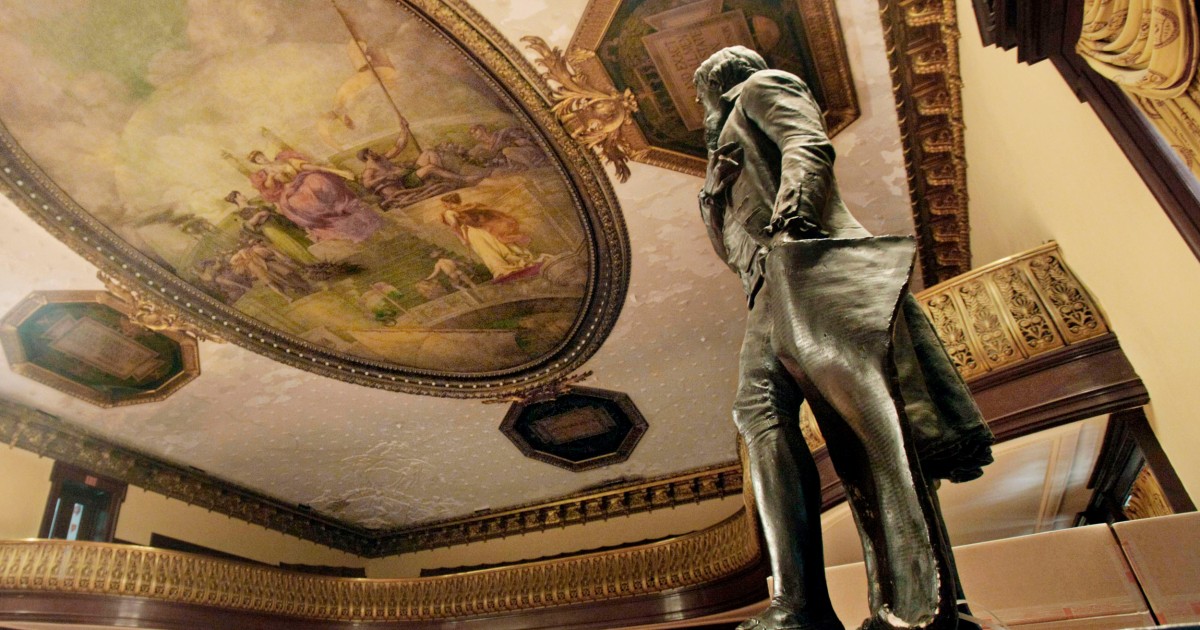
Well, it’s finally happened. The late, great Thomas Jefferson, one of our most important Founding Fathers, and a principal writer of the Constitution of the United States, is being “evicted” from the magnificent New York City Council Chamber.
'Principal writer'?
Jefferson didn't write a sentence of the constitution.
Thomas was in France at the time.
Jefferson's influence on the constitution is unmistakable. He controlled a lot power and influence on it via his buddies, his influence on the american people via his writing, and and his previous government work. Safe to say that Jefferson had the most influence on the constitution. The communists are working really hard to erase Jefferson now.
"
Jefferson was the
principal author of the Declaration of Independence in 1776 and also a mentor to James Madison, a driving force behind the 1787 Constitutional Convention.
Prior to then, Jefferson certainly wrote about and debated constitutional issues. Also back in 1776, Jefferson was unable to attend the Virginia state convention that drew up the Virginia Declaration of Rights, but he sent
his own version of a draft constitution back to his home state to consider.
Jefferson’s only book,
Notes on the State of Virginia, was at first published anonymously in Europe in 1785, and in it, he spent a great deal of time pondering constitutional issues. (The first American edition appeared in 1788 in Philadelphia.)
While in Paris before the Constitutional Convention, Jefferson closely followed developments in the United States. He corresponded with individuals who would eventually contribute to the formation of the Constitution, like Madison and John Jay, an author of the Federalist Papers.
Jefferson corresponded regarding the failures of the Articles of Confederation and
discussed a need for a more powerful central government. After it was decided that a Constitutional Convention was going to be held, Madison wrote to Jefferson
expressing his anxiety as he anticipated the upcoming meeting in Philadelphia.
The Constitutional Convention took place from May 25th to September 17th, 1787, during which the text of the Constitution was debated, drafted, and ultimately decided upon by the delegates. On June 6th, Madison
wrote a letter to Jefferson with a list of the individuals attending the Convention, but explained that he couldn’t reveal more about the substance of the ongoing debates because the delegates agreed that the proceedings should be kept secret.
Jefferson
expressed his frustration with the secrecy of the Convention, but he did share some ideas with Madison while it was ongoing. For example, Jefferson
wrote to Madison on June 20th explaining why the federal government should not be given the power to veto laws passed by the states. This federal power was not included in the final draft of the Constitution despite
Madison’s support of the idea.
On September 6th, Madison wrote a letter to Jefferson detailing some key provisions that were going to be included in the Constitution, as he reasoned that by the time the letter would arrive in France the details of the Constitution would be made public. Madison explained how state and federal governments were to be organized, and noted that some of the provisions may “
surprise” Jefferson.
On December 20th, 1787, after the Constitutional Convention was over and while the ratification of the Constitution was being debated in state legislatures, Jefferson
wrote a letter to Madison objecting to key parts of the Constitution. Among other things, Jefferson was concerned that the document lacked a Bill Of Rights and failed to establish term limits for federal officials. In earlier correspondences to other acquaintances, in 1786 Jefferson
extolled government protection of civil liberties and wrote, for example, that “our liberty depends on the freedom of the press”. Jefferson also was a proponent of protections for religious liberty and wrote the
Virginia Statute for Religious Freedom, which passed the Virginia General Assembly in 1786.
By the fall of 1788, Madison was convinced that the inclusion of a Bill Of Rights to the new Constitution would be prudent. While advocating for a bill of rights, Madison
relied upon an argument first articulated by Jefferson – that a list of rights would help give the judiciary the power to ensure that other branches of governments would not infringe on citizens’ civil liberties.
In the long run, Jefferson would have a big impact on constitutional issues as a political party leader and as a President for eight years. Peter S. Onuf, a University of Virginia professor, stated Jefferson and Madison’s overall impact a few years ago in an
essay for the Gilder Lehrman Institute.
“Madison’s federal Constitution had created a national state that would prove strong enough to survive a cataclysmic Civil War; as party leader and national builder, Jefferson gave voice to the fundamental values and aspirations that have defined Americans as a democratic people,” he wrote."