Whatever will Leons' Tesla company do? What about all the Obiden charger stations?
< such a waste of trillions in that phony New Green Steal >
Change to hybrid?
Develop a decent battery?
Develop a fuel cell?
Change to other power source?
We may already be there;
Abstract
Room-temperature sodium–sulfur (Na–S) batteries offer a sustainable energy storage solution to conventional lithium (Li)-based systems<a data-track="click" data-track-action="reference anchor" data-track-label="link" data-test="citation-ref" title="Liu, R. et al. Establishing reaction networks in the 16-electron sulfur reduction reaction. Nature 626, 98–104 (2024)." href="
High-voltage anode-free sodium–sulfur batteries - Nature">1</a>,<a data-track="click" data-track-action="reference anchor" data-track-label="link" data-test="citation-ref" title="Pan, H. et al. Non-encapsulation approach for high-performance Li–S batteries through controlled nucleation and growth. Nat. Energy 2, 813–820 (2017)." href="
High-voltage anode-free sodium–sulfur batteries - Nature">2</a>,<a data-track="click" data-track-action="reference anchor" data-track-label="link" data-test="citation-ref" title="Liao, M. et al. Hybrid polymer network cathode-enabled soluble-polysulfide-free lithium–sulfur batteries. Nat. Sustain. 7, 1709–1718 (2024)." href="
High-voltage anode-free sodium–sulfur batteries - Nature">3</a>, owing to the high element abundances and theoretical electrochemical performance<a data-track="click" data-track-action="reference anchor" data-track-label="link" data-test="citation-ref" title="Bai, R. et al. Preferable single-atom catalysts enabled by natural language processing for high energy density Na-S batteries. Nat. Commun. 16, 5827 (2025)." href="
High-voltage anode-free sodium–sulfur batteries - Nature">4</a>,<a data-track="click" data-track-action="reference anchor" data-track-label="link" data-test="citation-ref" title="Zhao, L. et al. A critical review on room-temperature sodium-sulfur batteries: from research advances to practical perspectives. Adv. Mater. 36, 2402337 (2024)." href="
High-voltage anode-free sodium–sulfur batteries - Nature">5</a>. However, their practical applications have been severely hindered by the low discharge voltages and the need for largely excessive Na metal anode<a data-track="click" data-track-action="reference anchor" data-track-label="link" data-test="citation-ref" title="Yao, W. et al. Rechargeable metal-sulfur batteries: key materials to mechanisms. Chem. Rev. 124, 4935–5118 (2024)." href="
High-voltage anode-free sodium–sulfur batteries - Nature">6</a>,<a data-track="click" data-track-action="reference anchor" data-track-label="link" data-test="citation-ref" title="He, J., Bhargav, A., Shin, W. & Manthiram, A. Stable dendrite-free sodium–sulfur batteries enabled by a localized high-concentration electrolyte. J. Am. Chem. Soc. 143, 20241–20248 (2021)." href="
High-voltage anode-free sodium–sulfur batteries - Nature">7</a>,<a data-track="click" data-track-action="reference anchor" data-track-label="link" data-test="citation-ref" title="Lei, Y.-J. et al. Understanding the charge transfer effects of single atoms for boosting the performance of Na–S batteries. Nat. Commun. 15, 3325 (2024)." href="
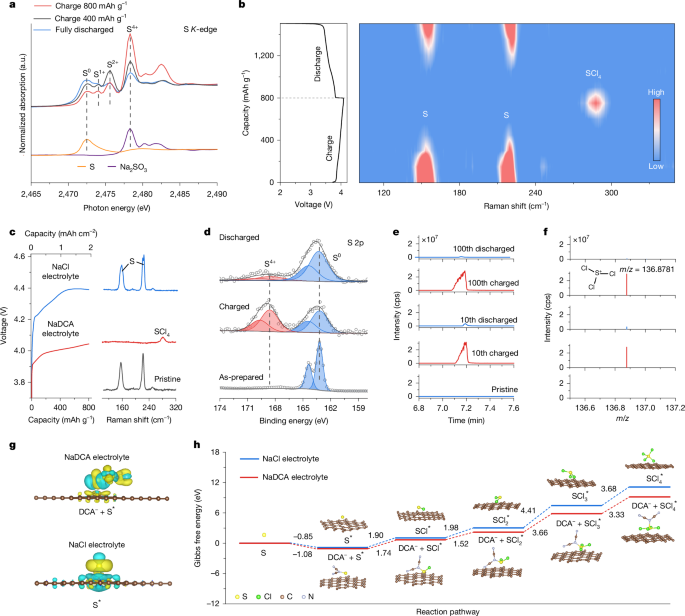
High-voltage anode-free sodium–sulfur batteries - Nature">8</a>. Here we report a 3.6 V class Na–S battery featuring a high-valence sulfur/sulfur tetrachloride (S/SCl4) cathode chemistry and anode-free configuration. We show that sodium dicyanamide (NaDCA) can simultaneously unlock reversible S/SCl4 conversion and Na plating/stripping in a non-flammable chloroaluminate electrolyte. This design enables the maximum energy and power densities of 1,198 Wh kg−1 and 23,773 W kg−1, respectively, calculated on the basis of the total electrode mass including both the cathode and the anode. Also, we demonstrate facilitated S/SCl4 conversion by incorporating a bismuth-coordinated covalent organic framework (Bi-COF) catalyst (8 wt% loading) into the S cathode, which realizes an impressive discharge capacity of 1,206 mAh g(sulfur+catalyst)−1, contributing to a maximum energy density of 2,021 Wh kg−1 calculated on the basis of the total electrode mass. With an estimated cost of US$5.03 per kWh and excellent scalability, our anode-free Na–S battery shows promise in grid energy storage and wearable electronics.
A new architecture based on high-valence sulfur/sulfur tetrachloride cathode chemistry is described for manufacturing high-voltage anode-free sodium–sulfur batteries, demonstrating promise for applications in grid energy storage and wearable electronics.

www.nature.com