In a recent article on
The Top Four Reasons Why Rep. Ilhan Omar Is Wrong About AIPAC, Israel and the Palestinians, CAMERA notes that historically, US support for Israel was actually minimal before 1970 — despite the combined alleged influence of the Jewish vote, Jewish political contributions, and the activities of the pro-Israel lobby. After all, just 3 years earlier, in 1967, Israel’s main source of weapons was not the US; it was the British and the French. Yet after 1970, US support for Israel began to grow rapidly.
The turning point was President Richard Nixon — and Arafat.
As Alex Safian puts it in the article:
The US president in 1970 was Richard Nixon, a Republican who knew very well that overwhelmingly Democratic and left-leaning American Jews had already voted against him in large numbers and would do so again in 1972. What happened in 1970 that convinced Nixon, the arch practitioner of realpolitik, to press for increased support for Israel?
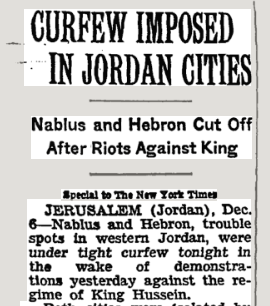
Safian quotes the late Harvard professor, Nadav Safran, who in his book “Israel: The Embattled Ally,” notes that the turning point in US/Israel relations was not any kind of Jewish influence. That influence was consistent and yet had failed to improve US-Israel relations. Instead, the turning point was the crisis of Black September, when Arafat’s Palestine Liberation Organization, with the assistance of invading Syrian tanks, attempted to overthrow and assassinate Jordan’s King Hussein, who was an ally of the US. If successful, they would have posed a threat to western oil supplies.
According to Safran, when the Syrian army captured Irbid, a city in northern Jordan which contained a junction of roads linking Jordan, Syria, Iraq and Israel — King Hussein appealed for American and British help. The British refused and advised the US to do the same. Other European allies also advised against helping. Nixon had Kissinger work out a plan for a joint American-Israeli intervention. Kissinger and Israeli Ambassador Rabin put together a plan for a combined Israeli air strike and armored assault on the Syrian forces in conjunction with an American airborne descent on Amman airport. If necessary, Israeli armored columns would advance in a pincer movement from the Golan and the Jordan Valley and cut off the Syrian intervention forces and destroy them.
Because of the American and Israeli support, King Hussein was able to commit all his forces to fighting Arafat’s forces. The Syrians, on the other hand, wary of that support, and of a flanking attack by columns of Israeli tank columns, withdrew — saving Jordan, and making direct Israeli intervention unnecessary.
(full article online)
How Arafat Helped Establish Israel As The Major US Ally In The Middle East That It Is Today