The WTC buildings steel was tapered in thickness from 6″ thick in the subbasements to 5″, 4″, and so on up to the highest floors, where it was only 1/4″ thick.
Which components are you talking about? Core columns? Perimeter columns?
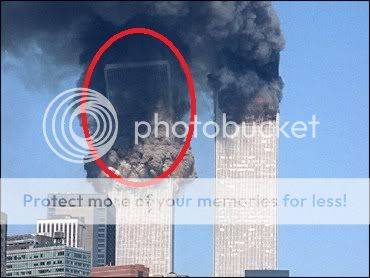
Thus, the relative mass of the steel for the top 14 floors of the North Tower, for example, which were alleged to have been weakened by the intense fires and collapsed onto the 96 floors below, represented on 1.4% of the mass of the steel. The very idea that that miniscule relative mass could overcome the lower 98.6% is a physical absurdity.
I love it!
Do you treat all objects and structures as one solid object? How incredibly stupid. Using your logic, a baseball can NEVER smash through the window of a house because the relative supporting mass of the entire house attached to the window behind it wouldn't allow that to happen right?
Plus the fires didn't burn for long enough nor get hot enough to cause the steel to weaken, much less melt, as witnessed in the rubble piles....That burned for 3 months. If they had burned long enough and hot enough to cause the steel to weaken, since those fires were asymmetrically distributed, their effects would have been asymmetrical, with gradual sagging and tilting, not the complete, abrupt and total demolition sequence that occurred.
The fires didn't get hot enough? At what temperature does steel start to weaken? Now add a load to said steel?
Also, why do you continually forget to add the impact damage to the perimeter and core columns? What happened to the load from the upper structure above that those previously undamaged core and perimeter columns? Those previously undamaged components used to help support SOME of the load from above right? Did that load vanish like a fart in the wind? Or was it redistributed to the other remaining components? Now weaken those remaining components in addition to adding more load to them when the other components were damaged/severed due to the impact?
Now what?
Now what? Now maybe you can present how exactly did NIST assume that collapse was going to be a certainty. What did they base their conclusions on?
The impact damage took out minimal components, and the building redistributed the loads according to the designers plans. They then stood while fires were estimated to have burned. Estimates that were not indicative of steels failure point.
Fire damage would be a slow progressive action, and the expected outcome of such fire damage would have been partial failures at the parts succumbing to the most intense heat.
IOW's, the parts of the building most heavily damaged, would be expected to fail first, then the collapsing parts would encounter much resistance provided by the undamaged, more robust lower parts below.
This would have resulted in a much slower collapse front.
This is not what we saw. Why not?
As it stands now, we are expected to just assume that that the entire undamaged structures below would provide such minimal resistance as to allow a seemingly uncontested progression of collapse? Based on what?
Where in the NIST reports is this confirmed?
BTW, it was the Bazant theory of collapse (that was released 2 days after the attacks?) that used the upper and lower block analogy, that NIST reinforced and used.
Zdenek Bazant and Yong Zhou must be super-geniuses. They were able to understand how two skyscrapers could crush themselves to rubble, a newly observed behavior for steel structures, and write a paper about it in just two days.
So if you have a problem with this take it up with them.
In it they describe "creep buckling" of columns when mentioning the steel slowly losing its strength. This was not a "creep" it was stable on minute and then all resistance was suddenly lost.
They said that "the heating PROBABLY accelerated due to loss of fire insulation material" NIST conducted testing that was inconclusive regarding this.
How many other instances of even larger fires have been witnessed, with no total global collapse in under 20 seconds observed?
They mention that "the failed parts gather speed until it impacts the lower parts" This is logical but where is the evidence that these 2 masses met? The impact would have been visibly noticeable, and recordable.
They mention that "At that moment, the upper
part has acquired an enormous kinetic energy and a significant downward velocity. The
vertical impact of the mass of the upper part onto the lower part (stage 4) applies enormous
vertical dynamic load on the underlying structure, far exceeding its load capacity, even if it
is not heated."
What is lacking in this theory, is that all of this does not happen instantly. It takes time for the undamaged parts to be overcome, especially the parts that are not weakened have not sustained any damage by fire.
Again they leave out the readily obvious debris falling away from the buildings, so it can not contribute to the load, and therefore has less kinetic energy involved.
They don't take into account the buildings reserve strength ratios, either.
They assured us that no FF would be possible due to the resistance the lower structure would supply. This is logical, but as was proven in WTC 7 was proven false.
Using videos, it was also determined buy others, that the roof of the towers, did not experience any halting, or hesitation as would be expected when the 2 masses met.
The collapse progression continued seemingly uncontested by undamaged, stronger components below. The argument has been made that, as each subsequent floor succumbed to failure, their weight was then added to the burden that the lower had to resist. A major problem with this is that we can observe much of this supposed added weight burden, being ejected away from the building, and another part of them was turned to dust.
Bottom line is that NIST has no data to support a total global collapse theory.
No historical precedent to base it on, and failed testing, using exaggerated temps, and figures.
The collapses should have taken significantly longer. They know this which is why they don't go into any detail about it.
They assured us that no FF would be possible due to the resistance the lower structures would supply and the collapsing parts would encounter. This is logical, but as was proven in WTC 7 was false.
Where is the data to back up the NIST conclusions?
What you are asking me to provide, is what you should be demanding in a report from those charged with that responsibility. That would be an explanation with the data that substantiates their assumption/theory.
Those buildings were assisted by something else other then fires and plane damage, and they were charged with making the fire and damage only theory fit. But their own reports
betray them.
They came down too quick. 3 times in one day. There are too many anomalies to even be considered coincidental. They don't explain why.