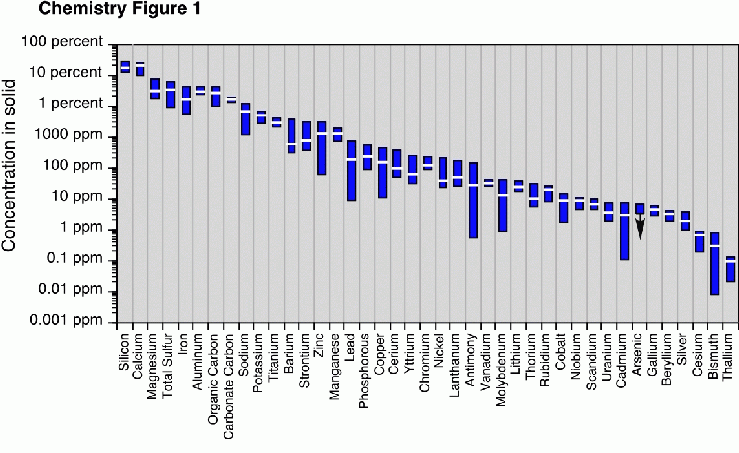
Here's what the USGS found in the dust of the Trade Center...
Strontium, Barium, Thorium, Cerium, Lanthanum, Yttrium and other elements were discovered in the dust and are characteristic fission products of Uranium. Even some Uranium was present in significant amounts.
Now where did all that radioactive shit come from?
Let's see what the USGS really found:
Dust Components
The dust samples were largely made up of a mix of materials commonly used in building construction or found in office buildings: particles of glass fibers, gypsum wallboard, concrete, paper, window glass, etc.
The dust contained higher amounts of lead, zinc, antimony, copper, and other elements of building materials than found in natural soils. The level of lead in some samples was high enough to be a potential concern.
The team also found the less dangerous variety of asbestos, chrysotile asbestos, in most samples at higher levels than what is found in urban particulate matter.
However, the team was grateful not to find amphibole asbestos the kind generally viewed as the more dangerous, more carcinogenic form of asbestos in any of the samples.
Even though this more dangerous form of asbestos was absent from the dust samples, the materials that were found indicated a potential health threat, and USGS scientists reported that cleanup of dusts and debris should be done with appropriate respiratory protection and dust control measures.
By combining the remotely sensed data with the lab results, the team produced a series of maps that showed the distribution of asbestos, concrete, and other materials in the dust around lower Manhattan. As one might expect, heavier materials tended to settle closer to Ground Zero, while lighter materials traveled further away.
Trying to Identify Dust in the Lungs
More recently, scientists have been trying to determine whether this dust signature can help link exposure to World Trade Center dust to respiratory problems experienced by some of the September 11 survivors and emergency responders.
In 2009, Dr. David Prezant, the chief medical officerat the Office of Medical Affairs for the New York City Fire Department, asked Meeker to examine the lung tissue of a firefighter who had developed pulmonary fibrosis. Prezant wanted to know whether particles the firefighter had inhaled as a first responder may have contributed to the disease.
Due to his disease, the firefighter had had a lung transplant, and with both a sample of lung tissue and the means to potentially identify World Trade Center dust, USGS scientists examined the tissue to see if they could demonstrate a link.
What they found was inconclusive. They found an abundance of particles in the lung tissue, but no definitive proof that any of it was dust from the World Trade Center. This lack of proof was not surprising as most glass fibers dissolve in the lungs over time, and it would be unlikely that the particles found in the lung tissue years after the event would be in the same ratios and form as the samples collected.
But this was just one sample, and as more lung tissue becomes available for testing more data may help experts to find better answers about the possible link between exposure to the dust and long-term health problems.
September 11, 2001: Studying the Dust from the World Trade Center Collapse | Science Features