
Reiny? Any comment? Do those first data show significant warming? Do those second data show a high degree of correlation?ReinyDays said "Here's NOAAs data, which includes a statement as to HOW they came up with the data ... but more importantly HOW it's used ... please point and describe what is fraudulent"
ReinyDays said "Man made climate change is a scam by SMART PEOPLE to **** over STUPID PEOPLE, like SMART PEOPLE always do ... for some despicable reason ..."
Have you been drinking? How did you plan on getting away with lies like that when the proof was in the post immediately above?
No one has ever said that CO2 is the only factor affecting global temperatures and no one has ever suggested that there would not be variability. But if you think these data don't show significant warming


Since 1850, these historical events have accelerated climate change
Evidence shows that key historical developments such as industrial revolutions contributed significantly to global warming.
www.weforum.org
or that these data don't show a high degree of correlation
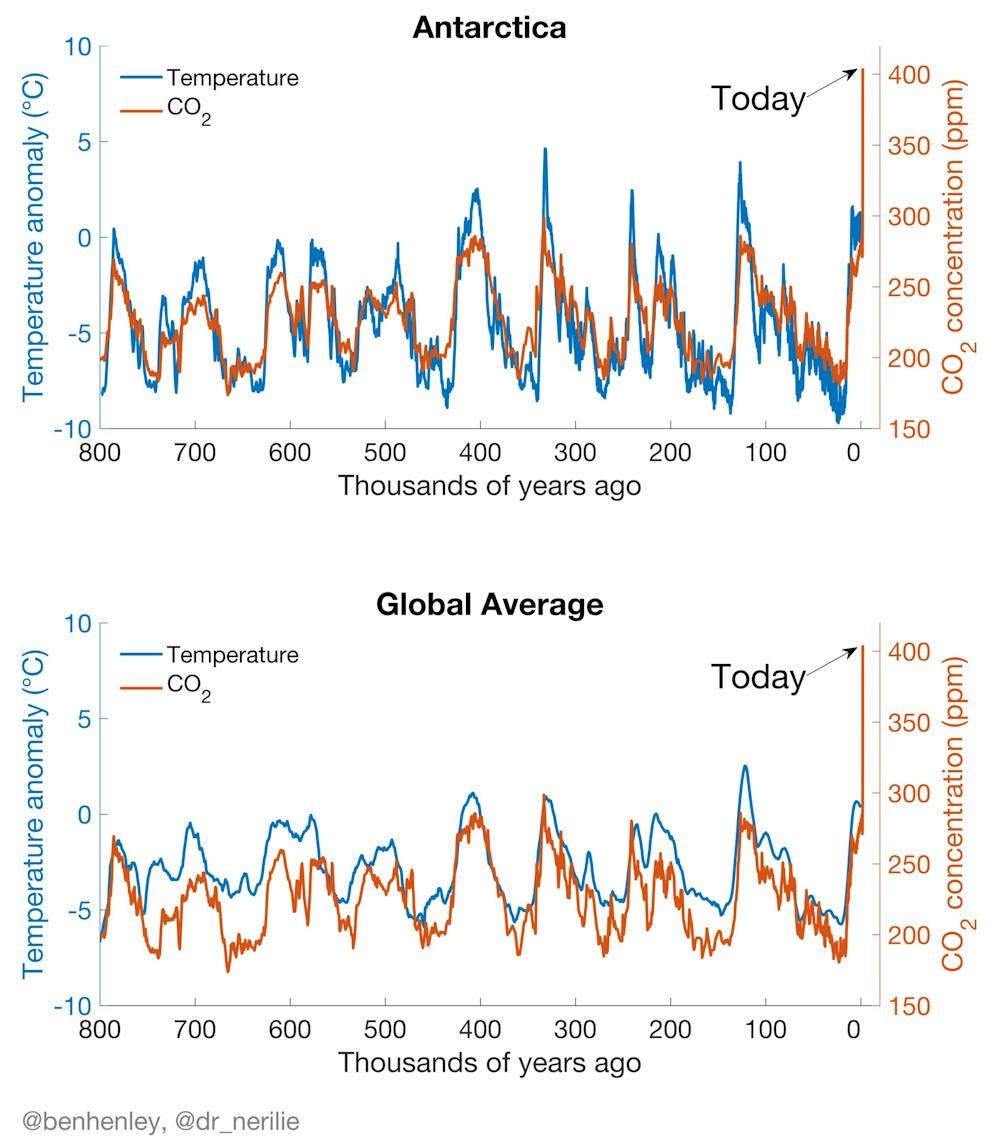
then you've either chosen to lie to yourself or you're as stupid as a rock.
Click to expand...
Navigation
Install the app
How to install the app on iOS
Follow along with the video below to see how to install our site as a web app on your home screen.
Note: This feature may not be available in some browsers.
More options
Style variation
You are using an out of date browser. It may not display this or other websites correctly.
You should upgrade or use an alternative browser.
You should upgrade or use an alternative browser.
50 years of green fAiL
- Thread starter skookerasbil
- Start date

I do. Your graphs are misleading which makes them fake news.Reiny? Any comment? Do those first data show significant warming? Do those second data show a high degree of correlation?
How are they misleading?I do. Your graphs are misleading which makes them fake news.
How are they misleading?
- They smooth out climate variability seen from northern hemisphere ice core data.
- They don't reflect that 8500 years of the past 10,000 years were warmer.
- They use an arbitrary and misleading reference temperature.
- They give a false impression of the recent warming trend.
Crick said : "How are they [the data graphs in post #35] misleading?"
1) You've been claiming that "northern hemisphere ice core data is the be-all and end-all of paleo temperature reconstructions. Perhaps you've posted a link to some well-respected climate scientist(s) making and supporting that assertion, but I haven't seen it. All I've ever seen is your claims and I strongly suspect that what you mean by "northern hemisphere ice cores" is Greenland ice cores because they support your otherwise completely unsupported contentions much better than any other temperature reconstructions. So, sorry, but I strongly believe the failure of Greenland ice core data to match multiple Holocene reconstructions all using multiple proxies from all over the planet is due to the qualities of Greenland ice cores and not the multiple reconstructions which all match each other quite closely.
The temperature data I posted has a rather long provenance (my apologies) but the data actually come from a dataset supplied by Reddit user BGregory98 for public usage and published in Nature Geoscience. From the Nature article in which it is supplied:
Abstract
Multi-decadal surface temperature changes may be forced by natural as well as anthropogenic factors, or arise unforced from the climate system. Distinguishing these factors is essential for estimating sensitivity to multiple climatic forcings and the amplitude of the unforced variability. Here we present 2,000-year-long global mean temperature reconstructions using seven different statistical methods that draw from a global collection of temperature-sensitive paleoclimate records. Our reconstructions display synchronous multi-decadal temperature fluctuations, which are coherent with one another and with fully forced CMIP5 millennial model simulations across the Common Era. The most significant attribution of pre-industrial (1300-1800 CE) variability at multi-decadal timescales is to volcanic aerosol forcing. Reconstructions and simulations qualitatively agree on the amplitude of the unforced global mean multi-decadal temperature variability, thereby increasing confidence in future projections of climate change on these timescales. The largest warming trends at timescales of 20 years and longer occur during the second half of the 20th century, highlighting the unusual character of the warming in recent decades.
 www.ncbi.nlm.nih.gov
2) This is the same as #1 and my response is the same.
3) I assume by "reference temperature" you mean baseline. The graph uses the 1961-1990 average as a baseline. The author is not the first person to use that value for a baseline; that baseline is actually fairly common. To be honest, I don't think you have the faintest idea; you have basically answered my question as to how it's misleading by telling me it's misleading. When plotting anomaly data, there is actually nothing wrong with a completely arbitrary baseline but there is a very common practice to pick meaningful values. To delve further into the question, here is a discussion of baseline selection from "The Phyical Science Basis from the 3rd Assessment Report: https://archive.ipcc.ch/ipccreports/tar/wg1/483.htm.
4) This appears to be even MORE of #1. It doesn't match your ice core.
Sorry dude, but this is a completel fail.
Really? This is your answer?
- They smooth out climate variability seen from northern hemisphere ice core data.
- They don't reflect that 8500 years of the past 10,000 years were warmer.
- They use an arbitrary and misleading reference temperature.
- They give a false impression of the recent warming trend.
1) You've been claiming that "northern hemisphere ice core data is the be-all and end-all of paleo temperature reconstructions. Perhaps you've posted a link to some well-respected climate scientist(s) making and supporting that assertion, but I haven't seen it. All I've ever seen is your claims and I strongly suspect that what you mean by "northern hemisphere ice cores" is Greenland ice cores because they support your otherwise completely unsupported contentions much better than any other temperature reconstructions. So, sorry, but I strongly believe the failure of Greenland ice core data to match multiple Holocene reconstructions all using multiple proxies from all over the planet is due to the qualities of Greenland ice cores and not the multiple reconstructions which all match each other quite closely.
The temperature data I posted has a rather long provenance (my apologies) but the data actually come from a dataset supplied by Reddit user BGregory98 for public usage and published in Nature Geoscience. From the Nature article in which it is supplied:
Abstract
Multi-decadal surface temperature changes may be forced by natural as well as anthropogenic factors, or arise unforced from the climate system. Distinguishing these factors is essential for estimating sensitivity to multiple climatic forcings and the amplitude of the unforced variability. Here we present 2,000-year-long global mean temperature reconstructions using seven different statistical methods that draw from a global collection of temperature-sensitive paleoclimate records. Our reconstructions display synchronous multi-decadal temperature fluctuations, which are coherent with one another and with fully forced CMIP5 millennial model simulations across the Common Era. The most significant attribution of pre-industrial (1300-1800 CE) variability at multi-decadal timescales is to volcanic aerosol forcing. Reconstructions and simulations qualitatively agree on the amplitude of the unforced global mean multi-decadal temperature variability, thereby increasing confidence in future projections of climate change on these timescales. The largest warming trends at timescales of 20 years and longer occur during the second half of the 20th century, highlighting the unusual character of the warming in recent decades.
Consistent multi-decadal variability in global temperature reconstructions and simulations over the Common Era - PMC
Multi-decadal surface temperature changes may be forced by natural as well as anthropogenic factors, or arise unforced from the climate system. Distinguishing these factors is essential for estimating sensitivity to multiple climatic forcings and ...
www.ncbi.nlm.nih.gov
2) This is the same as #1 and my response is the same.
3) I assume by "reference temperature" you mean baseline. The graph uses the 1961-1990 average as a baseline. The author is not the first person to use that value for a baseline; that baseline is actually fairly common. To be honest, I don't think you have the faintest idea; you have basically answered my question as to how it's misleading by telling me it's misleading. When plotting anomaly data, there is actually nothing wrong with a completely arbitrary baseline but there is a very common practice to pick meaningful values. To delve further into the question, here is a discussion of baseline selection from "The Phyical Science Basis from the 3rd Assessment Report: https://archive.ipcc.ch/ipccreports/tar/wg1/483.htm.
4) This appears to be even MORE of #1. It doesn't match your ice core.
Sorry dude, but this is a completel fail.
Yes. That's my answer.Crick said : "How are they [the data graphs in post #35] misleading?"
Really? This is your answer?
1) You've been claiming that "northern hemisphere ice core data is the be-all and end-all of paleo temperature reconstructions. Perhaps you've posted a link to some well-respected climate scientist(s) making and supporting that assertion, but I haven't seen it. All I've ever seen is your claims and I strongly suspect that what you mean by "northern hemisphere ice cores" is Greenland ice cores because they support your otherwise completely unsupported contentions much better than any other temperature reconstructions. So, sorry, but I strongly believe the failure of Greenland ice core data to match multiple Holocene reconstructions all using multiple proxies from all over the planet is due to the qualities of Greenland ice cores and not the multiple reconstructions which all match each other quite closely.
The temperature data I posted has a rather long provenance (my apologies) but the data actually come from a dataset supplied by Reddit user BGregory98 for public usage and published in Nature Geoscience. From the Nature article in which it is supplied:
Abstract
Multi-decadal surface temperature changes may be forced by natural as well as anthropogenic factors, or arise unforced from the climate system. Distinguishing these factors is essential for estimating sensitivity to multiple climatic forcings and the amplitude of the unforced variability. Here we present 2,000-year-long global mean temperature reconstructions using seven different statistical methods that draw from a global collection of temperature-sensitive paleoclimate records. Our reconstructions display synchronous multi-decadal temperature fluctuations, which are coherent with one another and with fully forced CMIP5 millennial model simulations across the Common Era. The most significant attribution of pre-industrial (1300-1800 CE) variability at multi-decadal timescales is to volcanic aerosol forcing. Reconstructions and simulations qualitatively agree on the amplitude of the unforced global mean multi-decadal temperature variability, thereby increasing confidence in future projections of climate change on these timescales. The largest warming trends at timescales of 20 years and longer occur during the second half of the 20th century, highlighting the unusual character of the warming in recent decades.
Consistent multi-decadal variability in global temperature reconstructions and simulations over the Common Era - PMC
Multi-decadal surface temperature changes may be forced by natural as well as anthropogenic factors, or arise unforced from the climate system. Distinguishing these factors is essential for estimating sensitivity to multiple climatic forcings and ...
2) This is the same as #1 and my response is the same.
3) I assume by "reference temperature" you mean baseline. The graph uses the 1961-1990 average as a baseline. The author is not the first person to use that value for a baseline; that baseline is actually fairly common. To be honest, I don't think you have the faintest idea; you have basically answered my question as to how it's misleading by telling me it's misleading. When plotting anomaly data, there is actually nothing wrong with a completely arbitrary baseline but there is a very common practice to pick meaningful values. To delve further into the question, here is a discussion of baseline selection from "The Phyical Science Basis from the 3rd Assessment Report: https://archive.ipcc.ch/ipccreports/tar/wg1/483.htm.
4) This appears to be even MORE of #1. It doesn't match your ice core.
Sorry dude, but this is a completel fail.
- They smooth out climate variability seen from northern hemisphere ice core data.
- They don't reflect that 8500 years of the past 10,000 years were warmer.
- They use an arbitrary and misleading reference temperature.
- They give a false impression of the recent warming trend.
That would be expected comparing data from a single proxy to one constructed from 70 or 80 of them.Yes. That's my answer.
- They smooth out climate variability seen from northern hemisphere ice core data.
That would be because multiple proxies indicate that they were not.
- They don't reflect that 8500 years of the past 10,000 years were warmer.
That is simply incorrect.
- They use an arbitrary and misleading reference temperature.
They do not.
- They give a false impression of the recent warming trend.
And, of course, you STILL haven't explained a damned thing. The question was "why are they misleading" not "in what ways do you think they are misleading". You need to tell us what was wrong with the process used by the several different scientists who assembled these reconstructions.
And incorrect if the goal is to identify climate changes.That would be expected comparing data from a single proxy to one constructed from 70 or 80 of them.
That would be because multiple proxies indicate that they were not.
That is simply incorrect.
They do not.
And, of course, you STILL haven't explained a damned thing. The question was "why are they misleading" not "in what ways do you think they are misleading". You need to tell us what was wrong with the process used by the several different scientists who assembled these reconstructions.
And you STILL haven't explain WHY you believe they were misleading. I am finding it more and more difficult to avoid concluding that you don't answer simply because you can't.And incorrect if the goal is to identify climate changes.
Sure I did. Go back and re-read the discussion. Then tell me what you think I said it was and then we can talk.And you STILL haven't explain WHY you believe they were misleading. I am finding it more and more difficult to avoid concluding that you don't answer simply because you can't.
No thanks. I'm tired of your evasions.Sure I did. Go back and re-read the discussion. Then tell me what you think I said it was and then we can talk.
I'm the least evasive person here. Don't blame me for your dementia.No thanks. I'm tired of your evasions.

skookerasbil
Platinum Member
- Thread starter
- #53
More failing....

skookerasbil
Platinum Member
- Thread starter
- #54
No thanks. I'm tired of your evasions.
Dude...evasions?

Who is going to try to evade when they are already publicly pwning you? Routinely btw...
Eventually, anybody gets bored of trying to respond to absurdities. It is a natural response to a condition known as cognitive dissonance....which btw, runs concurrent with OCD btw...
Sadly, it's no different than the guy who can't leave his house without washing his hands 17 times.
Evasive?
Dude...people get bored of winning all the time. Guess you never watched The Twilight Zone....
Posting the same link and the same graphic over and over and over and over isn't addressing issues. It's obsession.I'm the least evasive person here. Don't blame me for your dementia.

jc456
Diamond Member
- Dec 18, 2013
- 160,575
- 40,137
- 2,180
and yet, that's what you do.Posting the same link and the same graphic over and over and over and over isn't addressing issues. It's obsession.
jc456
Diamond Member
- Dec 18, 2013
- 160,575
- 40,137
- 2,180
ironic huh?I'd have guesses that's what it must look like to you since you're an ignorant troll.
No. It's called winning. Why would I stop playing a winning hand? I wouldn't.Posting the same link and the same graphic over and over and over and over isn't addressing issues. It's obsession.
Similar threads

- Replies
- 13
- Views
- 600

- Replies
- 4
- Views
- 163


- Replies
- 160
- Views
- 3K


- Replies
- 48
- Views
- 482
New Topics
-

-
-
Protesters In Washington State Convicted of Conspiracy to Impede ICE Transport
- Started by Hollie
- Replies: 3


