Actually Bunky, you shot yourself in the foot with Post Number One -- the same one you reposted over and over and over --- that floats a myth in its first paragraph and then proceeds to provide a link that debunks the same myth, all in a single post.
As for that CRA vote, I got your count right here Sprinkles.
By party: Solid support, both sides. Easy win.
By REGION: Holy shit.
's your significant pattern, Cletus. And that's when the South shifted from Blue to Red, as soon as Uncle Strom sent word that it was OK to do that.
>> 80% of Republicans in the
House and
Senate voted for the bill. Less than 70% of Democrats did. Indeed, Minority Leader Republican
Everett Dirksen led the fight to end the filibuster. Meanwhile, Democrats such as
Richard Russell of Georgia and
Strom Thurmond of South Carolina tried as hard as they could to sustain a filibuster.
Of course, it was also Democrats who helped usher the bill through the House, Senate, and ultimately a Democratic president who signed it into law. The bill wouldn't have passed without the support of Majority Leader
Mike Mansfield of Montana, a Democrat. Majority Whip
Hubert Humphrey, who basically split the Democratic party in two with his 1948 Democratic National Convention speech calling for equal rights for all, kept tabs on individual members to ensure the bill had the numbers to overcome the filibuster.
Put another way, party affiliation seems to be somewhat predictive, but something seems to be missing. So, what factor did best [in] predicting voting?
.... You can see that g
eography was far more predictive of voting coalitions on the Civil Rights than party affiliation. What linked Dirksen and Mansfield was
the fact that they weren't from the south. In fact, 90% of members of Congress from states (or territories) that were part of the Union voted in favor of the act, while less than 10% of members of Congress from the old Confederate states voted for it. This 80pt difference between regions is far greater than the 15pt difference between parties.
But what happens when we control for both party affiliation and region? As Sean Trende
noted earlier this year, "sometimes relationships become apparent only after you control for other factors".
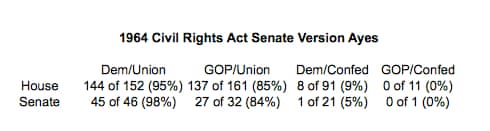
In this case, it becomes clear that Democrats in the north and the south were more likely to vote for the bill than Republicans in the north and south respectively. This difference in
both houses is statistically significant with over 95% confidence. It just so happened southerners made up a larger percentage of the Democratic than Republican caucus, which created the initial impression than Republicans were more in favor of the act.
Nearly 100% of Union state Democrats supported the 1964 Civil Rights Act compared to 85% of Republicans. None of the southern Republicans voted for the bill, while a small percentage of southern
Democrats did.
The same pattern holds true when looking at ideology instead of party affiliation. The folks over
at Voteview.com, who created
DW-nominate scores to measure the ideology of congressmen and senators, found that the more liberal a congressman or senator was the more likely he would vote for the Civil Rights Act of 1964, once one controlled for a factor closely linked to geography.
That's why Strom Thurmond
left the Democratic party soon after the Civil Right Act passed. He recognized that of the two parties, it was the Republican party that was more hospitable to his message. The Republican candidate for president in 1964,
Barry Goldwater, was one of the few non-Confederate state senators to vote against the bill. He carried his home state of Arizona and
swept the deep southern states – a first for a Republican ever.
Now, it wasn't that the Civil Rights Act was what turned the South against the Democrats or minorities against Republicans.
Those patterns, as Trende showed, had been developing for a while. It was, however, a manifestation of these growing coalitions. The South gradually became home to the conservative party, while the north became home to the liberal party.
... Thus, it seems to me that minorities have a pretty good idea of what they are doing when joining the Democratic party. They recognize that the Democratic party of today looks and sounds a lot more like the Democratic party of the North that with near unity passed the Civil Rights Bill of 1964 than the southern Democrats of the era who blocked it, and today would, like Strom Thurmond, likely be Republicans. << ---
The Guardian