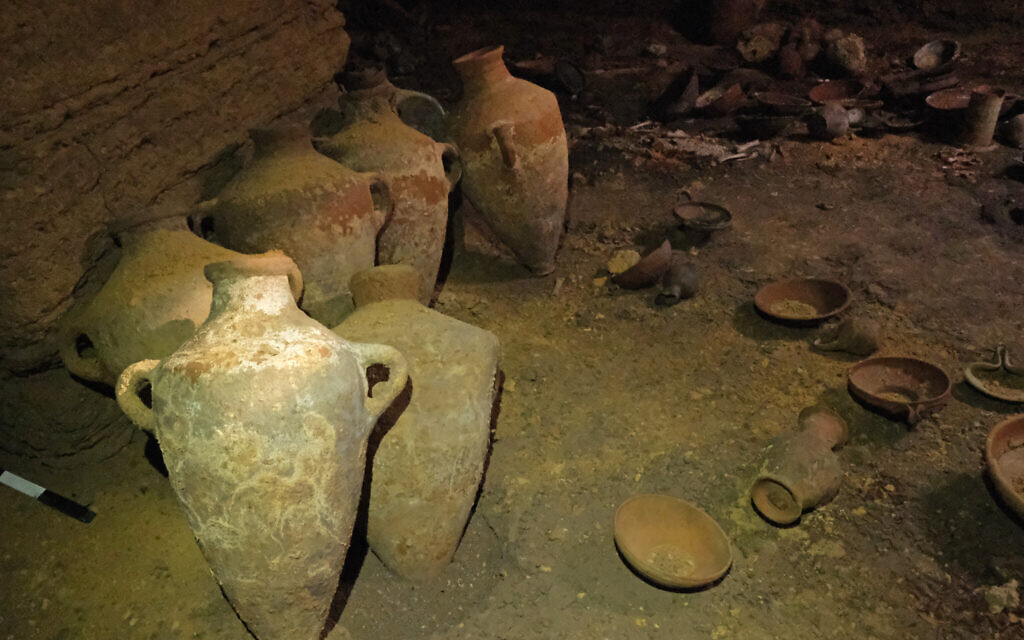
The Israel Antiquities Authority team first enter the cave. Film: Uzi Rotstein, Israel Antiquities Authority
A 3,300 year-old intact burial cave was discovered south of Tel Aviv along the coast off the Mediterranean Sea, the Israel Antiquities Authority announced on Sunday.
The cave, dating back to the period of Rameses II, regarded by some scholars as the Pharaoh of the biblical exodus from Egypt, was discovered in the Palmahim Beach National Park as a mechanical digger broke through its roof during development works by the Israel Nature and Parks Authority.
As Israeli archeologists walked down a ladder into the site, they saw what they described as a cave “frozen in time,” featuring several dozens of intact pottery and bronze artifacts as they would have been arranged in a burial ceremony, about 3,300 years ago. During that period, vessels were presented as burial offerings for the deceased in the belief that they would serve the person in the afterlife. The burial cave chamber was hewn into a bedrock in the form of a square with a central pillar supporting its ceiling.
In the burial chamber, the archeologists found deep and shallow bowls, some red-painted, footed chalices, cooking pots, storage jars and oil lamps for lighting. The archeologists believe that some of the storage jars were produced along the coast of Syria and Lebanon. Smaller vessels, mainly jugs and juglets, used to store and trade small amounts of expensive commodities, originated from Tyre, Sidon, and other ports along the Lebanese coast, whilst other pottery vessels came from Cyprus.


 www.jpost.com