Inexpertly, the Democratic advantage has tended to be (mathematically) "C + G". Republicans may have a slight advantage in "I", especially if you consider NAFTA as a "Republican-like policy", perhaps a political compromise of sorts. But, business investments are a small fraction of US GDP.
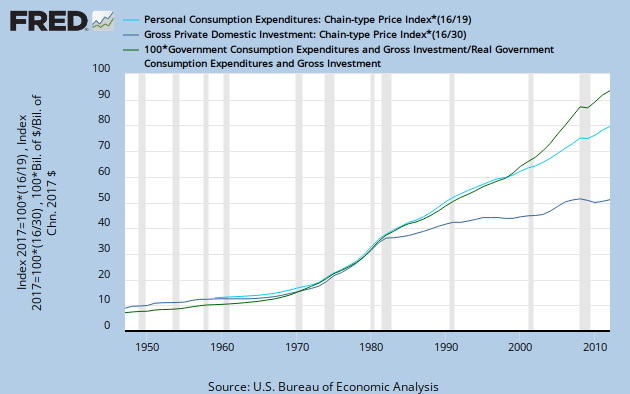
Price-levels for personal consumption (C), investments (I), & government (G) tracked together, until c.1980. Then, the price-levels for (C,G) diverged, from the price-level for (I). OPEC's agreement, to reduce oil prices, during Reagan's Presidency, led to the "Great Moderation", apparently most prominent for investments (houses, factories), where-amongst price-levels have increased only 50%. Conversely, price-levels have increased 150% for consumers, and 200% for government, the latter sky-rocketing above the former under Pres. Bush the younger:
Inexpertly, investments in capital (houses, factories) seem to occur "an economy apart" from personal consumption (food, cars) and government (teachers, police, soldiers; ships, bases, computers). Lower prices imply "fewer dollars chasing after products", so perhaps relatively less money circulates amongst capital investments ? Or, given the "Great Moderation", perhaps costs are simply lower for private-sector capital projects
(so that the private investments AS curve is simply lower, compared to consumption & government) ?
Net corporate taxes, relative to GDP, actually increased under Pres. Reagan, and so "reduced taxes" or "corporate welfare" do not seem to explain the "Great Moderation" in capital investment price-levels.