Heidi Shierholz, economist at the non-profit, non-partisan Economic Policy Institute told Here & Nows Robin Young that the underlying cause of long term unemployment is much larger. Its not a worker skills problem, its not that people are taking vacation on their UI [un-employment insurance] benefits. Its because there is very weak demand for workers, she said.
Yeah that's right. Now why is there very weak demand for workers? That's really the question, isn't it?
I have been curious as to how the standard of living has been going. I finally decided to accept the personal consumption expenditures portion of the GDP as being close enough. It isn't an absolute measure, but it is good enough to compare the relative change over time.
What I was really wondering about is how the standard of living changed for people that are working. We can be reasonably sure that the per capita standard of living falls during a recession. The question is, what happens to the standard of living for the employed population. Does it fall or is the decrease entirely on the backs of the newly unemployed.
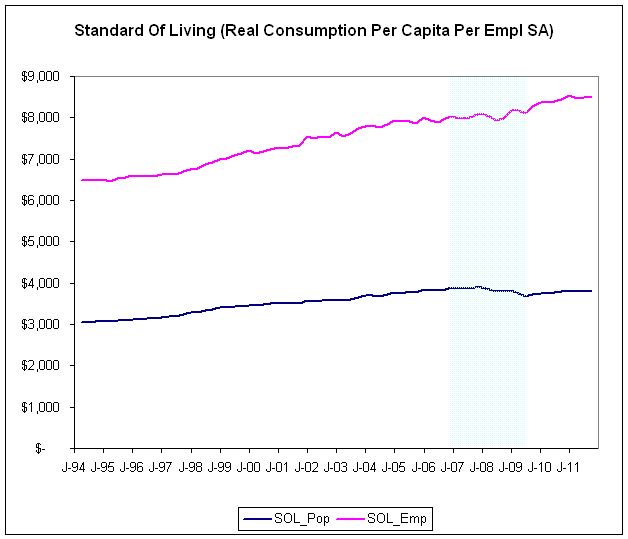
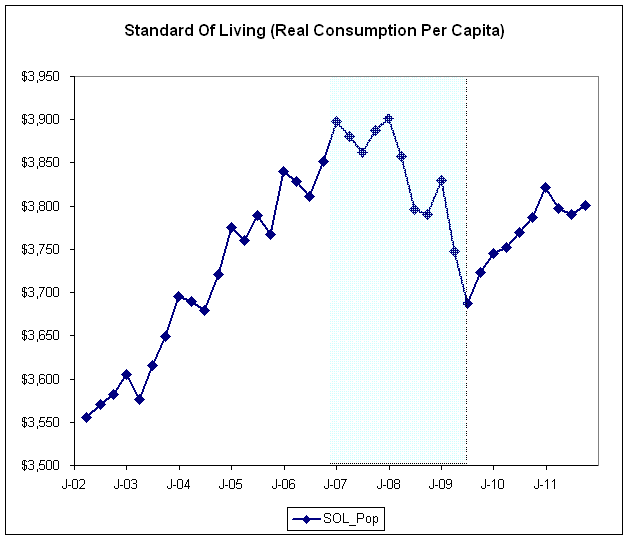
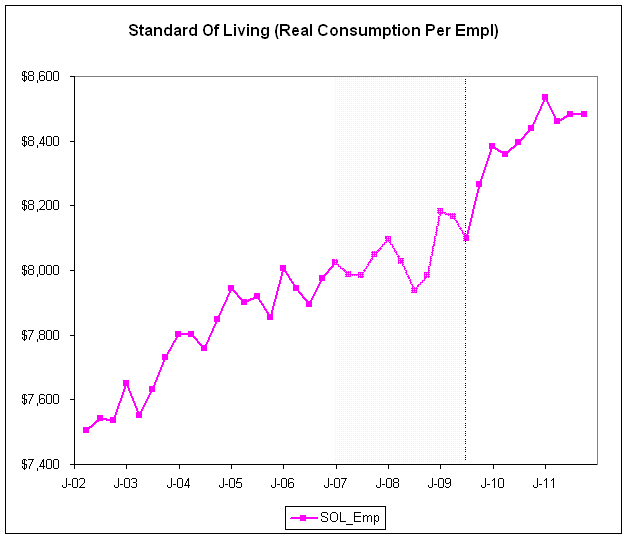
I think we can make a good guess, but just to be sure, here is the real dollar per capita and per worker personal consumption expenditures.
I did both the long decade trend and the trend bracketing the recession.
And, of course, the standard of living for the employed remained relatively steady. On a working person basis, it took a bit of a deceleration, then rebounded.
As a proxy measure is suffers a bit. But that is the problem with macro economic information, it all suffers a bit.
Obviously, by whatever means it comes about, the long term unemployed, disabled, elderly, institutionalized, military, and homeless are consuming some portion of that total personal consumption expenditures. Somehow, those that are working do produce enough for the unemployed and disabled to scrape by. It would be nice to be able to separate consumption out by income level, employment, even adjust it for quality.
Still, it is telling. What appears to be an aggregate decrease, when examined from the perspective of the total population, nearly disappears when examined from an employment perspective. If you didn't know there was a recession in there, you would hardly notice.
If you think about it, when the economy recedes, the change in the standard of living is insulated in impact from those remaining on the employment rolls and ever further insulated in impact as income level increases. And of course it does. Demand falls, production cuts back, the labor force is trimmed, and income per working person remains the same. In fact, one might wonder if the recovery in standard of living happens from the top down.
Beyond the initial shock of the housing bubble burst, it should be fairly clear that the reduction in demand caused the recession. There is another view, when looking at consumer credit, that makes it clear that it is a deceleration of consumption that initiated the recession.
If Say's law applied, there would be no recession. If supply side worked, there would be no recession. If supply creates it's own demand, given that supply was up, then demand would have been up and no recession would have occurred.
Demand fell, GDP fell, and not because of a lack of production capacity. It fells for lack of demand. Then the workforce was trimmed, investments and capital as well, as necessary. And it was trimmed until the economy settles into a new stable balance. We need, after all, only two percent of the workforce, or about one percent of the population, to grow sufficient food.
The reason we have such long term unemployment is because we have an oversupply of labor given the demand. And, we always do. If not for a bubble, technology, housing or otherwise, the economy doesn't need to employ everyone. It is stable right where it is. The standard of living for the employed continues to increase without a decrease in the employment to population ratio. (I've got another graph of that.)
If you think the economy sucks, it depends on what we mean. It doesn't really. It's just a smaller economy. The functional economy, that existed in 2006, is simply smaller now. It just sucks for that portion that are no longer a part of it.