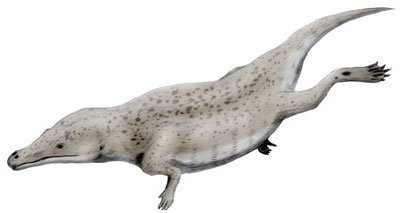
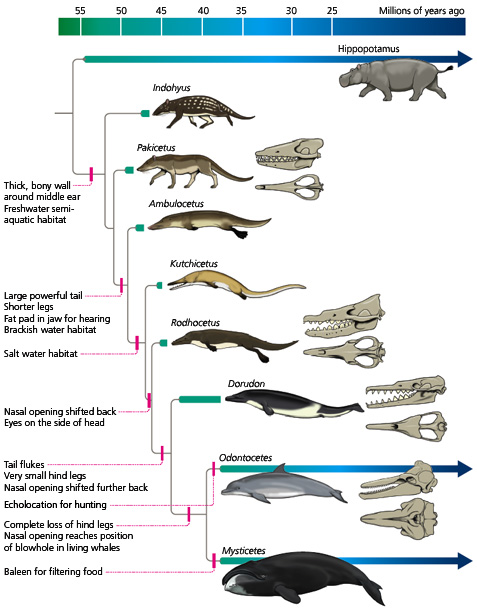
'"It is reported that Hans Thewissen, an assistant professor of anatomy at Northeastern Ohio Medical School; Tasseer Hussain, professor of anatomy at Harvard University; and M. Arif, a geologist of the Geological Survey of Pakistan, happened upon the fossil during a 1992 dig in hills west of Islamabad, Pakistan. The
Plain Dealer, along with its article, has a good picture of the fossil.
When some of the ICR staff looked at the picture with the knowledge that Thewissen and fellow workers called this creature a whale, they laughed. Evolutionists may claim that this was because of ignorance of subtle distinctions of anatomy; on the other hand, associating the word "whale" with a creature with large and powerful front and hind legs does seem a bit ludicrous to skeptics. In their
Science article,[6] Thewissen and coworkers state that
Ambulocetus was about the size of a male sea lion, weighing about 650 lbs. and had a robust radius and ulna (the two bones in the upper forearm). They report that the structure of the forearm would have allowed powerful elbow extension by triceps, and that, unlike modem cetaceans, elbow, wrist, and digital joints were flexible and synovial (lubricated). The hand was long and broad, with five digits. The femur was short and stout, and the feet were enormous. The toes were terminated by a short phalanx carrying a convex hoof. They suggest that unlike modern cetaceans,
Ambulocetus had a long tail, and that it probably did not possess flukes.'

www.icr.org
ETA: If you want to show us some evidence of sea-to-land mammal, the show us the transitional fossils. There should be plenty of them as you would need a large population for evolution to do its magic wouldn't you? It's hard for me to see a sea mammal start walking on land suddenly as their breathing apparatus are vastly different.