
Doc7505
Diamond Member
- Feb 16, 2016
- 23,505
- 41,835
- 2,430
Why can't the West match Russia's ammunition production?
The Western world never thought it would need to make this much gunpowder again. It's now struggling to compensate for 'strategic bottlenecks,' including dependence on China.
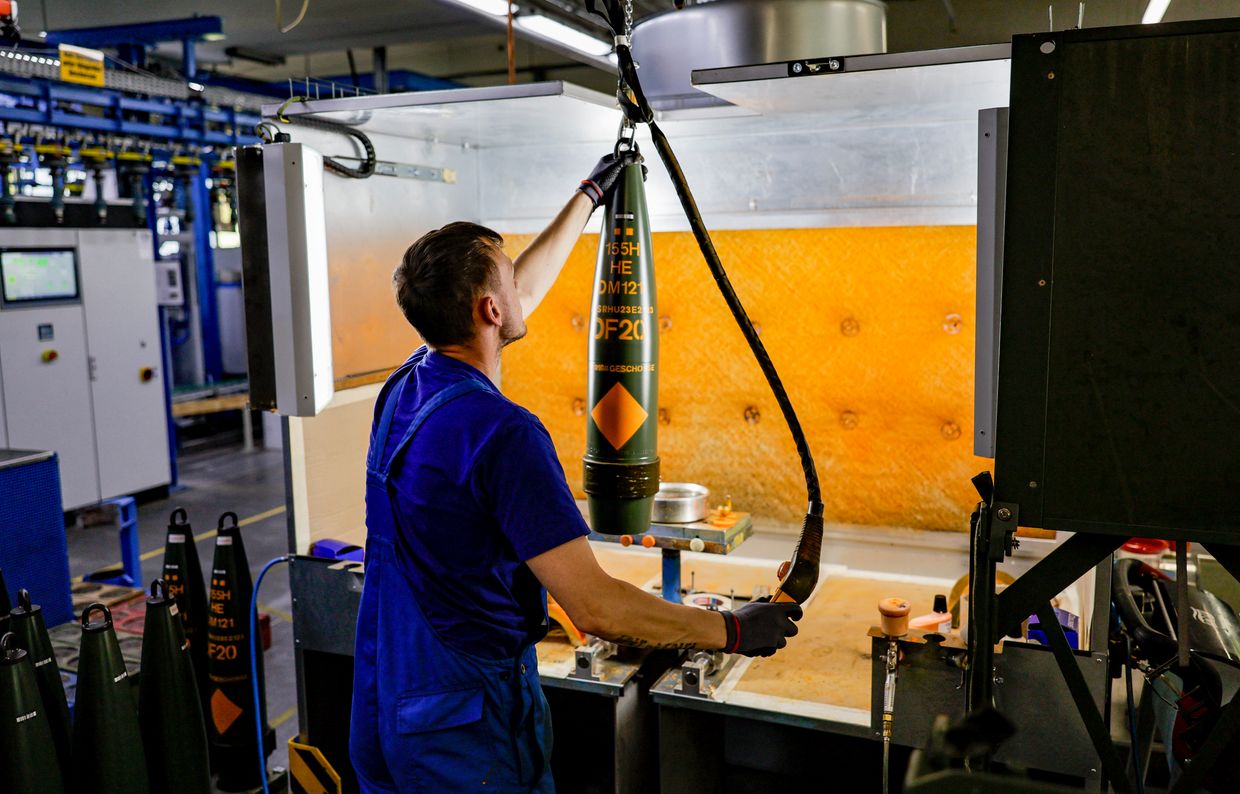
Why can't the West match Russia's ammunition production?
Editor's Note: This article has been updated to reflect new details of BAE Systems' new chemical process that the company confirmed to the Kyiv Independent after initial publication. The West is failing to catch up to Russia's production of the most basic unit of war for the past...
 kyivindependent.com
The West is failing to catch up to Russia's production of the most basic unit of war for the past half-millennium — gunpowder.
The modern propellants and explosives that power war have largely been offshored. While Western manufacturers are churning out shell casings, they are short on the materials to fill them with. A dearth of ammunition from NATO allies has long hampered Ukraine, but is more recently alarming the Western alliance.
"Putin's war machine is speeding up, not slowing down," NATO Secretary General Mark Rutte said at a June 9 speech in London. "In terms of ammunition, Russia produces in three months what NATO produces in a whole year."
"Russia could be ready to use military force against NATO within five years. Let's not kid ourselves: We are all on the Eastern flank now," Rutte continued.
It is no secret that Ukraine has relied on the West for ammunition since Russia's full-scale invasion. NATO's militaries have been sounding the alarm as to dwindling artillery reserves since at least late 2022. But they have been far slower in ramping up production than Russia.
Jammed between unequal arsenals, Ukraine has long felt the pinch.
With stocks running low, NATO's armories are finally confronting the harsh reality that they have outsourced core defense manufacturing functions to hostile nations.
In part, that disparity is because Russia has converted to a wartime economy and can act more decisively. But it is also because Russia never had the environmental controls that the U.S. and EU have. The production of the raw chemicals that power guns, bombs, rockets, and artillery is a filthy business, literally.
~Snip~
"It is a fact that gunpowder and propellants represent a bottleneck in the manufacturing process compared to the relatively straightforward production of shells," Andrej Cirtek, a spokesperson for the Czechoslovak Group, or CSG, told the Kyiv Independent.
~Snip~
"In Europe, starting production of explosive components from scratch is practically infeasible due to lengthy regulatory processes and limited availability of necessary technologies. For this reason, CSG focuses on restoring and expanding production at sites with a historical manufacturing legacy," Cirtek told the Kyiv Independent.
Basic ballistics
The most relevant "excitants" for military production are broken down into propellants and explosives. Gunpowder is a propellant. TNT is an explosive.
As an example, a typical 155 mm artillery shell features a chamber filled with an explosive, often TNT or hexogen, usually called RDX. A modern mortarist loads a usually explosive-packed shell and then "bags" of propellant, whose weight and composition are determined by required range.
The divide between propellants and explosives is not black and white, says John Gray, a former U.S. Army ordnance disposal specialist who now trains U.S. servicemen how to make improvised explosives.
~Snip~
A major Reuters investigation from last July found that nitrocellulose production was particularly hamstringing NATO's efforts to build artillery shells.
There are multiple reasons. Raw materials or chemicals feature lower profit margins than end-stage weapons. They also leave massive environmental footprints, particularly of nitric and sulphuric acid, which are key to making everything from nitrocellulose to RDX.
~Snip~
The West has clearly recognized this is a problem for both Ukraine and NATO members. A flurry of government contracts and arms maker announcements have touted acquisitions and refurbishments on industrial centers everywhere from Virginia to Saxony.
Those few companies that have hung onto the explosives industries are seeing massive profits.
~snip~
Gray pointed to patents for nitrocellulose-free powder originally filed by Dynamit Nobel — today ChemRing Nobel — and using RDX contained in fillers to produce a propellant as the most likely alternative.
A potential pivot away from nitrocellulose-derived propellant may be the most chemically interesting result of today's shortage.
Commentary:
Most men especially politicians and bureaucrats in the West don’t know which end of a screwdriver to hold. Not their fault either.
Lest we forget, America decided to be a ‘service economy’ built on ‘finance’ and lawyers suing doctors. Thank You Democrats and Bill Clinton. Manufacturing, and the skills and education that went with it, was TOSSED ASIDE, as it meant getting our hands dirty.
We need at least a DECADE to straighten out yet I haven’t seen any signs of people in the West figuring this out.
Trump is the only one that has tried to turn this around.
Democrats are more concerned with giving serial numbers to every cartridge manufactured and that cartridge should be made in the most environmental method conceivable.
In the movie "Enemy at the Gates" the opening shows Russian soldiers lining up and one out of 5 got a rifle the other four were give a 5 round clip of 7.62x54r. That is the philosophy of Russian war. Showing they have no problem using humans as cannon fodder.
If Russia loses more than one million in the war and 20 or 30 thousand North Koreans, to them that is no problem.
Meanwhile they are producing more munitions at a faster rate than the U.sS., and Europe combined.
Trump was right to demand that NATO countries raise their percentage of support to 5%.


