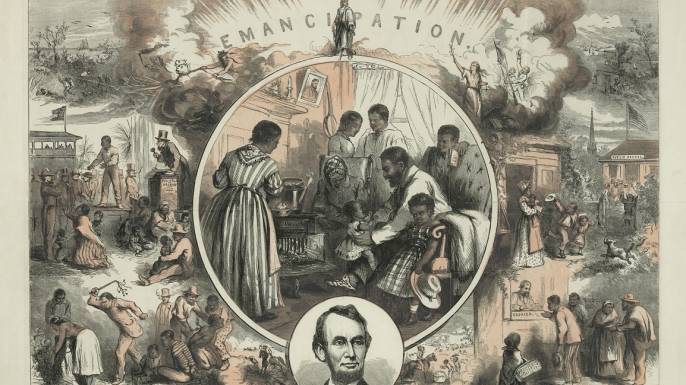
There were racists in the north, but at the end of the day, hundred's of thousands northerners gave their life for a Union without slavery.
There were non-racists in the south, but at the end of the day, hundred's of thousands southerners fought for a Union with slavery.
The northerners were MORE racist than southerner, since they had little or no contact with Blacks, and did not understand Blacks and white are actually the same mentally.
This was true until after WWII, when lots of southern Blacks went north to fill jobs, and people in the north got familiar with Blacks.
Neither northerner nor southerners were fighting over slavery.
They were fighting over economics about whether or not the south could be economically and politically independent of the north.
The main argument was over tariffs, not slavery.
The north never proposed anything to free the slaves until after the Civil War was over.
The Emancipation Proclamation did not free northern slaves.
{...
Yet at the time of this first Juneteenth, slavery had not yet been abolished throughout the United States, even by law. That momentous occasion wouldn’t occur until
ratification of the 13th Amendment on December 6, 1865, more than half a year after the surrender of Confederate forces as Appomattox.
Where in the U.S. did slavery manage to persist after Juneteenth had come and gone? The answer, and even the sheer number of places, may surprise you.
The Emancipation Proclamation and the 13th Amendment
The Emancipation Proclamation, issued on January 1, 1863, was Lincoln’s order, as commander-in-chief of the Union’s military forces, that slavery was abolished in those parts of the U.S. which had been in rebellion and which had been re-captured by Union troops.
This meant that slavery remained legal in those slave states which had remained in the Union. This included the border states, such as Delaware, Kentucky, and Maryland, but also those northern “free states” which permitted slavery under certain circumstances, such as when the slave owner claimed to be a permanent resident of a southern state. Those states legally permitting slavery under such circumstances stretched from the Atlantic to the Pacific.
The Emancipation Proclamation also did nothing to discourage the practice of informally permitting slavery in many northern states where it was no longer permitted by law. Many African-Americans remained in slavery under this practice, which also existed from coast to coast in the “free states,” often quietly but in many cases quite openly.
...}
Today, June 19, is widely celebrated as Juneteenth, which marks the day in 1865 when Union troops arrived in Galveston, Texas, bringing word that the Civil War had ended and the enslaved population

www.tracingcenter.org