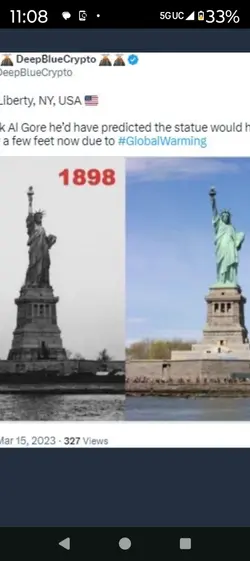
What ever happened to that ridiculous climate change hoax.

The thing is, the reality is that we have damned little evidence of the glacial cycles. The best we can really do is proxy data from the Antarctic Ice Cores. And even then, it's only a proxy and not "true" temperatures. And as somebody that has been studying geology for decades, that is one of the first things I learned.

Interesting dialogue here ... I only want to weigh in on the meteorological parameters ... and how this relates to "true" data against proxy data ...

These parameters are temperature, pressure, humidity, wind speed and direction, and precipitation ... these are the measurements we take every hour at every weather station ... these are the values that are measured directly, not inferred from any proxy data nor do they result with any statistical manipulation ... these six parameters are the "cold hard facts" of the matter ...

"Statistics don't lie, but liars use statistics" -- unknown
"Lies, damned lies and statistics" -- Benjamin Disraeli

I think reading to much into these proxies is part of the bigger trouble from reading too much into statistical results ... and yes, average is a statistical result ... easily manipulated into saying exact what we want the average to say ... just pick and choose what you're averaging ... and climate model simulations run on computers can only say what they're programmed to say ...

if ( $T > 75 ) { echo "We're all gonna die"; }
else { echo "We're still gonna die"; }

See, really easy to encode perfect lies ...

=====

Consensus is political ... not scientific ... in science we use "cause-and-effect" ... never opinion ...
 
Not really, because we know snowfall can extend quite deep into most of North America. Yet the evidence of over 3 million years of glacial cycles show that other than around New England and the Great Lakes they barely extend beyond the US-Canada Border.

I have seen six foot deep snow drifts in my yard in North Carolina, and gone through sub-zero temperatures in Texas. Does not mean those would ever be covered by glaciation short of another Cryogenian era like we had 635+ mya.

Huh?

Washington, Oregon, California get a lot of snow annually in the Cascade mountains, and it snows a lot in New Mexico Colorado region too.

Snoqualmie pass in Washington gets over 450 inches a year of snow on average at just 3,022 foot elevation.

LINK

Mt. Rainier has the largest glacier system of the lower 48 states by far and that is at the 47 degree north level.

The mid California Sierras get massive snow most years too.
 
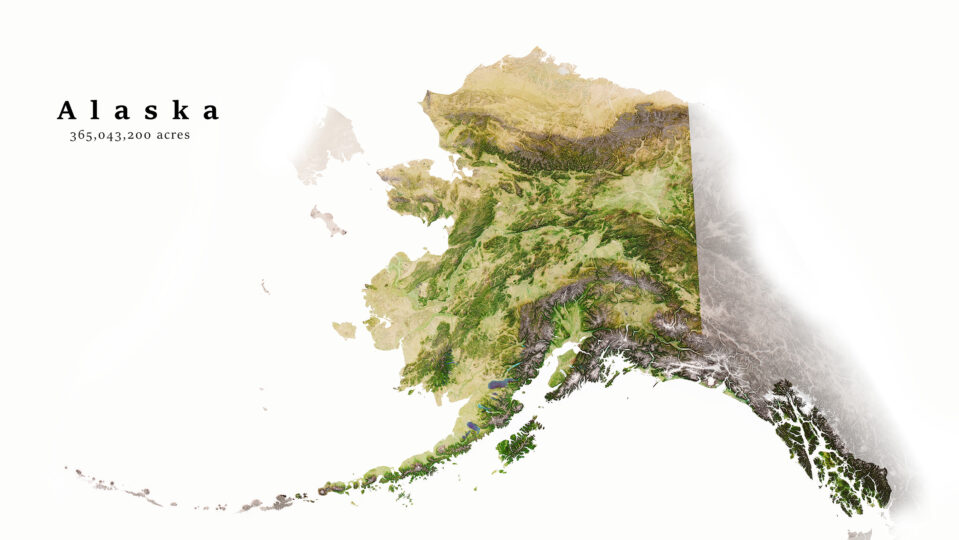
Greenland hosts massive ice sheets due to its vast landmass in the Arctic, proximity to moisture-laden North Atlantic currents (like a branch of the Gulf Stream), and lower summer melt, while interior Alaska remained largely ice-free during the last Ice Age because the Brooks Range created a rain shadow, blocking Pacific moisture and creating a dry, grassy "Beringia" refuge with less snowfall despite its northern latitude. Greenland acts like a continental center for ice accumulation, whereas Alaska's interior is too dry and far from ocean moisture for massive, permanent ice sheets to form, relying more on alpine glaciers.

Some have a serious issue in trying to comprehend how topography affects climates.

The reason is actually rather simple, when one knows about plate tectonics. Greenland is sitting well inland on a tectonic plate where the nearest tectonic activity is sea floor spreading. In other words, it is a geological dead zone with not much happening.

On the other hand, Alaska is sitting on a highly active plate boundary with active subduction occurring. That has caused significant uplift in addition to the addition of terranes.

PermafrostPathways-AKTopo_wide_map_light_w_labels_6_2_22-959x540.jpg


That section between Alaska and the Pacific is a mélange made up of thrust faulting, volcanic activity and exotic terranes that as you stated creates a rain shadow effect. That is why here in the Pacific Northwest almost all of the rain stops within 100 miles of the ocean. Both the coastal range then the Cascades causes most of the rain to precipitate out, leaving the eastern part of Oregon and Washington dry.

In Alaska, it simply happens from South to North instead of West to East. And why if somebody looks at a map of glaciation of Alaska during the LGM, this is what they see.

4WaQ9sRc_o.png
 
Yes, glaciers exist far from the poles, found in high mountain ranges on every continent except Australia, like the Himalayas, Andes (even tropical ones), and Rockies, because high altitude creates cold enough conditions for snow to accumulate and form ice, even near the equator. While most glacial ice is polar, these mountain glaciers, though smaller, are significant freshwater sources, as seen with Asian glaciers feeding rivers to billions, notes the USGS.

Hell, the newest glacier on the planet is less than 50 years old and sits inside of an active volcano. And less than 200 years ago there was glacier expansion happening on a global scale.
 
Not really, because we know snowfall can extend quite deep into most of North America. Yet the evidence of over 3 million years of glacial cycles show that other than around New England and the Great Lakes they barely extend beyond the US-Canada Border.

I have seen six foot deep snow drifts in my yard in North Carolina, and gone through sub-zero temperatures in Texas. Does not mean those would ever be covered by glaciation short of another Cryogenian era like we had 635+ mya.
Sure if you are arguing the limits of how far south snow can fall, but not if you are arguing where it's normal to have snow fall during winter, not so much.

1768321309608.webp


1768321445718.webp


Interesting dialogue here ... I only want to weigh in on the meteorological parameters ... and how this relates to "true" data against proxy data ...

These parameters are temperature, pressure, humidity, wind speed and direction, and precipitation ... these are the measurements we take every hour at every weather station ... these are the values that are measured directly, not inferred from any proxy data nor do they result with any statistical manipulation ... these six parameters are the "cold hard facts" of the matter ...

"Statistics don't lie, but liars use statistics" -- unknown
"Lies, damned lies and statistics" -- Benjamin Disraeli

I think reading to much into these proxies is part of the bigger trouble from reading too much into statistical results ... and yes, average is a statistical result ... easily manipulated into saying exact what we want the average to say ... just pick and choose what you're averaging ... and climate model simulations run on computers can only say what they're programmed to say ...

if ( $T > 75 ) { echo "We're all gonna die"; }
else { echo "We're still gonna die"; }

See, really easy to encode perfect lies ...

=====

Consensus is political ... not scientific ... in science we use "cause-and-effect" ... never opinion ...
Do you disagree that earth's climate evolved over the last 50 million years from a greenhouse state to an icehouse state? Or that since the time the planet entered into an ice age ~ 3 million years ago (i.e. bipolar glaciation) that the northern hemisphere has oscillated between glaciation and deglaciation? Or that that this oscillation between glaciating and deglaciating has global impacts?

Because that's all I am using the proxy data for. And it isn't just one single proxy. It's a plethora of different pieces of evidence that tells that story.
 
Consensus is political ... not scientific ... in science we use "cause-and-effect" ... never opinion ...
It can be, sure. But the geologic record of earth's paleo-climates isn't that controversial nor has it been politicized much like climate science has. Which is part of the reason I like using it.
 
Unfortunately, this will all be back if the left steals power again.
The voters were hoodwinked.
0bama's father Biden Clinton Russian Pelosi
Bear false witness Schiff.
The all enjoy insider stock tip & political impunity.
It's our fault, we didn't have any journalism era.
 
I have no interest in what a random, uneducated slob has to say about climate science.

Sorry.
This is what sustains you endless ignorance,
People see that here.

You're in way over your head
apocalyptic searise guy.

Your audience is leaving and it's still the first quarter bro.

Now would be a good time to show your resume, really your last shot on one of my threads.
Show your cv. & ill show you mine.
 

Attachments

  • Screenshot_20250510-110800.webp
    Screenshot_20250510-110800.webp
    44.9 KB · Views: 9
What's your level of education?
It's a secret.
He'll bring it if he's serious.
Doubtful are both.
little boats shouldnt sail far from the shore.
especially little boats with a big fat bad Democrat superiority complex.
 
15th post
Sure if you are arguing the limits of how far south snow can fall, but not if you are arguing where it's normal to have snow fall during winter, not so much.

Is does not matter if snow falls or not. What matters is how much of that snow will remain past "winter" so that it can accumulate year after year.

Now for that to happen short of a radical shift in climate (like an Ice Age), you generally need to have altitude. And by looking at a topographical map of the planet, one can quickly see that the places for that to occur are relatively few. Plus other factors are at play, like the length of the day-night cycle and if enough snowfall can be deposited in the shorter winter days so that the snowfall can remain and evolve into a glacier through the longer day cycle of the summer.

That is why there was relatively little glaciation in California as opposed to Oregon and Washington. During the LGM, the Cascades were heavily glaciated, often times with glaciers not actually part of the Cordilleran Ice Sheet flowing downhill until it met with and joined the ice sheet.

But this did not happen anywhere to the same degree in California, and what glaciation there was pretty much stayed in the upper Sierra-Nevada Range. Being farther south, that meant the extremes of day-night cycle were much less, and less snow was able to remain year round. There is a connection between glaciation and latitude. The farther north (or south) you go from the equator, the easier it is for glaciers to form. In short, the closer to the poles and father from the equator, combined with altitude and placement in relation to the coast.

That is why Mt. St Helens (46.1°n, 8,366') completely destroyed her glacier in 1980, and already has a new one that formed shortly afterwards. Yet Mount Lassen (40.5°n, 10,457') erupted over a century ago and still has not had new glaciers form to replace the ones melted in the 1921 eruption. That 6 degrees of latitude north makes all the difference.

Now Lassen will likely develop new glaciers, if enough time passes. It is high enough to retain snowfall year round, but not enough has remained to form a new glacier in just 100 years. But we can see seven of them on Mt. Shasta, which have formed in the roughly 3,200 years since it last erupted.

In general, you can draw a line at roughly around 38° north latitude, and other than at the highest altitudes there is little to no glaciation. And not just now, even during the last ice age. The more "temperate" day-night cycle simply prevents enough year round snow from accumulating to allow it to grow to the degree that a glacier can form.

This is why there is a lot of evidence of glaciers in Yosemite, but almost none farther south even if the mountains are even higher. Longer days and shorter nights in the winter just do not allow as much of it to add up year after year.
 
Because that's all I am using the proxy data for.

Which is fine as long as you identify the proxy ... and then let me decide if the proxy is appropriate ... I use the ice core data you post here on a regular basis ... close enough to illustrate the need for longer time spans to calculate our temperature averages ...

Scientifically accurate temperature readings started with Daniel Fahrenheit in the early 18th Century ... though collection of this data didn't start until the late 19th Century ...
 
Is does not matter if snow falls or not. What matters is how much of that snow will remain past "winter" so that it can accumulate year after year.

Now for that to happen short of a radical shift in climate (like an Ice Age), you generally need to have altitude. And by looking at a topographical map of the planet, one can quickly see that the places for that to occur are relatively few. Plus other factors are at play, like the length of the day-night cycle and if enough snowfall can be deposited in the shorter winter days so that the snowfall can remain and evolve into a glacier through the longer day cycle of the summer.

That is why there was relatively little glaciation in California as opposed to Oregon and Washington. During the LGM, the Cascades were heavily glaciated, often times with glaciers not actually part of the Cordilleran Ice Sheet flowing downhill until it met with and joined the ice sheet.

But this did not happen anywhere to the same degree in California, and what glaciation there was pretty much stayed in the upper Sierra-Nevada Range. Being farther south, that meant the extremes of day-night cycle were much less, and less snow was able to remain year round. There is a connection between glaciation and latitude. The farther north (or south) you go from the equator, the easier it is for glaciers to form. In short, the closer to the poles and father from the equator, combined with altitude and placement in relation to the coast.

That is why Mt. St Helens (46.1°n, 8,366') completely destroyed her glacier in 1980, and already has a new one that formed shortly afterwards. Yet Mount Lassen (40.5°n, 10,457') erupted over a century ago and still has not had new glaciers form to replace the ones melted in the 1921 eruption. That 6 degrees of latitude north makes all the difference.

Now Lassen will likely develop new glaciers, if enough time passes. It is high enough to retain snowfall year round, but not enough has remained to form a new glacier in just 100 years. But we can see seven of them on Mt. Shasta, which have formed in the roughly 3,200 years since it last erupted.

In general, you can draw a line at roughly around 38° north latitude, and other than at the highest altitudes there is little to no glaciation. And not just now, even during the last ice age. The more "temperate" day-night cycle simply prevents enough year round snow from accumulating to allow it to grow to the degree that a glacier can form.

This is why there is a lot of evidence of glaciers in Yosemite, but almost none farther south even if the mountains are even higher. Longer days and shorter nights in the winter just do not allow as much of it to add up year after year.

Just a quick note ... Yosemite Valley is a pretty big counter-example to this reasoning ... it snows in Ecuador, right along the Earth's equator ... the Andes Mountain reach far above the freezing level ...

90% of all rain worldwide is melted snow ...
 

New Topics

Back
Top Bottom