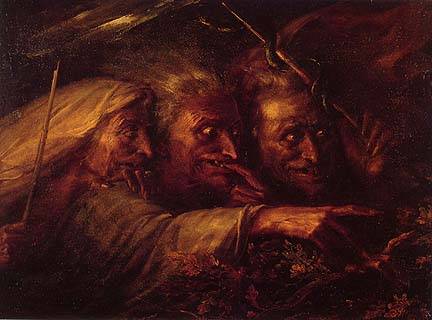
The official Catholic position was that it was just nonsense peasant superstition and there was no such thing, at least to the scholars. Most of the witch burnings actually were during the laughably mis-named 'Enlightenment;, and committed by hysterical peasants, who were mostly still pagans even up to the early 20th Century in many parts of Europe. The biblical verses read more like they were condemning the practices as fraudulent and con artists creating harmful beliefs, which is in fact the case.
It's worth noting that almost no witch burnings took place in the heavily Catholic regions in Italy and Spain over the centuries, and most of them were in politically unstable border regions where Protestants were the main rulers.
Part of the 'Burning Times' myth is exploded here:
Since the Enlightenment, rationalists have liked to cite witch burning as a prime example of medieval ignorance and religious (usually Catholic) bigotry run amok. (Leftists today still denounce it as…

www.crisismagazine.com
"Sixty years ago, one of the neopagan movement’s founders, Gerald Gardner, coined the term “the Burning Times” to describe this time of persecution. Although Gardner’s historical expertise has since been questioned, neopagan proponents Margot Adler and Starhawk (born Miriam Simos) are still preaching Gardner’s teachings because, they say, “invented history is satisfying myth.”
Nine million women burned is a figure conveniently larger than the Jewish Shoah, yet it was actually invented out of whole cloth by American feminist Matilda Joslyn Gage in 1893. Radical feminists have made much of this mass “gynecide,” as antipornography activist Andrea Dworkin has called it. The feminists see witches as the natural enemy of patriarchy, rallying around them as Old Leftists did around the leaders of the Spanish Republic. For them, as for pagans, playing the politics of victimization strengthens solidarity.
....
Although the general public has yet to notice, recent academic research has largely demolished both the old Enlightenment certainties and the new neopagan theories. Archival studies conducted in different regions of Europe over the last few decades have more accurately measured who killed how many of whom under what circumstances. Using the tools of anthropology and psychology, historians have reconstructed the social context in which the witch-hunts happened. They have a clearer picture now of how witchcraft theories developed and on what intellectual basis."
Another fact is a number of serious crimes, like murdering people via poisoning for instance, was lumped under 'witchcraft' as well. Given the lack of power women had, this was indeed likely a common crime by women against wife beating husbands and the like.
The Church inherited Roman and Germanic laws regarding maleficent magic, laws that treated witchcraft as a crime. But to St. Augustine, concrete witchcraft consisted of idolatry and illusion rather than harm to others. Following Augustine, an anonymous ninth-century text, Canon Episcopi, became part of the Church’s canon law, declaring that belief in the reality of night-flying witches was heresy because there was no such thing as an actual witch. Although the idolatry and heresy associated with witchcraft resided only in the will, not in actual deeds, they were nevertheless sinful, Augustine wrote. Punishment was in order — but not burning.