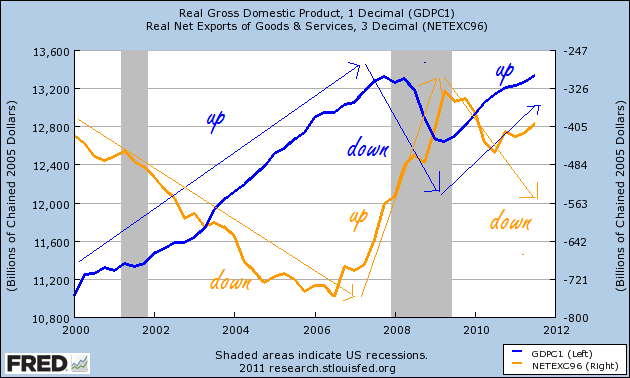
imports are not detrimental to the GDP for the reasons which I've put forward earlier. exports do not constitute as dominant a source of employment or commerce than does retail and its relationship to improts. what you are contending is not accurate, and the proposal to support an inaccurate premise is flawed for that reason.
You state that US exports are not as direly necessary to the world but they are of critical importance to foreign producers of goods that are destined or could be destined for USAs domestic market.
Typographical error. Message #56; my (Supposns) response to Antagone. My response should have been that you, (Antagone) stated US exports are not as directly necessary to the world but USAs purchases of foreign goods, (aka USA imports) are of critical importance to foreign producers of goods.
Global trade is a buyers market; buyers being importers and sellers being exporters. Advantages are not given but must be taken. Because the USA does not take advantage of the fact that were net buyers, then it is the producers of USAs imports that have the advantage over us.
///////////////////////////////////////////////////////////////////
Antagone, the expenditure method of calculating GDP is the simplest and most common method for calculating a nations gross domestic product, (i.e. GDP).
Imports are detrimental and exports contribute to a nations GDP. This is not an opinion but is true by all defining mathematical formulas accepted by the global community of economists and statisticians. Why would you believe that imports are not detrimental to the GDP?
After USA products reach their factories shipping platform or after imported goods are unloaded dockside at their USA ports of entry, theres no economic difference between them. From those moments forward they will both equally contribute to USAs economy.
Prior to reaching the shipping platform the USA labor, materials, services and components that are integral to the domestic goods all contributed to USAs GDP. These are included within the goods prices.
There are often many things which support domestic producers and contribute to the USA GDP but are not included within the prices of domestic goods; infrastructure such as highways, railroads, bridges utility lines; local high schools and community colleges may offer specialized technical courses to better feed domestic producers labor pools. These all support production of goods, contribute to USAs GDP but are not included within the prices of the goods.
When production volume increases often induce economies of scale; this is particularly true of manufacturing mass production. This is reflected into lower per unit costs of goods which is economically beneficial and (due to greater volumes of sales) it also contributes to the GDP. One producers increased production often increases production of unrelated goods or service products. A factorys increased production may increase production of local beauty parlor services which contribute to the nations GDP but are not included within the prices of the manufactured goods.
All domestic production contributes to the nations GDP but only production thats included within the prices of USAs exported goods are attributable to global trade. Economist argue as to the extent of this secondary production or production multiplier factor but its generally agreed that exports contribution to the GDP well exceeds double the value of the exports themselves. Thats why the GDP formula always understates trade surpluses contribution to the GDP.
The GDP formulas deduct the value of the natiion's trade deficit from or the value of the nation's trade surplus to the nations GDP. The GDP formula always understates global trades' affects upon their nations' GDPs.
Respectfully, Supposn