Well let us start with the fact that nearly everyone pays taxes. Granted, only 50% pay federal income tax. However, anyone who works pays SS and Medicare tax. Along with this, there are sales and use taxes, liquor and tobacco taxes, gasoline taxes, and a plethora of other taxes. Even the working poor pay around 20% of their earnings in these taxes.
Secondly, the idea that $49 billion will cover the uninsured is ludicrous. $49 billion might cover 1 million people. I can assure you there are a hell lot more than 1 million uninsured in this country.
I don't mind debating the pros and cons of this issue, but I get tired of those who continue to defend the system as it is, knowing full well that it is going to bankrupt the entire country, including the wealthy, within the next twenty or so years.
And I love the stupid arguments from people who say they shouldn't be forced to pay for health insurance if they don't want or need it because they are healthy. And then if they get sick, we all end up paying for it. But hey, it's there right. If you willingly choose not to insure yourself and have the ability, then I think if you get sick, they should just let you die.
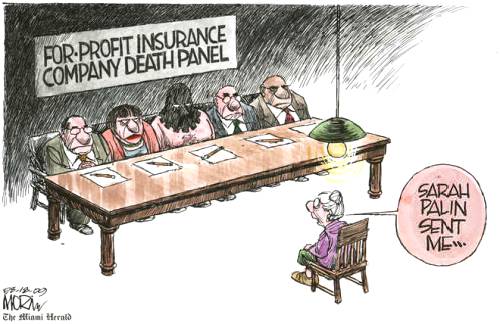
But in our system, if you are sick, insurance companies will find any way possible to remove you from the system so they don't have to pay for your care. And then you can't get coverage even if you are willing to pay for it, or they make it so expensive, only the truly wealthy can afford it. And all the while, the costs continue to soar. It won't be long and we will be spending 30% of GDP on healthcare, and eventually it will top 40%. And all we get is arguments of how this is so wonderful?
All I can do is laugh, because the US will eventually end up having worse healthcare than the rest of the world as we will no longer be able to afford it period. All I hear is how people from other countries come to the US for healthcare. Well the fact is that more and more Americans are going to India and Taiwan or other countries for their medical care because they can't afford it here, even with insurance in many cases. And those numbers are only going to increase dramatically in the future.
Up til' now I considered you worthy as some sort of counter-expert.
But your inability to do simple math obviates any such thought.
"... $49 billion might cover 1 million people..."????
Don't you realize that you are claiming $50 thousand dollars per person to cover these uninsured?
And that is if there are 50 Million of them, and there are only about 8 to 15 million, so you must be budgeting about $200,000 per!!!!
What is wrong with you???
"...but I get tired of those who continue to defend the system as it is, knowing full well that it is going to bankrupt the entire country,..."
You are a compendium of misinformation and have clearly become one who believes in feeling rather than knowing.
1. The vast majority are satisfied with their healthcare.
"Among insured Americans, 82 percent rate their health coverage positively. Among insured people who've experienced a serious or chronic illness or injury in their family in the last year, an enormous 91 percent are satisfied with their care, and 86 percent are satisfied with their coverage."
ABCNEWS.com : U.S. Health Care Concerns Increase
2. The costs of healthcare have been going down, not up.
2003 8.6%
2004 6.9%
2005 6.5%
2006 6.7%
2007 6.1%
Compare to 10.5% in 1970 and 13% in 1980
And while heathcare is improving the lives of Americans, it is 'education' that is spinning out of control, and not fulfilling its promise.
I can't begin to tell you how disappointing you have turned out to be.
Yes PC, that is exactly what I am saying. It will cost $50,000 per person over the ten year period we are discussing. The cost of $1 trillion being discussed is over the next ten years, not for one year. So when you use your figure of $49 billion, I had to assume you were talking about the duration of the entire projection and not just one year. In reality, it will probably cost a bit more considering we are currently spending $7900 per year per person. But hopefully, some cost savings will be realized to reduce that number under the proposed program.
Now, I think we should address your statement that the cost of healthcare has been going down over the last few years. How can anyone take you seriously when you make such an absurd statement? Maybe you meant to say that spending increases are declining, but even that is nothing to brag about. That is like saying that our deficit spending will begin to decrease in a few years (may or may not happen), but we will still be adding to the deficit, just as healthcare costs are rising at more than double the rate of inflation currently and have been for the last decade.
NCHC | Facts About Healthcare - Health Insurance Costs
"The CBO is actually being kind to the would-be reformers. Its analysis likely understatesby at least $1 trillionthe true costs of expanding health coverage as current Democratic legislation contemplates. Over the last few months, my colleagues and I at the consulting firm Health Systems Innovations have provided cost estimates of health-care reform to both Republican and Democratic members of Congress, and weve posted these estimates on our website as well. We believe that the Democratic bills currently under consideration in the House and Senate would cost $2.1 trillion and $2.4 trillion, respectivelymuch higher than CBOs figures."
Another Trillion? by Stephen T. Parente, City Journal 5 August 2009
The better model for ObamaCare is the original estimate for Medicare spending when it was passed in 1965, and what has happened since.
"That year, Congressional actuaries (CBO wasnt around then) expected Medicare to cost $3.1 billion in 1970. In 1969, that estimate was pushed to $5 billion, and it really came in at $6.8 billion. House Ways and Means analysts estimated in 1967 that Medicare would cost $12 billion in 1990. They were off by a factor of 10actual spending was $110 billioneven as its benefits coverage failed to keep pace with standards in the private market. Medicare spending in the first nine months of this fiscal year is $314 billion and growing by 10%. Some of this historical error is due to 1970s-era inflation, as well as advancements in care and technology. But Democrats also clearly underestimatedor lowballedthe publics appetite for free health care. "
Cost of ObamaCare Higher than Expected - WSJ.com
But do not overlook the sleight of hand of the administration:
They have no intention or belief that the plan will have anything but a deleterious effect on budget and deficits.
Proof?
None of these accepted and proven cost-cutting measures are inclued:
1. Scrap all city, state, federal mandates for healthcare insurance policies. When a statute says policies must cover mammograms of everyone 35 and over, how is this fair for a construction company with all male employees? What about Podiatry, or sexual reorientation surgery/? Allow insurance companies to write policies covering exactly what the consumer asks for:
Take two very different states: Wisconsin and New York. In Wisconsin, a family can buy a health-insurance plan for as little as $3,000 a year. The price for a basic family plan in the Empire State: $12,000. The stark difference has nothing to do with each states health sector as a share of its economy (14.8 percent in Wisconsin as of 2004, the most recent year for which data are available, and 13.9 percent in New York). Rather, the difference has to do with how each states insurance pools are regulated. In New York State, politicians have tried to run the health-insurance system from Albany, forcing insurers to deliver complex Cadillac plans to every subscriber for political reasons, driving up costs. Wisconsins insurers are far freer to sell plans at prices consumers want.
The gulf in insurance-premium prices among American states is a sign that too much government interventionnot too littleis whats distorting prices from one market to the next. The key to reducing health-care costs for patients, then, is to promote competition, not to dictate insurance requirements from on high. Unfortunately, a government-run insurance plan is the core of ObamaCare.
Bigger Is Healthier by David Gratzer, City Journal 22 July 2009
a. NJ has some 68-69 mandates including in vitro fertilization, which alone adds some 2-2.5% to the cost of the policy
2. Tort reform:
The number of U.S. malpractice payments in 2008 was the lowest since creation of the federal National Practitioner Data Bank, which has tracked payments since 1990. And the average payment about $326,000 was the smallest in a decade.
While malpractice litigation accounts for only about 0.6 percent of U.S. health care costs, the fear of being sued causes U.S. doctors to order more tests than their Canadian counterparts. So-called defensive medicine increases health care costs by up to 9 percent, Medicare's administrator told Congress in 2005. "
Canada keeps malpractice cost in check - St. Petersburg Times
Now, compare those with these:
"Also, its worth noting that while these figures sound like a lot of money and few would dispute the fact that health insurance company CEOs make healthy salaries these numbers represent a very small fraction of total health care spending in the U.S. In 2007, national health care expenditures totaled $2.2 trillion. Health insurance profits of nearly $13 billion make up 0.6 percent of that. CEO compensation is a mere 0.005 percent of total spending."
FactCheck.org: Pushing for a Public Plan
So my conclusion is that the cost of malpractice suits is equal to the profit of the entire industry.
This may be significant of and by itself, but when we look at the costs of defensive medicine, it alone adds to the costs of healthcare by a factor 15!!!
Once we have tort reform, we should move toward coordinated care networks that take responsibility for their members' medical needs in return for fixed annual payments (called "capitation"). One approach is through vouchers; Medicare recipients would receive a fixed amount and shop for networks with the lowest cost and highest quality.
3.. Doctors currently have no ability to re-price or re-package their services that way every other professional does. Medicare dictates what it pays for and what it wont pay for, and the final price. Because of this there are no telephone consultations paid for, and the same for e-mails, normal in every other profession.
Most doctors dont digitize records, thus they cannot use software that allows electronic prescription, and make it easier to detect drug interactions or dosage mistakes. Again, Medicare doesnt pay for it.
4. Another free market idea aimed at better quality is have warranties for surgery as we do for cars. 17% of Medicare patients who enter a hospital re-enter within 30 days because of a problem connected to the original surgery. The result is that a hospital makes money on its mistakes!
5. Walk-in clinics are growing around the country, where a registered nurse sits at a computer, the patient describes symptoms, the nurse types it in and follows a computerized protocol, the nurse can prescribe electronically, and the patient sees the price in advance
6. To reduce healthcare costs, increase the number of doctors. Obama care would do the opposite. Both tax incentives and support of the tuition of medical school.
7. Identify the 8-10 million who need and are unable to get healthcare, including those with pre-existing conditions,and provide debit cards as is done for food stamps:
"Food debit cards help 27 million people buy food, similar to the number who need help buying health coverage. In all fifty states, debit card technology has transformed the federal food stamp program, which used to be notorious for fraud and abuse. (Only 2 percent of card users are found to be ineligible, according to the General Accounting Office.) Cards are loaded with a specific dollar amount monthly, depending on family size and income, and allow cardholders to shop anywhere. The same strategy could be adapted to provide purchasing power to families who need help buying high-deductible health coverage. It's what all Americans used to buy (see chart 5), and it's all that's needed for families with moderate incomes, who can afford a routine doctor visit. "
Downgrading Health Care
8. Current law provides unlimited tax relief for coverage obtained through an employer but no comparable relief for those who purchase coverage outside their places of work. S. 334 would replace the current tax preference for employer-based health coverage with a new individual-based system. The bill would end the tax exclusion in the personal income tax for employer-based health insurance benefits and instead use a combination of subsidies and tax deductions for health insurance. Ideally, the current employer-based tax structure should be replaced with a fair and equitable universal tax credit. An across-the-board, fixed-dollar health care tax credit, for example, would offer every American federal tax relief for health care.(Wyden-Bennett Bill)
Which would not reduce costs?
Which would cause the negative backlash that ObamaCare has generated?
To which would you object if they were part of healthcare?