Are you implying the implication alone proves causation?
Are you saying that questioning your personal interpretation and conclusion from the data, means I'm questioning the data itself?
It is possible that your interpretation and conclusions are wrong, even if the data is right.
I'm saying, according to the available data, GDP grew more when there was more union membership, and annual compounded corporate profits were higher.
The data available, not just from, demonstrates that the deterioration of unions have resulted in a collapse of incomes.
Again... correlation does not equal causation. The sun came up today. Obama is in office. Therefore Obama caused the sun to come up. Only if you are a brain damaged leftard, who thinks that correlation equals causation.
I've been to Europe, and it's not nearly as close to us, as the left portrays. Not by a long shot. They are not poor.... didn't say that... but comparatively, we're miles and miles beyond where they are.
Logically, our ability to advance by leaps and bounds, is limited because there is no one ahead of us.
'in terms of quality of life'. That's subjective. Quality of life for me, is being able to own a massive luxury car, with leather interior, that can fit 5 people, and pull a boat, even though I make less than $20K a year. Can I do that in Italy? Nope. I've been there.
How do you define luxury car? You're not buying a 55K SUV on 20K per year.
I had a Jeep Grand Cherokee Laredo, V8, with hitch, and all the bells and whistles.
I'm not even talking about the value of the car. You can't afford the gas in Italy, or a place to park it. I've been there. You can't. That's why they drive all those tiny midget mobiles.
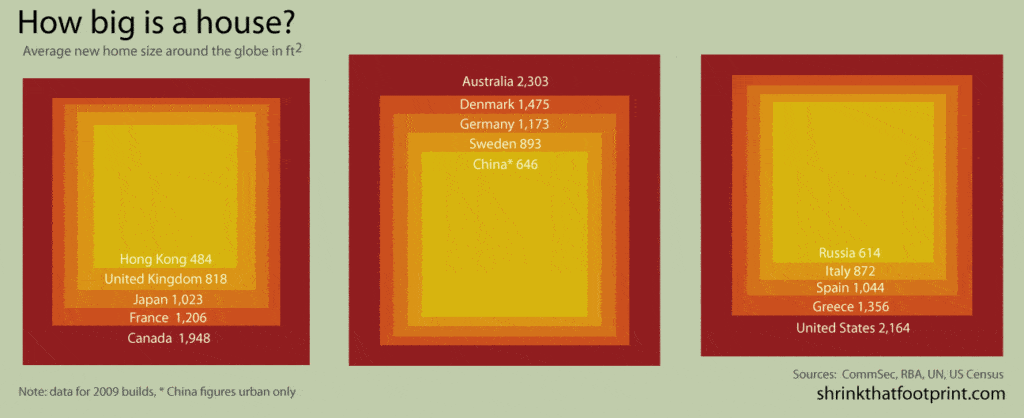
The average home size in Europe, and especially Italy, is a fraction of what it is here.
To compare, again, I earn $20K a year, and my home is 1.2K sq feet. Or... 111 sq Meters. And I have two bedrooms, and I have 1.5 bath, and I have a fully furnished basement.
Other countries have different building codes, zoning laws, etc.
For example, in Italy, people don't want new builds. They don't want them in their localities, and home buyers aren't willing to shell out 300,000 Euro for a 5 bedroom, 3.5 bath in say.....Bassano del Grappa, Pudua or Vicenza. For example, they conducted a survey in Veneto and found the vast majority of local politicians don't want any new home construction (besides the fact Italian banks aren't lending for new construction).
"people don't want new builds" "Survey of local politicians don't want any new home construction".
Do you assume that all the politicians speak for public? I doubt it.
More home construction would lower the cost of getting a place to live.
Currently, the cost of an average 1 bedroom rental apartment, is 400 Euros ($500 a month), that's for a 50 sq meter apartment, or a 530 sq foot apartment. And that's for an apartment on the outskirts. A 'downtown' apartment will run you 800 to 1000 Euros.
For the exact same price, I can get a 2 bedroom 825 sq foot apartment (76 sq meters), right in the middle of Columbus.
The tax rate in Italy for a single wage earner, is 45%
Natural gas and electricity, will run you about 200 euros a month, which is $250. My utilities this month, gas and power, about $60.
The average gross wage in Italy, is 28.5K Euros, or $36,000 a year.
So, they earn quite a bit less. They pay nearly double in taxes. Pay triple in Utility costs. Pay many times as much in fuel. Live in significantly smaller homes, at a vastly higher price. Heaven forbid you want to to go out to eat, the cheap joint is $30. A decent mid level restaurant, is $60 to $70..... for one person.
Yeah... Italy is barely comparable to the US. Barely. The only way they look good, is by comparing them to a 3rd world country. The poor people of the US, have a standard of living that most middle class Italians don't have.
By any economically viable measure, our standard of living is MUCH higher than that of Europe.
And again, I've been to Europe. I've seen their poor. To claim that the poor in Europe are better off than the poor in the US... is just flat out laughable. I'm not even going to bother with that one.
Um....no it's not. The claim that we in the US have a higher standard of living is based on the US having a higher average income than most EU countries. This doesn't relate to income distribution. For example, if Warren Buffet walked into Outback Steakhouse, all the patrons would see their average income increase by hundreds of millions or even a billion dollars, depending on how many people were in the restaurant.
Also, since Americans have higher average incomes, why do most Europeans have a higher savings rate than Americans? Quality of life also encompasses things like health care, free education, institutions, etc.
Around 20% of American children live below the poverty line, so do 23% of the elderly, these are some of the highest numbers in the western world.
The poverty line is different in different countries. Again, if you think that poor of Europe are better off than the poor of the US, then you are just ignorant. It's not even close. I've seen the poor in Europe taking showers in public rain pools. I've seen it. You show me the poor in the US, and they have cars, they cell phones, they have computers and cable TV. I'm talking about the working poor of Europe and the US. It's not even close.
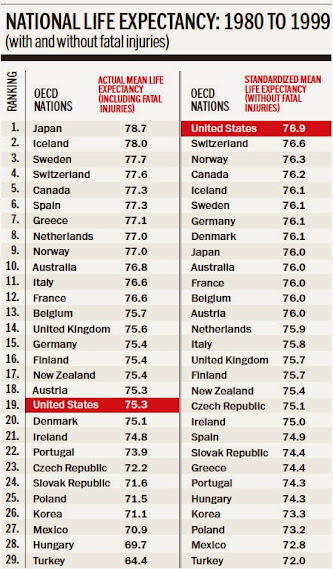
Further, life expectancy is higher in the US, when you exclude fatal injury. Americans die in homicide and auto accidents, more than in Europe. This is because we like our cars. Obviously, if you live in Europe, and can't afford a car, you have a lower chance of dying. But that would hardly be considered a sign of higher wealth and living standards.
I'm glad you mentioned auto accidents. US life expectancy is currently 79 and 80 if we factor in auto deaths. However, Germany is 81, Japan is 83 and Canada is like 82. Three additional years is fairly significant.
In the US, we spend two to three times more on health care, but we're at the bottom of the barrel, in terms of infant mortality(29th), life expectancy, and major diseases. We also have 60% more cancer cases than our European partners.
We have kick ass medical technology but a laughable delivery system that is extremely inefficient compared to the other OECD counties. People babble on about we have the awesome system but the numbers tell us the reality.
Europe does not count all births. If a baby is born to early, it's not counted as being born at all. In the US we count all birth.
I specifically said all fatal injuries. Not 'only' auto deaths.
Source OECD.
Really.... Funny because my pay stub clearly says that I earned $6,000, that I don't have. So unless you propose the Martian Money Mice, came and ate $6,000 out of my check, it would seem to me that government sucked up that money.... and given my pay stub says they did, I'm willing to bet they did.
The federal government taxes to regulate aggregate demand among other things, but it's not to raise revenue, although this is one of the biggest misconceptions out there.
You can assign any purpose you want to the rational. Doesn't change the fact that I don't have $6,000, that as a $20,000 wage earner, I could really use.
Unionization had nothing to do with it. I doubt there is any worth while conclusions that can be made from comparing Union membership and GDP, since there is simply too much non-union GDP created, and far too many external factors.
The decimation of unions has resulted in income inequality, less output and decreased corporate profits in the aggregate data sets I looked up. To say that unions are bad for an economy is revisionism of the highest order.
That's your opinion. Thanks, but I don't care about your opinion. The people of Hostess still all lost their jobs, no matter what your opinion is. The people of GM and Chrysler still lost their jobs, no matter what you claim is revisionism.
Well get the employees working at Toyota, and the ex-employees that used to work for GM, and tell them both that it was the lack of Unions that increased income inequality. After they laugh at you and walk away, I'll post the video on YouTube, and we'll discuss the comments by all the people about whose opinion matches reality.
I'm interested in data sets, not your preconceived biases towards unions and collective bargaining. Why is it that Germany pays their autoworkers around twice as much as we do and why do they sell more automobiles then we do?
I'm interested in reality, and not your cherry picked statistics. For example, you are wrong about what Germany pays their autoworkers, and you don't even know it.
The way that the left conceals the reality, is by only counting the wages of Union employees. Which, if you focus exclusively on the Union member wages, then yes, they are relatively high compared to the US.
The problem is, most workers in the German auto industry, are not Union members. Most are temp employees.
http://www.nytimes.com/2011/04/20/business/global/20temp.html?pagewanted=all
Peter Hintermeier, a 60-year-old pipe fitter, is one of the people who have made
Germany competitive again, but he is not too happy about it.
Originally from the area around Erfurt in eastern Germany, Mr. Hintermeier has spent 15 years as a temporary worker, going wherever the jobs are.
“You’re doing the same work for less pay,” said Mr. Hintermeier, who earns about 9 euros, or almost $13, an hour. That is about $2.86 an hour less than the average for eastern Germany, and $7.16 to $8.59 less than in wealthier regions of the country, where Mr. Hintermeier often works.
Peter is a pipe-fitter, but not part of the Union, and not earning a Union wage.
Norbert Reithofer, the chief executive of BMW, has often said that the company’s use of temporary workers helped the automaker remain profitable during the steep downturn in 2009 because it could quickly reduce the work force when sales started to plunge. German labor laws normally make it costly and time-consuming to let permanent employees go.
http://www.ft.com/cms/s/0/0bf80e46-0fc2-11e3-99e0-00144feabdc0.html#axzz3ESNLboXG
In 2003, German unemployment was spiking up at 12%. Before that time, the ability of companies to hire non-Union temp employees, was extremely limited. But in 2003, the laws were relaxed.
Unsurprising to those of us on the right, when you allow the wage to float on the free-market, unemployment drops, and the German rate dropped in half, within 4 years. Shockingly when customers can buy labor at a lower price.... they buy more of it.
Non-traditional contracts, are those which don't have high union wages.
The numbers of temp employment at German's big three auto makers is difficult to determine because they also run a network of suppliers, that each have their own level of Union and Non-Union temp employees. IG Metall, the German Union, says that prior to 2009, the number was 50%, and today is around 20% to 30%.
If you include these auto workers, who are paid a fraction of Union wages, the average German Auto Worker is nowhere close to 'double' the wages of a US worker.

CEO compensation should increase faster than employee compensation. This is natural and normal, and good.
Say I invest into building a store, and the store makes me $150K a year.
Now, I open a second store, and it makes me $150K a year.
My income is now $300K. Tell me, do the economic fundamentals of the second store double? Can I pay the workers twice as much?
No, the economic fundamentals of the first store, are exactly the same as second.
Say I open 100 stores. Now my income is $15 Million.
Can I pay the employees of all the stores, 100 times as much money? Of course not. The economics of each store, is exactly the same as the original store, that only made $150K in profit.
The idea that CEO pay should only increase in direct relation to employee pay, is both absolutely idiotic, but it's also incredibly destructive.
If you were to limit my income, to only 40x a workers salary, once I hit that mark, why would I ever bother to expand the business? Why would I ever produce more goods that grow the economy? Why would I ever create more jobs?
If my lowest paid worker is $20,000 a year, once I opened 5 stores, I would never bother to open another one. 95 stores serving millions of customers, and providing thousands on thousands of jobs, would never exist, and never be created. The entire country would be worse off.
It's not a good thing at all. The ratio between pay for CEOs and workers has increased 1000% since about 1950. This data is freely available. Your average Fortune 500 CEO makes 204 times more than regular workers. This ratio has increased from 20-to-1 in 1950, to 42-to-1 in 1980, and 120-to-1 in 2000.
The excessive amount of income going to the top 1%, and the fact that the vast majority of these activities are economically useless, such as returns on stocks or serving as a CEO in the finance sector, for example, has finally demonstrated that marginal productivity theory is bullshit. It’s become impossible to rationalize this concentration of wealth among those at the very top of the pyramid with the lame idea people ultimately get what they deserve mostly due to their marginal contributions to production.
The problem, in the end, after all the analysis, is that capitalists are almost pathologically driven to seek economic rent to grab a higher percentage of value than is given to workers, regardless of any type of productive contribution.
Hence, why we need unions and collective bargaining.
You didn't answer, or respond to the point that I made. Go back, and re-read the prior post, so that you grasp the concept, before responding ignorantly again.