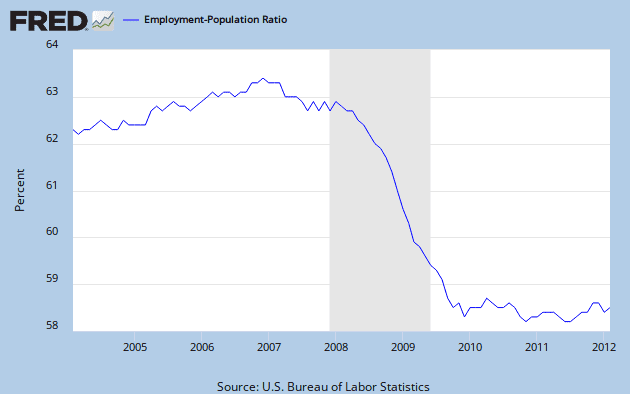
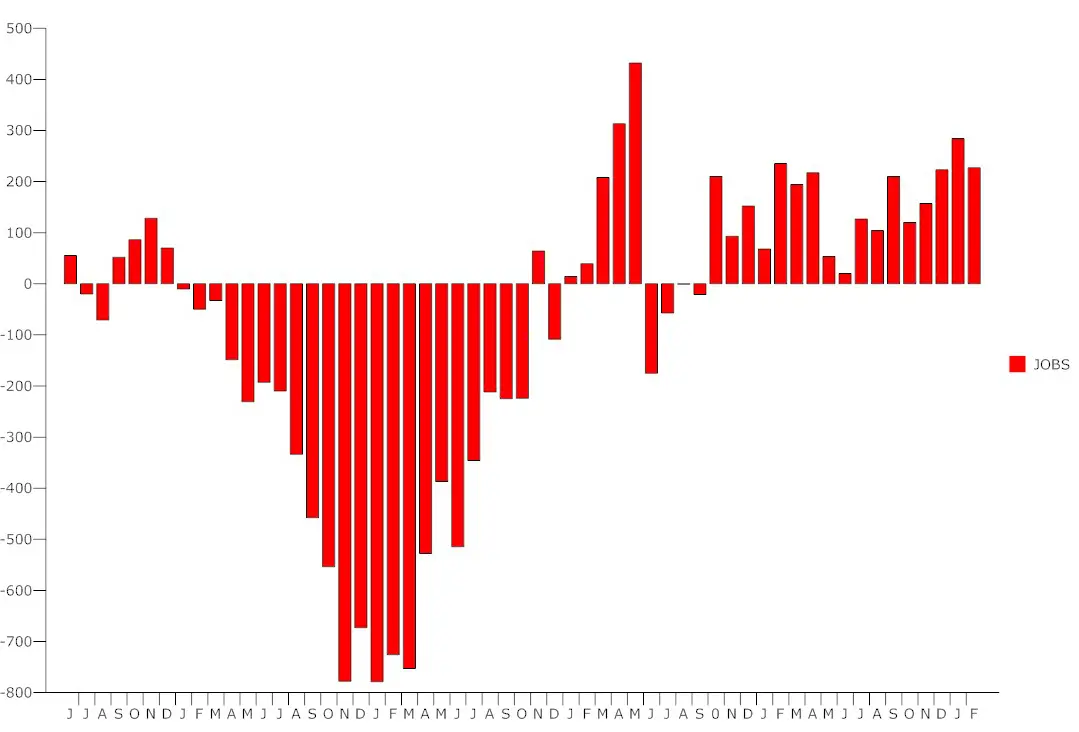
First, there's no upper age limit for the adult civilian non-institutional population.
Second, since any benchmark LF participation rate is purely arbitrary, and since the rate can change for non labor market reasons, it's not objective.
Third, the adjustment doesn't work both ways: if we use the LF rate from the 50s, that would show our cerrent UE rate as negative.
Third, Gallup has a margin of error of +/- 0.7% (mening there range is from 8.6% to 9.8%) while the BLS error is +/- 0.2%
Fourth, the methodology hasn't had any major changes since 1967, the only change under Obama was allowing responses of more than 2 years for duration of unemployment and that had no effect on the rate (before, anyone unemployed over 2 years were classified as 2 years)
The current Gallup poll that has CON$erviNutzis so euphoric has a sampling error of + or - 1%, not .7%, so Gallup's accuracy is getting worse and therefore CON$ love it more.
U.S. Unemployment Up in February
Survey Methods Gallup classifies American workers as underemployed if they are either unemployed or working part time but wanting full-time work. The findings reflect more than 25,000 phone interviews with U.S. adults, aged 18 and older in the workforce, collected during a given month. Gallup's results are not seasonally adjusted and are ahead of government reports by approximately two weeks.
Results are based on telephone interviews conducted as part of Gallup Daily tracking from Feb. 1-29, 2012, with a random sample of 27,275 adults, aged 18 and older, living in all 50 U.S. states and the District of Columbia, selected using random-digit-dial sampling.
For results based on the total sample of U.S. workers in the workforce, one can say with 95% confidence that the maximum margin of sampling error is ±1 percentage point.
Interviews are conducted with respondents on landline telephones and cellular phones, with interviews conducted in Spanish for respondents who are primarily Spanish-speaking. Each sample includes a minimum quota of 400 cell phone respondents and 600 landline respondents per 1,000 national adults, with additional minimum quotas among landline respondents by region. Landline telephone numbers are chosen at random among listed telephone numbers. Cell phone numbers are selected using random-digit-dial methods. Landline respondents are chosen at random within each household on the basis of which member had the most recent birthday.
Samples are weighted by gender, age, race, Hispanic ethnicity, education, region, adults in the household, and phone status (cell phone only/landline only/both, cell phone mostly, and having an unlisted landline number). Demographic weighting targets are based on the March 2011 Current Population Survey figures for the aged 18 and older non-institutionalized population living in U.S. telephone households. All reported margins of sampling error include the computed design effects for weighting and sample design.
In addition to sampling error, question wording and practical difficulties in conducting surveys can introduce error or bias into the findings of public opinion polls.